


Another legislative session has come and gone, and folks, it was a doozy. If you feel like you just emerged from a tornado of bad bills, procedural gymnastics, and culture war nonsense, same. But before we collapse into a deep sleep until the next election cycle, let’s pause—because sometimes understanding where we're going requires reflecting on where we've been.
Last weekend was the 60th anniversary of Bloody Sunday—the historic civil rights march across the Edmund Pettus Bridge. We were in Alabama facilitating a training for the Alabama Democratic Party and had the honor to attend the commemoration. Crossing that bridge, retracing steps soaked in courage and sacrifice, was a profound reminder of the power ordinary people have to challenge injustice, even when faced with overwhelming odds.
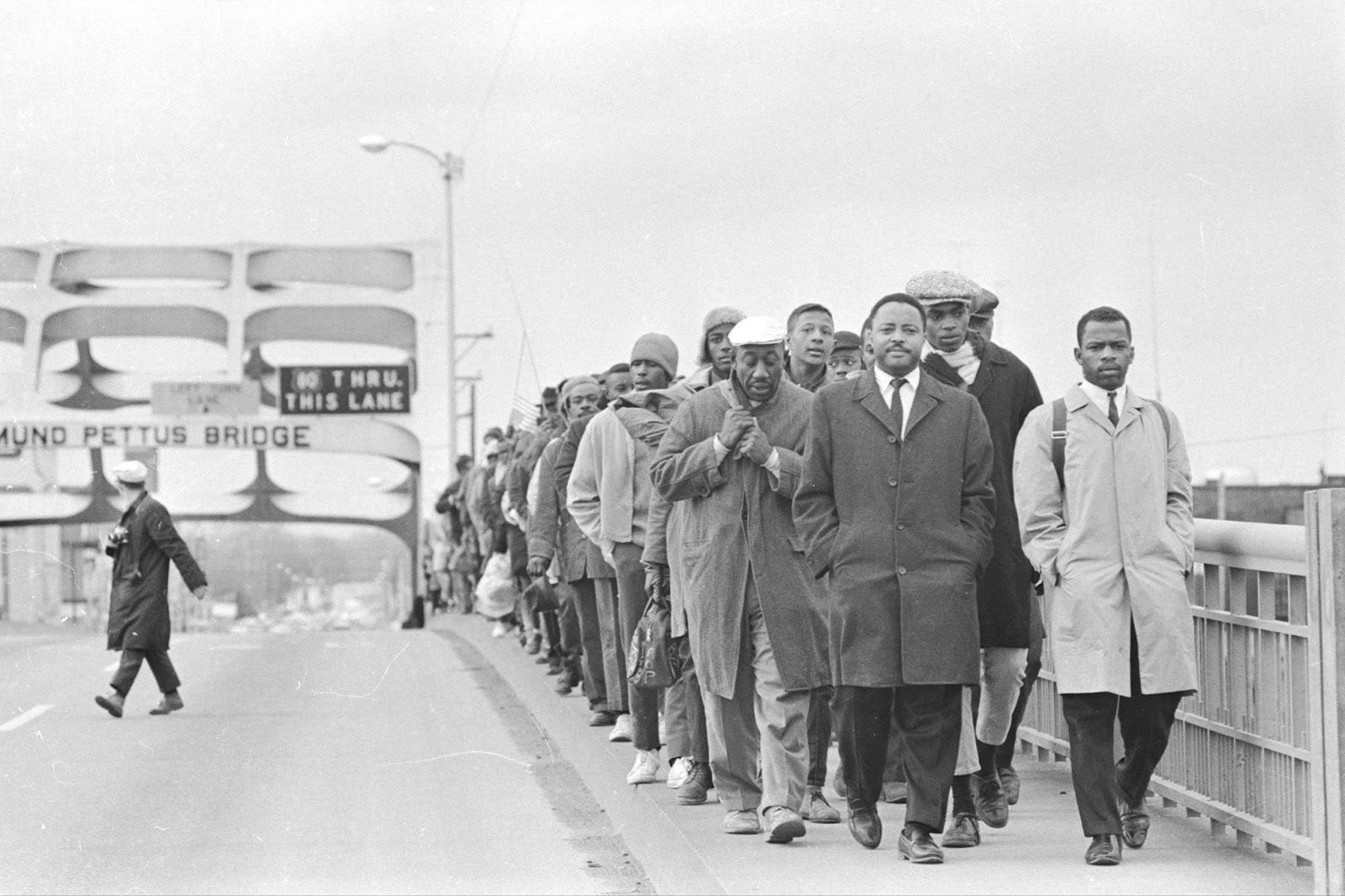
Before we go on, we want to acknowledge something very important:
We are three white people writing about a civil rights movement led by Black Americans, for Black Americans. One that we did not and will never experience firsthand. We are not here to equate our political struggles in Utah to those who risked their lives fighting for the right to vote. We are not here to co-opt history or make ourselves the center of a fight that wasn’t ours.
But what we can do is listen, learn, and act.
Because the lessons of Selma don’t just belong to history books—they belong to today. And while we will never truly understand the depths of what those marchers endured, we can recognize patterns of injustice when we see them. And right now, we are watching those patterns play out in Utah.
The Fight for Democracy Was Never Meant to End
In 1965, Black residents of Selma, supported by civil rights leaders like John Lewis and Martin Luther King Jr., faced unimaginable brutality in their fight for voting rights. Although Black residents outnumbered white residents in Selma, voting rolls were 99% white.
Black organizers in the Dallas County Voters League fought tirelessly to register voters, facing violent suppression, arrests, and a judiciary complicit in their oppression.
The decision to march across the Edmund Pettus Bridge wasn't spontaneous: it was strategic and deliberate.
President Lyndon B. Johnson was privately drafting a voting rights bill, but he hesitated to announce it. He worried Congress wouldn’t act, that it was too soon after the Civil Rights Act of 1964 to push for another landmark law. So, civil rights leaders rightfully forced the issue.
On March 7, 1965, 600 peaceful marchers set out to walk from Selma to Montgomery to demand the right to register to vote. As they reached the crest of the bridge, they were met by dozens of state troopers armed with clubs and tear gas.
What followed is now etched into history as Bloody Sunday.
State troopers charged into the crowd, brutally beating marchers. Amelia Boynton, one of the leaders, was knocked unconscious, her body left on the ground as news cameras rolled. The images shocked the nation, and just five months later, the Voting Rights Act of 1965 was signed into law.
Here’s the thing: laws alone don’t guarantee democracy.
The Voting Rights Act was gutted in 2013. Since then, state legislatures across the country have passed hundreds of voter suppression laws, rolling back the very protections marchers fought for. The same forces that tried to block those marchers 60 years ago are still trying to chip away at democracy today—just with different tools.
And Utah is a proving ground for those tools.
Utah is the Testing Ground for Authoritarian Power
Our state has become a laboratory for the far-right’s political experiments. The supermajority has embraced extreme measures—gutting public education with voucher programs, dismantling judicial independence and voting rights, attacking immigrants and queer Utahns, and silencing citizens by undermining ballot initiatives.
But here’s the thing: these aren’t homegrown ideas. These aren’t just Utah Republicans going rogue.
These strategies are being exported here, directly from far-right national organizations that see Utah as the perfect place to test how far they can push their agenda. Because they hold total control. Because there is no check on their power.
Take HB300, Utah’s sweeping election bill that moves the state away from universal vote-by-mail, despite overwhelming public support for it.
The bill was openly promoted using materials from the Heritage Foundation, the same group behind Project 2025. During a Senate hearing, Rep. Jefferson Burton handed out a flyer showing Utah ranked 33rd in “election security” and promised that his bill would raise the state’s ranking to 9th—not based on facts, but based on Heritage’s deeply flawed, right-wing “Election Integrity Scorecard.”
And if you’re wondering how seriously to take Heritage’s rankings, let’s look at the other states that scored the highest:
Georgia (#1) – A state where conservative activists have weaponized voter challenges to disproportionately target Black voters, and where a new law (SB 189) makes it easier to remove voters from the rolls with no evidence.
Louisiana (#7) – The only state in the country that still uses entirely paperless voting machines, meaning there is no way to conduct an election audit—one of the biggest election security risks imaginable.
Texas (#6) – A state where election officials have been purged for enforcing actual election laws, and where laws like SB 1 have made it a felony to assist voters in ways that were once legal—disproportionately impacting voters with disabilities and non-English speakers.
Meanwhile, states with secure and accessible election processes, like Colorado and Washington, are ranked near the bottom because they make it easier for people to vote.
This isn’t about election security. It’s about political power.
When you rig the election process in your favor, you don’t have to worry about what voters actually want. And when you make it harder to vote by mail, you disproportionately disenfranchise rural voters, Native communities, elderly voters, and people with disabilities. That’s the goal.
The GOP supermajority here isn’t just enacting bad policy for its own sake, it’s building a model for how to consolidate power, weaken democratic checks, and make resistance nearly impossible. And if they succeed in Utah, they’ll take these same strategies elsewhere.
The fight we’re in isn’t just for Utah. It’s for every other state that will face these same attacks in the years to come.
Sine Die: The Legislative Session of Suppression
The session ended, as it always does, with a ceremonial sine die, Latin for "without a day." It’s the legislature’s way of saying, "We’re done here (for now)," and the final gavel drop usually comes with a mix of exhaustion and relief. Lawmakers shake hands, sing karaoke in their chamber, give out awards, and scatter like cockroaches when the lights come on.
But this year felt different.
The supermajority’s grip on power has always felt unshakable—until now. They rushed bills through without debate, smashed dissent within their own ranks, and gutted judicial oversight. Not because they are strong, but because they are losing control.
They can feel it slipping away.
This session wasn’t just about tax cuts for the ultra-wealthy or banning collective bargaining, it was about cementing their power while they still can. The Republican supermajority didn't just pass bad laws; they made it harder for anyone to undo them. They rewrote election laws, limited who can challenge unconstitutional policies in court, dismantled judicial independence, and bulldozed over Utahns’ right to pass ballot initiatives.
Because they know their days of unchecked rule are numbered.
For the first time, Utah’s rapid growth, its changing demographics, and its exhausted, angry voters are catching up with them. They know they are losing the next generation. And instead of trying to earn those votes, they’ve chosen suppression. The only way they stay in power now is if they rig the system so completely that voters never have the chance to throw them out.
But they can feel the ground shifting beneath them.
Winning a Fight is Not the Same as Winning Power.
Now Selma, the site of one of the most pivotal moments in civil rights history, is one of the poorest cities in the country. The average income for a family of four is barely above $30,000 a year. Tornado wreckage still scars the landscape. The annual commemoration of Bloody Sunday, an event that should be fully funded and revered, is instead pieced together with limited resources.
Because history alone is not enough.
Selfishly, we’ve spent all weekend reflecting—not just on Selma, but on what it means for us, for Utah, for democracy, for the future. And here’s what we know:
Winning a fight is not the same as winning power.
Just because the Voting Rights Act passed didn’t mean the fight ended. Just because a bad bill dies in committee doesn’t mean democracy is safe. Just because one election goes our way doesn’t mean the next one will.
So what happens if we keep thinking about success as just stopping bad bills for one more year? What happens if we keep playing defense instead of offense?
We already know the answer.
The GOP is playing the long game. And they are very good at it. We have to play it better.
We can’t just focus on the outrage of the moment—we have to build something that outlasts their chaos. That means:
Registering new voters and keeping them engaged—not just during elections, but year-round.
Running candidates everywhere—not just in competitive districts, but in every corner of the state where voters are looking for an alternative.
Holding them accountable—making their extremism and corruption the issue, on repeat, until it costs them power.
Consistently and clearly messaging broadly about what the Democratic Party in Utah stands for—what we believe in, who we fight for, and how we will improve the lives of every Utahn, not just the wealthy.
Because if we don’t build, we lose.
We don’t just remember Selma, we learn from it.
And if we’re not careful, Utah will become a different kind of lesson: one about what happens when we assume democracy is something we only have to fight for once.
If We Want a Different Outcome, We Have to Change the Strategy
To everyone who called their legislators, showed up at the Capitol, knocked doors, donated, organized, or simply paid attention: thank you. And fortunately or unfortunately, we still need you.
Utah is at a crossroads. Do we let this state become the model for how to dismantle democracy, or do we fight to make it a model for how to save it?
And as we fight, we will never forget where these lessons come from.
The Edmund Pettus Bridge still stands. Not as a relic, but as a reminder.
A reminder that no movement is guaranteed victory.
A reminder that the fight for democracy never truly ends.
A reminder that courage, if not sustained—can be erased.
We don’t just honor it, we build on it.
Let’s make sure that when we look back on this session, we remember it not as another year of GOP overreach, but as the year their grip on power started to slip.
If you enjoyed this post, consider a paid subscription with two bonus Substacks per month featuring exclusive content like:
Hot gossip, hotter takes, deep policy analysis, and the nerdiest data analysis and dashboards.
Your subscription supports Elevate PAC’s mission to bring balance to our state—because the GOP is ~clearly~ not going to rein itself in.
Elevate PAC is working to eliminate single-party control at all levels of our state’s government by elevating inspirational leaders, activating the new Utah majority, and centering our shared values and common purpose.
Our blueprint is to recruit and train candidates, invest early, support strategically, and build relationships.
Paid for by Elevate PAC