

By the numbers: 86,000 Utah households. 177,000 individuals. $30 million in monthly food assistance. All at risk of disappearing on November 1.
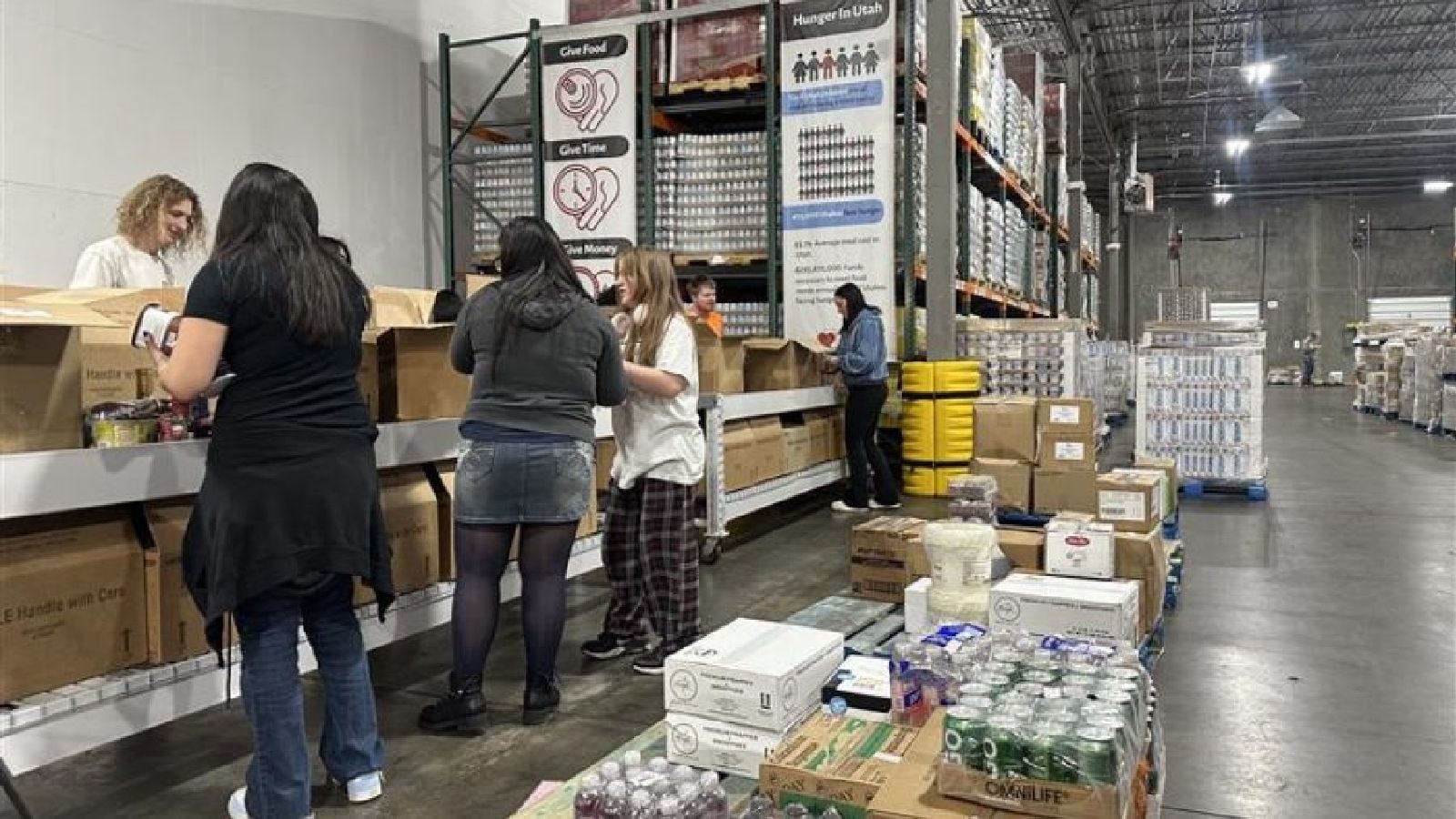
This week, it was announced there would be “insufficient funds” to pay November SNAP benefits while the government continues to stay shut down.
For Utah, a state that prides itself on having the lowest food stamp participation rate in America (just 4.8% of residents), this should have been a manageable crisis. Instead, it’s revealed something uncomfortable: our safety net has enormous holes, and when federal support disappears, our local government is unwilling to act.
Utah’s Hidden Hunger
Here’s what most Utahns don’t realize: One in eight Utah households (12.5% of our neighbors) experience food insecurity. That’s 415,000 Utahns who face uncertainty about where their next meal will come from, an increase of nearly 100,000 people in just the last year.
The Utah Legislature, just this year, rejected universal free school meals, then found $100 million for school vouchers.
In February 2025, Senate Minority Leader Luz Escamilla’s SB173, which would have provided universal free school meals for all K-12 students at a cost of $160 million, was tabled in the Senate Education Committee. Lawmakers worried it was “too expensive” and expressed concerns about “government dependency.”
In the same legislative session, Utah boosted its school voucher program by 25%, bringing total spending to over $100 million for a program that serves private school families who can already afford tuition.
Credit where credit is due, we did pass HB100, which expanded reduced-price and free school meals for 40,000 students in kindergarten through sixth grade with a $2.5 million investment. It’s progress. But it came after a 2024 request for $4 million to expand free school lunches failed to make the budget, and after school lunch debt statewide grew from $1.7 million in 2023 to $2.8 million in 2024.
When Policy Project representatives toured schools, they heard stories that should haunt us: A student athlete in Logan scavenging pizza from a dumpster. A student in West Valley City living in a car with no way to cook food from the food bank. A Granite School District student’s academic decline from chronic hunger.
Ginette Bott, President and CEO of the Utah Food Bank, was blunt about what no SNAP benefits in November means: “Food banks, food pantries cannot be expected to absorb the magnitude of food or request that those many families are going to have. 86,000 families. We can’t pick that up. We can help, but we certainly can’t fill that gap.”
Utah Food Bank serves 309 pantries across the state. Adding 86,000 families, nearly 177,000 people, would require absorbing $30 million in monthly SNAP benefits. It’s just not possible.
The Real People
Bria Cox, a single mother from American Fork, recently lost her housing. Now she’s facing the loss of food assistance too. “Being a single mom, having that benefit is very, very, very helpful, especially in times that are rough,” she told KSL. “Now losing the benefits for food just adds to the tremendous stress. Right now I’m unemployed, so I’m thinking, ‘How am I going to feed my kid?’”
Jennifer Snyder expressed the anxiety felt by thousands: “It’s scary. I have to find other resources and other means of ways to get my family and myself food. I just got a new apartment, and I’m not ready to struggle yet again. I just got ahead.”
Lee St. Onge worried about the elderly: “There’s a couple other seniors I know—one is on hospice that will be definitely affected by this. That’s all they have to buy food is their food stamps because of the high rent.”
What the Shutdown Reveals
When the Utah Department of Workforce Services announced that November SNAP payments wouldn’t be issued, the state offered no alternative plan. Spokeswoman Becky Wickstrom told KSL: “At this time, we’re not hearing they’re going to use state funding.”
Utah Senate President Stuart Adams said the state “is not equipped to fund federal programs for weeks or months in the absence of congressional action.”
But here’s what Adams didn’t mention: Utah has approximately $1.2 billion sitting in its rainy day fund.
Let that sink in. Utah maintains $1.2 billion for emergencies – money specifically designed for “revenue declines or unexpected expenditures.” One month of SNAP benefits costs $30 million. That’s 2.5% of the rainy day fund. Utah could cover three months of SNAP benefits and still have 92.5% of emergency reserves intact.
If 86,000 families facing food insecurity isn’t the kind of emergency that rainy day funds exist for, what is?
Utah’s Uncomfortable Truth
Utah has the lowest SNAP participation rate in the nation. That sounds like success, and state leaders often present it that way. But dig deeper, and a more complex picture emerges.
According to research from Bread for the World, SNAP lifted 47,000 Utahns above the poverty line between 2013 and 2017, including 23,000 children. Safety net programs reduced Utah’s poverty rate by 13%, pulling 33,000 people out of poverty.
Yet Utah’s food insecurity rate was 7% higher than the national average. Among specific populations, the disparities are even more pronounced:
21.7% of Black households experience food insecurity
17.2% of Hispanic households face food insecurity
28.6% of households with incomes below 185% of the poverty threshold are food insecure
It’s not that our low SNAP participation means that hunger doesn’t exist. It means we’re not reaching people who need help.
The Federalism Hypocrisy
Here’s the irony that should be uncomfortable for Utah’s Republican leadership: They’ve spent years arguing that states should be less dependent on the federal government, that local control is better, that Washington is unreliable and bureaucratic.
They’re right. This crisis proves it.
But when federal dysfunction actually hits, when Washington’s failure directly threatens 86,000 Utah families, the same leaders suddenly throw up their hands and say it’s not their problem.
Utah House Speaker Mike Schultz blamed Democrats in Washington, calling it a “stark reminder of how federal dysfunction” hurts Utahns. But his statement reveals something troubling: “Let’s be clear: this problem is not of Utah’s making.”
Actually, it kind of is.
The Republican federalism argument has always been: Washington can’t be trusted. States know their people better. Utah should control its own destiny.
Fine. Let’s take that seriously.
If Utah truly believes in state sovereignty and local control, then we need the capacity to act independently when federal systems fail. That means having backup plans. That means using state resources to protect Utahns when Washington drops the ball.
Otherwise, the “federalism” argument is just political theater, something to invoke when fighting federal regulations, but conveniently forgotten when state action would require spending state money. Something to appeal to your GOP delegates to emphasize “local control” and independence.
You can’t have it both ways. You can’t argue that states should be less dependent on Washington while simultaneously refusing to help your own citizens when Washington fails them. That’s not principled federalism, that’s just passing the buck.
The Bigger Political Conversation
For years, Utah Republicans have argued for block grants instead of federal programs, state flexibility, reduced federal mandates, and “Utah solutions for Utah problems.”
Now we have a perfect case study: Federal government fails, Utah has the resources to act, and 86,000 families need help. This is exactly the scenario where state sovereignty should kick in.
Utah has $1.2 billion in rainy day reserves. The state just deposited $145 million into those reserves in 2025. We have budget surpluses. But $30 million to feed 86,000 families for one month? Apparently impossible.
If you believe in state power, use it. If you believe in local control, control something. If you believe Utah should be less dependent on the federal government, then stop acting dependent when federal systems fail.
Tom Hogan, CEO of Community Action Services and Food Bank in Provo, framed it as a test: “This is really a great time for Utah to stand up and show the nation who we are as people. We’re good people, and this is going to put about $30 million worth of SNAP benefits out of commission throughout the state.”
He added, “These aren’t people that are lazy that are coming to my food pantries. These are people that are already working two jobs that are getting hit by higher housing costs, inflation rate on everything and higher grocery costs.”
So, since the Legislature can’t seem to come up with any solutions or spend their time on productive policies that help people, we are here to help!
The Big Ideas: What Utah Could Actually Do
Here are policy solutions that would actually, maybe move the needle:
1. USE THE RAINY DAY FUND NOW, CREATE A PERMANENT SNAP EMERGENCY FUND
Immediate Action: Utah should tap its $1.2 billion rainy day fund to cover November and December SNAP benefits.
Long-Term: Establish a dedicated state emergency fund ($50-100 million) to bridge SNAP gaps during federal lapses.
Why: The $30 million monthly cost represents just 2.5% of reserves. 86,000 families facing hunger due to federal dysfunction is exactly what emergency funds exist for.
The Politics: Frame it as “Utah taking care of its own while Washington plays games” and it becomes politically viable across the spectrum. You’re welcome, that’s some free messaging advice because God knows you could use it.
2. PASS UNIVERSAL SCHOOL MEALS
Make breakfast and lunch free for every Utah student, regardless of income. Estimated cost: $150-200 million annually.
Why: Utah already provides free/reduced lunch to 177,000 low-income children. Universal meals eliminate stigma, simplify administration, and ensure every child eats. States that implemented universal meals see better academic performance, fewer behavioral issues, and higher attendance.
The Politics: This helps every family, not just low-income ones. Compare $160 million for universal meals to $100+ million for school vouchers.
3. EXPAND DOUBLE UP FOOD BUCKS STATEWIDE
Utah already has a Double Up Food Bucks program that launched at Davis Food and Drug in La Verkin in June 2025. Every SNAP dollar spent on fresh fruits and vegetables earns a 10% discount. Scale this to every grocery store accepting SNAP.
4. CREATE A UTAH FOOD SOVEREIGNTY FUND
Invest $20-30 million in grants for local food production and distribution infrastructure:
Grants to food banks for refrigeration, trucks, and storage
Urban farming and community gardens in food deserts
Mobile pantries for rural Utah
Partnerships with Utah farmers to purchase surplus directly
Why: Utah Food Bank’s Local Food Purchase Assistance program has already purchased 181,148 lbs of food from local farmers. Scaling this creates resilient supply chains that don’t depend on federal programs.
5. MODERNIZE SNAP ELIGIBILITY AND ACCESS
Online application with 7-day approval (currently 30 days)
Automatic enrollment for anyone receiving Medicaid
Mobile SNAP enrollment vans at food banks
Text reminders for recertification
Why: Utahns Against Hunger notes that many eligible Utahns don’t receive SNAP due to application barriers.
6. CREATE REGIONAL FOOD SECURITY COORDINATORS
Hire 8-10 full-time regional coordinators to connect food-insecure Utahns with resources. Based in the Department of Workforce Services, they would work directly with food banks, pantries, schools, and healthcare providers.
The Cost: At $100k per coordinator plus expenses, we’re talking $1-1.5 million annually, basically a rounding error in Utah’s budget.
7. MANDATE FOOD INSECURITY SCREENING IN HEALTHCARE
Require all Medicaid-accepting healthcare providers to screen patients for food insecurity and provide referrals. Use the simple two-question “Hunger Vital Sign” screening at every visit.
Why: Food insecurity causes or worsens chronic conditions. Research shows food-insecure families have annual healthcare expenditures nearly $2,500 higher than food-secure families.
What This Costs vs. What We Spend
The big policy ideas above (all of them) would cost Utah roughly $250-350 million annually if fully implemented.
But consider:
Utah’s FY2025 general fund budget is approximately $11.5 billion
The state has run budget surpluses averaging $1+ billion in recent years
We’re talking about 2-3% of the state budget to essentially eliminate food insecurity in Utah
Compare that to what food insecurity costs us:
Higher healthcare costs ($2,500 more per food-insecure family annually)
Worse educational outcomes (higher dropout rates, lower test scores)
Lost economic productivity
This isn’t just the right thing to do morally. It’s the smart thing to do economically.
The Path Forward
Gina Cornia from Utahns Against Hunger urged people to call their congressional representatives and “demand that the USDA release funding.” That’s important. Here is a link to 5 Calls to easily contact your representatives.
But here’s what Utah could do right now, today, without waiting for Washington:
Immediate (Next 30 Days):
Governor Cox could declare a food security emergency
The legislature could call an emergency session to establish the SNAP bridge fund
Dramatically expand food bank funding and capacity
Launch statewide donation campaign with tax credit incentives
Short-Term (Next 6 Months):
Pass emergency appropriation for school meal expansion
Scale Double Up Food Bucks to all major grocery chains
Streamline SNAP enrollment and eliminate barriers
Hire regional food security coordinators
Long-Term (Next 1-2 Years):
Establish a permanent State SNAP Emergency Fund
Implement universal school meals
Create Utah Food Sovereignty Fund
Mandate food insecurity screening in healthcare
Build out infrastructure for local food production and distribution
What You Can Do Right Now
While we push for systemic change, people need help today.
Donate and Volunteer
Utah Food Bank - Services 309 pantries statewide
Community Action Services (Provo) - Serves 200 households daily
Financial donations have more impact than food drives so that food banks leverage wholesale pricing and logistics
Advocate
Federal:
Call Senators Mike Lee and John Curtis: Demand shutdown resolution
Call Representatives Blake Moore, Celeste Maloy, Mike Kennedy, and Burgess Owens: Demand USDA release contingency funding
State:
Call Governor Spencer Cox: 801-538-1000
Call your state legislator: Find them at le.utah.gov
Message: “Utah needs a backup plan for food security. We shouldn’t depend on Washington to feed our neighbors.”
Find Help If You Need It
Call 211 or visit 211Utah.org - Food pantry locations statewide
Utahns Against Hunger - SNAP information and emergency resources
Check jobs.utah.gov/mycase for SNAP benefit status updates
The Question Utah Needs to Answer
As November 1 approaches, Utah faces a choice.
We can view this as a temporary crisis. An unfortunate, regrettable, but ultimately Washington’s problem to solve. We can donate to food banks, volunteer a few hours, and hope Congress gets its act together.
Or we can view this as a wake-up call.
This was a problem before the shutdown. The shutdown is just making it even more visible.
The real question isn’t whether we can afford to fix this. We can. Easily. Utah’s fiscal health gives us options most states don’t have.
The question is whether we have the political courage to do it.
If we say we can’t help 86,000 families—4.8% of our population—during a crisis, then we’re admitting our system was never designed to help them in the first place. We’re admitting that food security in Utah is conditional, dependent on federal funding that can disappear with a political fight in Washington.
Is that really the Utah we want to be?
Why have a government, why pay taxes, if government leaders don't want the people dependent on government? We pay taxes to help the needs of the governed. Yet, the elected say no, that's not the job of government. In the meantime, the elected continue to collect a paycheck funded by our taxes. It seems the elected are the ones dependent on government. And this business of funding vouchers that benefit people who can already afford private school? Public tax dollars were never intended to fund private education!
fantastic article. love the work you do elevate utah! thank you for reporting on important issues and identifying potential solutions, action items, and supplemental aid resources for those in need.