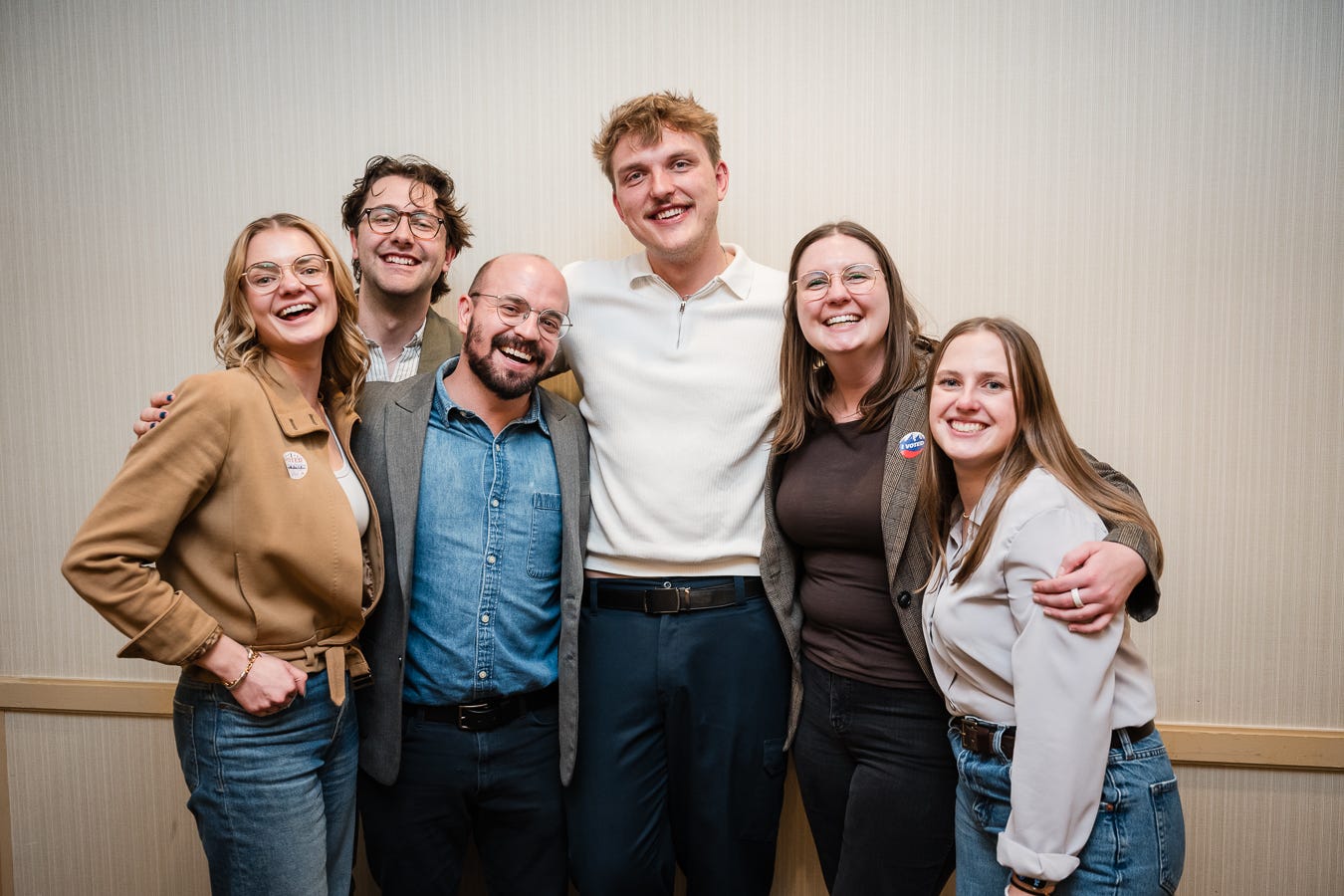
UHHHHHHHHH. UTAH????? HELLO???
We’re experiencing a new emotion. We believe the clinical term is electoral success.
We’ve spent years trying to convince people that Utah could change. We’ve written an absurd amount of Substacks about it, made increasingly elaborate spreadsheets, recruited candidates, knocked doors, and subjected our friends and family to a lot of very specific drama about legislative districts.
And through all of it, we’ve been pretty realistic about the timeline. We’re optimists, not delusional. We thought we could break the Republican supermajority by 2030. Maybe get a congressional seat back in 2026. Flip a few county offices. Slowly, methodically, one seat at a time make Utah politics a little less like a one-party system and a little more competitive.
Well. So. About that timeline. Our 2030 goals have been moved up to yesterday. So uh that’s fun.
The short version: WE ARE WINNING BASICALLY EVERYTHING.
Okay, we will preface everything by saying votes are still being counted. Several races are very much not over. But the results so far are genuinely extraordinary, and we would like to spend a little time being absolutely insufferable about them. And we won’t apologize for it because this is truly one of the most incredible moments of our careers. Maybe THE most incredible. We have run out of adjectives.
Let’s review our highlights:
The Republican supermajority in the Utah House is on track to be GONE. For the first time in 26 years, Republicans may not have the two-thirds majority they’ve used to run the Legislature however they please.
Democrats are on track to flip the Salt Lake County Council. Zach Robinson and Luke Maynes are both leading comfortably, which would give Democrats a 6-3 majority for the first time since 2010.
CONGRESSMAN-ELECT BEN MCADAMS. That’s it. That’s the update. He’s going back to Washington after winning Utah’s new 1st Congressional District by an enormous margin.
Amendment B FAILED. Roughly 62% of Utah voters rejected the Legislature’s latest attempt to make it harder for people to pass certain ballot initiatives.
Kirk Cullimore, Utah’s Senate Majority Leader and presumed next Senate President, is losing to Democrat Shana Anderson by double digits. We have many thoughts, most of which we should probably keep to ourselves.
And that’s not even the full list.
CJ Hernandez is leading in Senate District 5. David Chappell is leading in Provo. Democrats are poised to pick up three seats on the Utah State Board of Education. Two Democrats are heading to the Cache County Council. An unaffiliated candidate won the Box Elder County sheriff’s race. And in Davis County, unaffiliated candidate Bret Millburn is leading Trevor Lee’s mom, Susan Lee in a county commission race.
Cache County! Box Elder! Davis County! Utah County! We’re naming places outside Salt Lake County in a Democratic election recap, and not to explain why we lost there! This! Is! Fun! We have so much to discuss and even more joy.
Please Enjoy Our Totally Unbiased Expert Opinion
Nationally, Tuesday was a tremendous night for Democrats. Better than pretty much anyone expected. Democrats won control of both chambers of Congress, flipped seats in unlikely places, and gave Republicans plenty to think about. We are certainly the first people to have this take.
Now, as the smartest and most accurate political pundits in your inbox, we could spend the next 3,000 words explaining exactly why this happened, what it means, and how every decision we’ve ever made was obviously correct. Because we won, which means we were right about everything. That’s how political analysis works. Duh.
But we’ll spare you. For now. Here’s what we will say: Utah was part of a national blue wave, but that doesn’t explain the whole story.
Look at our friendly neighbors. Idaho Democrats are looking at a handful of legislative pickups. Montana Democrats are making gains, but nowhere near the scale we’re seeing here. North Dakota Democrats picked up seats around Fargo and Grand Forks, but Republicans still have supermajorities in both chambers.
Meanwhile, Utah Republicans are on track to lose more than a dozen House seats. The House supermajority we’ve been trying to break for years may be gone in a single election. In districts that have been gerrymandered to withstand this exact moment.
Same national political environment. Very different results.
We’ve written extensively about this in our Case for Utah series, but for decades, Utah Democrats have been trapped in a frustrating cycle. We couldn’t win because we didn’t have the candidates, money, or infrastructure to compete. And nobody wanted to invest because we couldn’t win. Meanwhile, Republicans could win a primary, wave from a parade float, and call it a campaign.
But this year, Democrats ran candidates in 88 of 98 legislative districts. People invested in races that had been written off for years. Candidates started earlier, raised more money, and actually talked to voters who hadn’t heard from a Democrat in ages. And countless organizations, volunteers, and donors spent years building toward this moment, long before anyone knew what the national political environment would look like.
We’re not going to pretend any one organization, campaign, or brilliant political consultant (hello) deserves all the credit. But we do think there’s a lesson here.
You can’t take advantage of an opportunity you haven’t prepared for.
The national wave helped. Fairer maps helped. But neither one knocks doors in Provo or recruits someone willing to run against a 20-year Republican incumbent.
People do that.
And it turns out, when you actually give Utahns a choice, some pretty interesting things happen.
The Supermajority: It’s Not You, It’s Two-Thirds
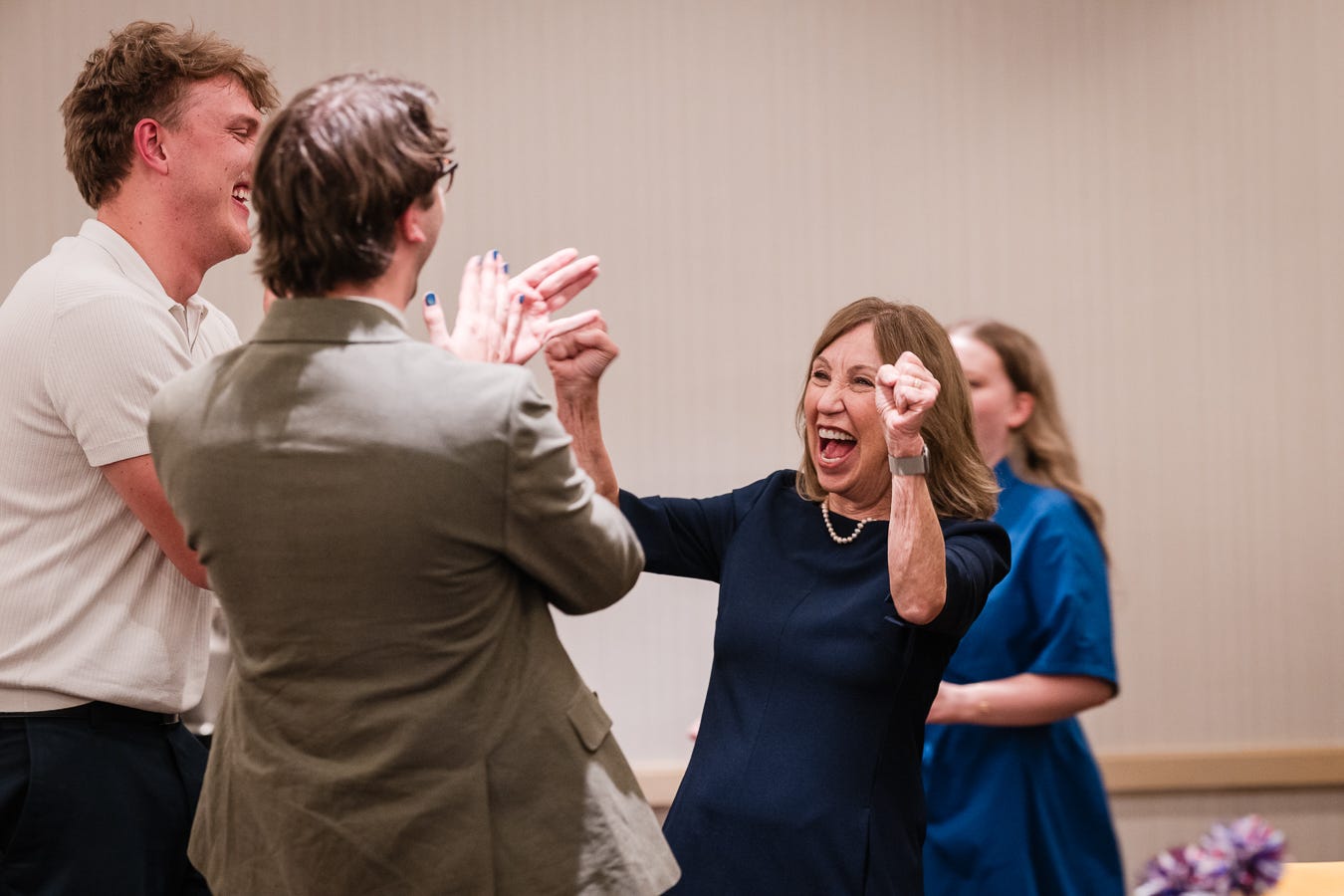
Okay. This one.
If you’ve been following us for any amount of time, you know that breaking the Republican supermajority has been something of an obsession around here.
We have an entire company and PAC centered around challenging one-party control. We have talked about this so much that our friends and family could probably repeat the stats just as well as we can.
And now, against our own projections, it appears to be happening.
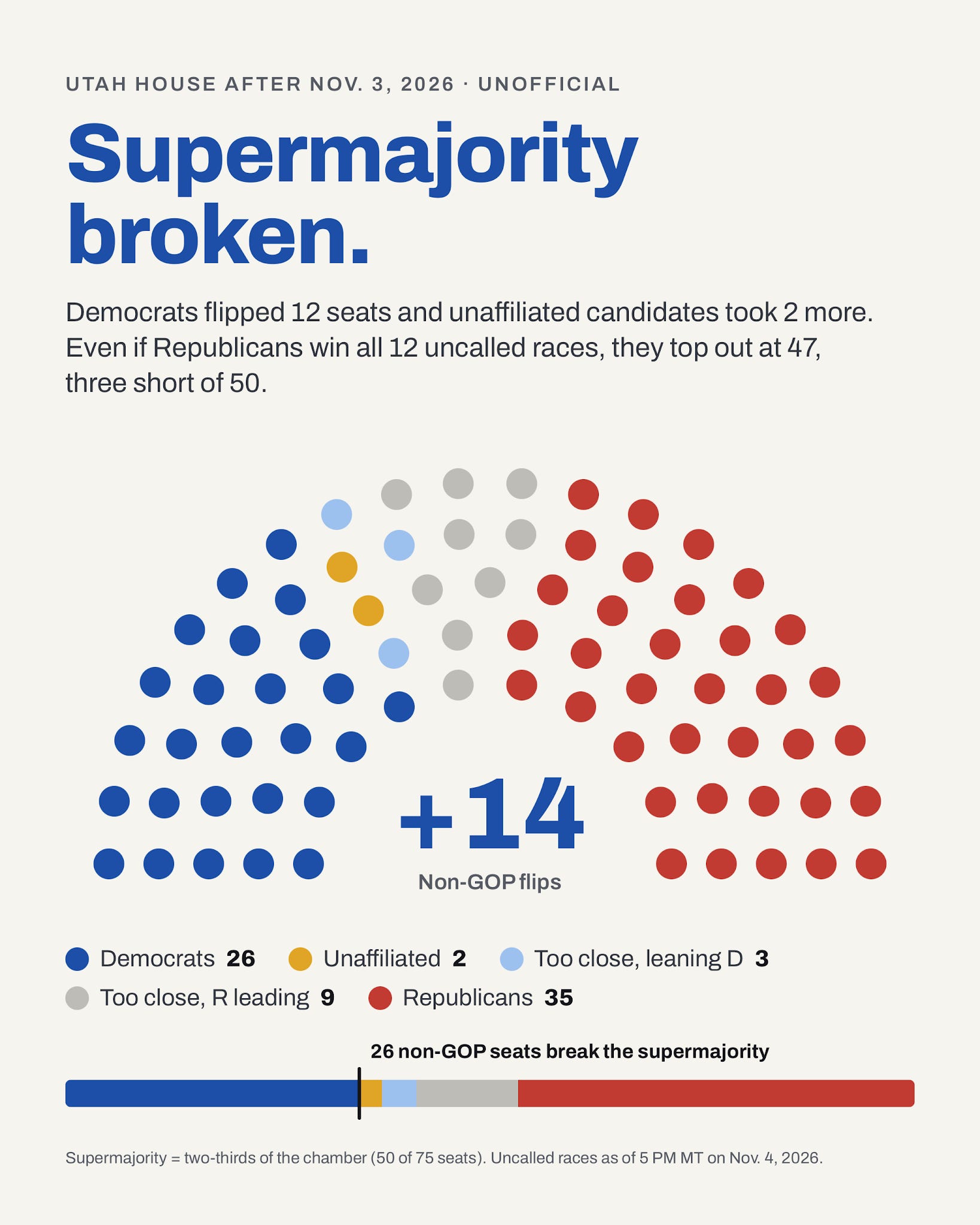
For context, the Utah House has 75 members. Republicans need 50 seats to hold a two-thirds supermajority. They began this year with 61.
That meant Democrats and other non-Republican candidates needed to take at least 12 seats from Republicans to break it.
Instead, as of Wednesday, Republicans are leading in as few as 44 House districts, with Democrats ahead in 29. TWENTY-NINE! Several of these races remain incredibly close, so those numbers will change as more ballots are counted.
But even accounting for the uncertainty, we are looking at a political transformation that would have seemed completely ridiculous a few years ago. Or a few hours ago.
And another interesting development: Patrick Belmont in House District 3 and Sergio Sotelo in House District 38 are both leading their Republican opponents. If those leads hold, we’ll have two unaffiliated legislators joining the House.
That would put us at 31 non-Republican seats in the Utah State House.
Which brings us to the important question: What actually changes when Republicans lose their supermajority?
1. No more overriding the governor whenever they feel like it.
Overriding a gubernatorial veto requires two-thirds of both chambers. Right now, Republicans can do that without a single Democratic vote.
If – or when hehehe – they lose their House supermajority, that’s over. For the first time in decades, the governor’s veto becomes a meaningful check on the Legislature, rather than a strongly worded suggestion that Republican leadership can ignore.
2. No more constitutional amendments without negotiating.
Remember Amendment D? The one where lawmakers tried to give themselves the power to rewrite voter-approved initiatives? Or Amendment B, which we just voted down?
Both required a two-thirds legislative vote to get onto the ballot.
Without that supermajority, Republicans can no longer put constitutional amendments before voters entirely on their own. Imagine having to convince someone outside your own party that your proposed constitutional amendment is a good idea before asking millions of Utahns to vote on it.
Horrifying, we know.
3. No more calling themselves into special session whenever it’s convenient.
The Utah Legislature can convene itself in a special session with a two-thirds vote.
Over the past few years, they’ve treated special sessions like a subscription service. Court ruling you don’t like? Special session. Voters passed something inconvenient? Special session. Need to change the rules before anyone notices? You guessed it.
Without the House supermajority, they lose the ability to convene themselves without bipartisan support. The governor can still call a special session, but that’s a different conversation.
4. No more instantly putting laws into effect on their own.
Ordinarily, legislation takes effect after a waiting period. To make a law effective immediately, the Legislature generally needs a two-thirds vote.
That safeguard gives people time to understand what their government just did, and in some circumstances, organize to challenge it.
But lawmakers have gotten very comfortable bypassing that waiting period. They may have to rediscover the virtue we call…patience.
5. The minority finally has some leverage.
This one is harder to quantify, but it might ultimately matter the most.
Democrats will still be in the minority. Republicans will still control the agenda, chair committees, and have the votes to pass plenty of legislation.
We’re not suddenly getting a progressive utopia. But Democrats will have something they haven’t had in a very long time: votes that Republican leadership actually needs.
That creates opportunities for negotiation, stronger opposition, and a little more accountability in a legislative process that’s become far too comfortable operating without any meaningful checks.
For a Legislature that has spent decades treating Democrats like particularly talkative furniture, that is a significant adjustment.
And we are VERY excited to watch them make it.
How Safe Are Those Republican Safe Seats?
One more interesting thing from our spreadsheets, because apparently flipping 14-plus House seats wasn’t enough to satisfy our data addiction.
Republicans aren’t just losing seats. A surprising number of the seats they’re still winning seem to be getting much more competitive.
This is definitely something we will look into more as the results are finalized but here’s what we mean: Utah has 75 House districts, and Republicans are currently leading or running unopposed in 44 (58.6%) of them.
Of those 44 seats:
5 Republicans ran completely unopposed.
24 Republicans are leading by more than 15 percentage points.
15 Republicans are leading by 15 points or less, including 10 races within 10 points.
So, across the entire Utah House, only 29 of 75 districts have a Republican running unopposed or leading by more than 15 points. Now that. That’s less than 40%...
Remember, these are districts drawn under maps that favor Republicans.
Now, a 15-point lead is still a pretty substantial margin. We’re not suggesting every one of these seats is suddenly a toss-up next year. But for a party that’s spent decades treating most of Utah as safely Republican territory, that’s a pretty interesting change.
It means more candidates have a reason to run, more voters have an actual choice, and more Republican incumbents might have to do something deeply unfamiliar: campaign for their jobs.
For us? It’s basically a recruitment list for 2028.
Salt Lake County Has Entered Its Democratic Majority Era
Now let’s talk about the Salt Lake County Council, because this deserves significantly more attention than county government typically receives.
This is a BIG deal.
Republicans have controlled the Salt Lake County Council since 2011. And despite Salt Lake County reliably electing Democrats to several other countywide offices, the council has remained a 5-4 Republican majority. Until, apparently, right now.
Zach Robinson is leading the countywide at-large race with about 65% of the vote. Luke Maynes is leading in District 3 by about 20 points.
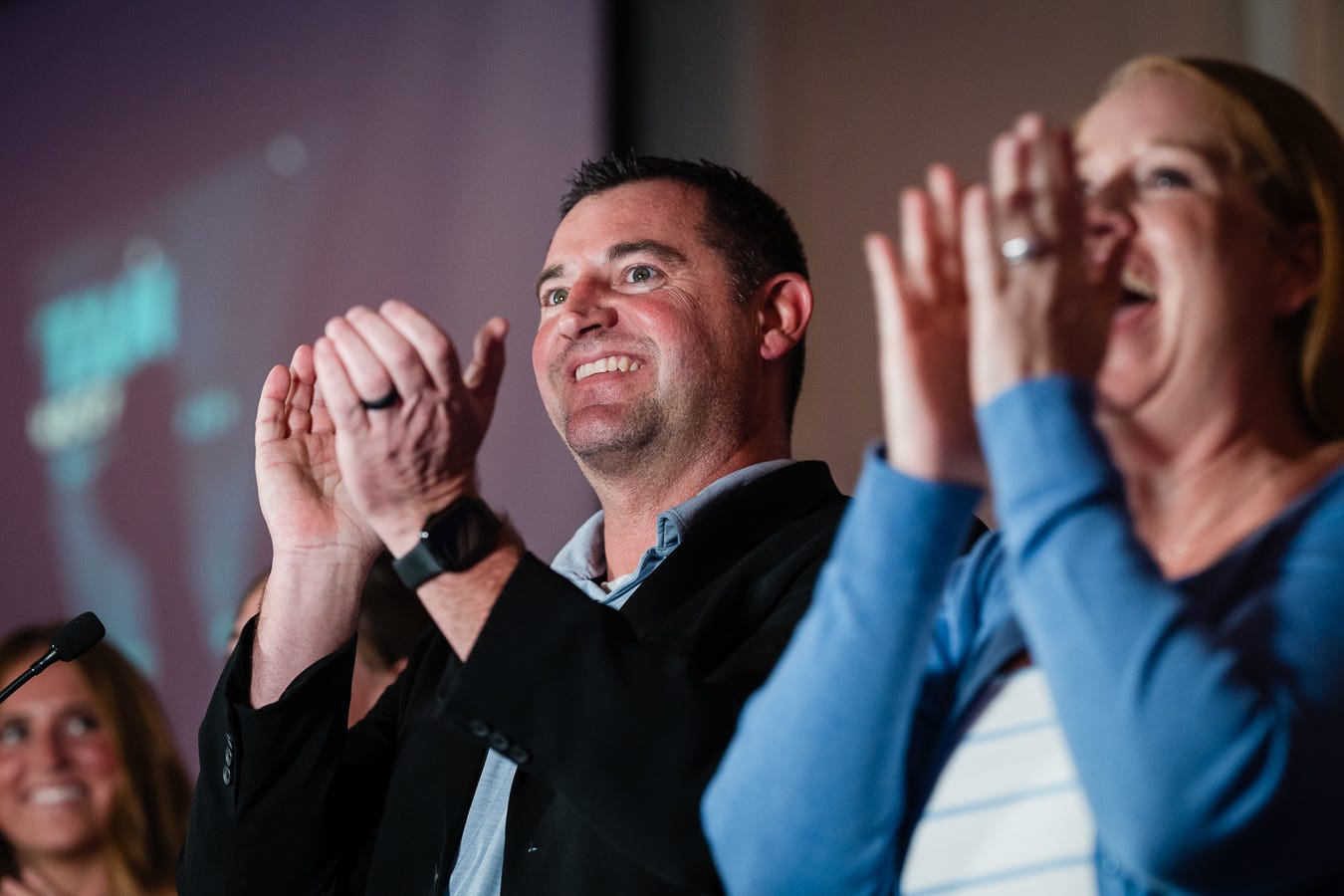
If those results hold, Democrats will have a 6-3 majority.
We are particularly excited about Zach, who we’ve had the pleasure of working with for years. He’s a former firefighter, a Sandy City Council member, and a person who genuinely understands that local government is supposed to make people’s lives better, not serve as a networking opportunity for aspiring state legislators.
But the real story here is what having six votes on the council actually means.
Salt Lake County is home to roughly 1.2 million people. More than a third of Utah’s population lives here. And county government makes decisions about an enormous number of things we all rely on: libraries, parks, senior services, behavioral health, public safety, and the county budget.
These may not be the issues that get national cable news coverage, but they’re the decisions that shape our daily lives. A county council majority gets to decide which services are priorities, how public money is spent, and whether the county is investing in the things that make life better for the people who live here.
We talk a lot about the difference between winning elections and actually governing. Salt Lake County Democrats are about to have a pretty incredible opportunity to demonstrate what that looks like. And because we’re professionally incapable of being satisfied, don’t you worry, we’ll be watching to make sure they do.
Congressman Ben McAdams. AGAIN.

Remember in 2018 when Ben McAdams won a congressional seat and Utah Democrats collectively lost their minds?
Well, welcome back to that feeling.
After years of legal battles over Utah’s congressional maps, voters in Salt Lake County finally had the opportunity to elect a representative from a district that wasn’t specifically designed to dilute their political influence.
And they elected Ben McAdams. By roughly 50 points.
FIFTY. 5-0.
A few years ago, the Legislature was willing to split Salt Lake County into four congressional districts to avoid electing a Democrat. Turns out that if you allow Salt Lake County voters to vote together, they’re pretty good at choosing one.
What a fascinating discovery.
We also know the Democratic primary was contentious. People had strong opinions, and we know not everyone got the outcome they wanted.
But the primary is over. Ben is going to Congress, and he’s going to represent the entire district, including the people who voted for someone else.
We hope everyone can recognize the opportunity that this creates, not just for this district but for Utah as a whole.
Having a Democratic member of Congress again means more than having someone with a D next to their name in Washington. It means having someone who can help build political infrastructure, bring attention to Utah issues, support other candidates, and give Utahns a different voice in federal debates.
And he’s heading into a Congress that Democrats will control.
Speaking of our new democratically-controled Congress, Mike Lee is about to lose his position as chair of the Senate Energy and Natural Resources Committee. Just as a fun aside.
As election results rolled in Tuesday night, Senator Lee posted an AI-generated video of the Titanic sinking with the caption “Current vibes.”
For once, Mike, we completely agree.
And then there’s Utah’s other senator, John Curtis.
While Mike Lee was apparently directing a low-budget AI disaster film, Curtis was publishing a Substack essay about how the Republican Party has abandoned its principles.
He chose election night, as a sitting Republican senator from Utah, and took to Substack to suggest that perhaps his party should try looking in the mirror.
We have so many thoughts about the timing, the message, and the fact that he decided to publish an entire political postmortem before Utah’s results were even in.
But we’ll save most of them for another day.
For now, welcome to Substack, John. We recommend turning on paid subscriptions. Apparently, political commentary is a growth industry in Utah.
Amendment B: Utah Voters Would Like Their Rights Back, Thanks
Somehow, we’ve made it this far without giving Amendment B the attention it deserves.
Because HOLY COW.
So far, roughly 62% of Utah voters rejected Amendment B.
I don’t know about you, there’s something deeply satisfying about using your constitutional right to vote to tell legislators that you’d like to keep your constitutional right to ballot initiatives.
And this wasn’t an isolated fight. Remember, in 2018 Utahns passed three ballot initiatives: medical cannabis, Medicaid expansion, and independent redistricting. The Legislature rewrote the first two and undermined the third. When the Utah Supreme Court ruled against them, lawmakers tried to change the Constitution. And when that didn’t work, they came back with Amendment B.
Apparently, Utahns are getting a little tired of this routine.
What’s especially interesting is that plenty of people who voted against Amendment B almost certainly voted Republican elsewhere on their ballots. Turns out, even Republican voters don’t necessarily appreciate having their power taken away.
Pair that with the apparent loss of the House supermajority, and the Legislature is running out of ways to change the rules without getting permission from the people affected by them.
A conservative state is not the same thing as a state that will tolerate whatever its conservative politicians do.
The Kirk Cullimore Situation
Oh, Kirk.
We have been trying very hard to approach this election with grace, humility, and an appropriate level of maturity.
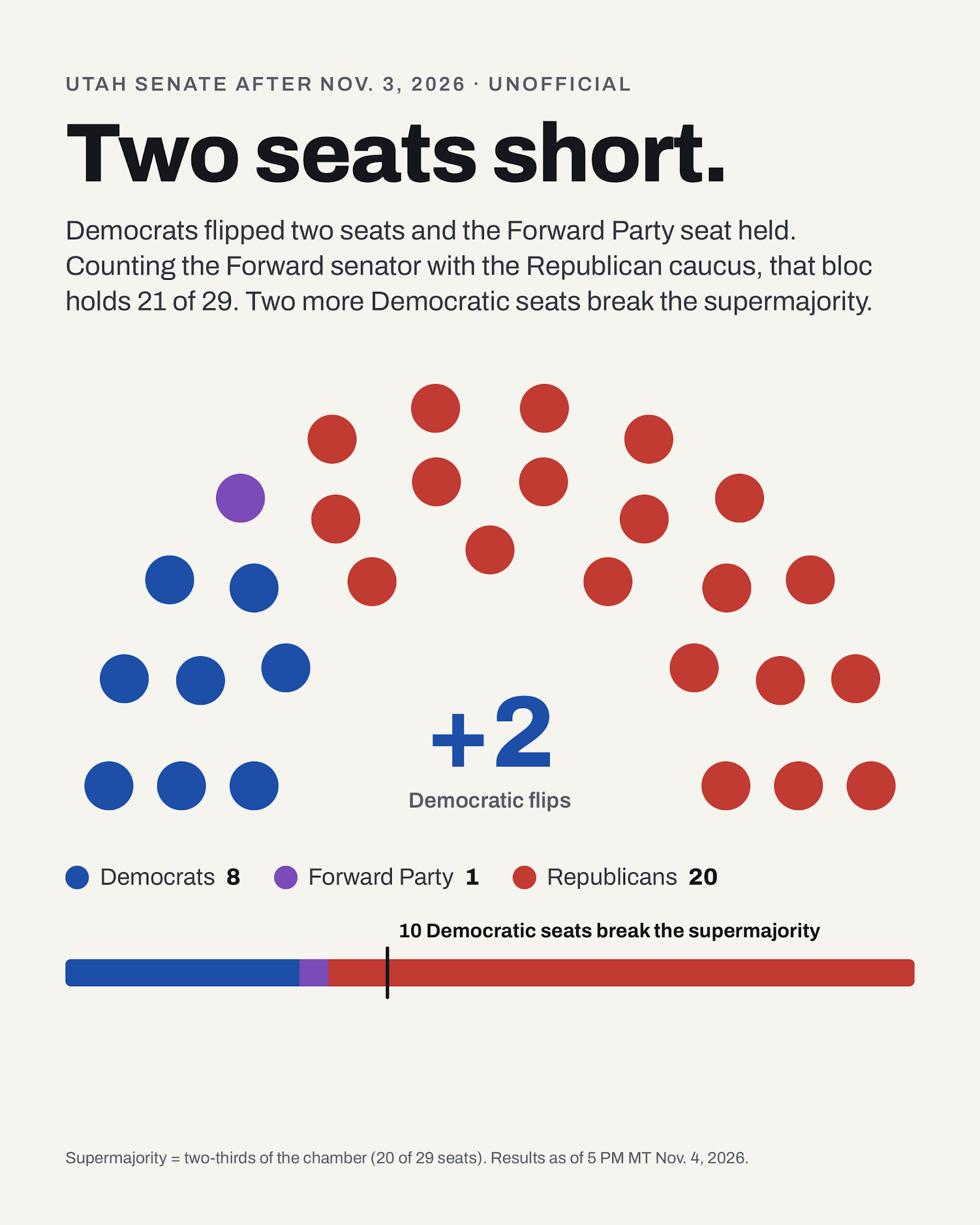
Unfortunately, the results in Senate District 19 are testing our commitment to all three. Utah Senate Majority Leader Kirk Cullimore is trailing Democrat Shana Anderson by nearly 14 points.
F-o-u-r-t-e-e-n p-o-i-n-t-s
This is a man who, until approximately yesterday, was widely considered the likely next president of the Utah Senate.
Remember, Stuart Adams lost his Republican primary back in June, an extraordinary development on its own? (We do, like it was yesterday) Cullimore, as majority leader, appeared well-positioned to take over.
Instead, it looks like he may not even be returning to the Senate. Which means that in one election cycle, Utah voters could effectively end the political careers of both the sitting Senate President and his successor.
That’s not exactly how succession planning is supposed to work.
Cullimore has been one of the most influential members of the Legislature for years. He’s played a central role in Republican leadership, backed the state’s ban on fluoride in public drinking water, and been deeply involved in some of the most consequential fights over state policy.
He has also become something of a symbol of a Legislature that seems much more comfortable exercising power than answering questions about how it’s used.
And while we’re sure there will be plenty of explanations for why he appears to be losing, we would suggest considering the possibility that voters simply weren’t particularly interested in giving him a promotion. Or keeping him around to continue not delivering for them.
Shana Anderson ran a good race, and the results reflect a district that is clearly open to a different kind of representation.
There are still ballots to count, and we won’t pretend the election is officially decided. But for now, let’s just say the Senate President’s office may want to hold off on ordering new stationery.
And It Wasn’t Just Salt Lake County
One of the most interesting parts of Tuesday night was watching the results come in from places that rarely make it into Democratic victory speeches.
Two Democrats, Allison Goulais and Mark Nafziger, won seats on the Cache County Council. Republican control of that body is no longer uncontested.
In Box Elder County, voters elected unaffiliated sheriff candidate Doug Christensen. And in Davis County, Bret Millburn, also running unaffiliated, is leading Republican Susan Lee (yes, Trevor Lee’s mother) for county commission.
These aren’t all Democratic victories, but they are examples of voters being willing to consider candidates outside the usual Republican establishment.
We’ve said it before, but we’ll say it again: Utah’s political future cannot be built entirely within Salt Lake County. If we want a truly competitive state, we need strong candidates and meaningful choices in communities across Utah.
Tuesday gave us some pretty exciting reasons to keep investing in exactly that.
So... What Do We Do With All This?
First of all, celebrate.
Seriously. Drink the champagne. Get a dirty Diet Coke. Mix the two if you’re feeling particularly reckless. Go hug a campaign volunteer. Text the person who told you Utah would never change and be only a little obnoxious about it. Feel what it’s like to have hope, optimism, and momentum.
You earned this.
We spend so much time in politics talking about what’s going wrong, what needs to change, and how much work there is left to do. We’re very good at identifying problems. Some might even say professionally annoying about them.
So when something goes right, especially something this big, we should allow ourselves to enjoy it. We certainly will be!
But once we’ve recovered from that, there’s something important we want to talk about.
Winning changes the job.
For years, our work has mostly been about opposition. Exposing bad legislation, challenging Republican leadership, fighting for fair elections, and trying to convince voters that things don’t have to stay the way they’ve always been.
And we’re certainly not done with any of that.
But now, we have a different opportunity.
We may have a House minority large enough to meaningfully check Republican leadership. A Democratic majority on the Salt Lake County Council. A Democratic member of Congress. More competitive legislative districts. And a growing number of communities electing leaders outside the traditional Republican establishment.
These people are going to have real opportunities to govern.
That means our job can no longer be just explaining what Republicans are doing wrong. We also have to help demonstrate what better government actually looks like.
We have to keep building strong campaigns, but we also have to support the people who win them. We have to keep holding Republican lawmakers accountable, but we have to be willing to hold Democrats accountable too, and be unapologetic about reminding their constituents on both counts – positive and negative.
And we have to resist the temptation to interpret one very good election as proof that the hard part is over.
Because it isn’t.
Republicans still control the Utah Legislature. They still hold every statewide elected office. They’re still well-funded, well-organized, and almost certainly spending today figuring out how to win back the seats they’ve lost.
And the next time the national environment is less favorable to Democrats, we need to make sure these gains don’t disappear.
That’s the difference between winning an election and building lasting political power.
It’s also why we’ve never believed Utah would change simply because younger people are moving here, or because Republicans are getting more extreme, or because demographics are shifting.
Those things can create opportunities. But opportunities don’t recruit candidates, knock doors, raise money, persuade voters, or turn in ballots.
People do.
And that’s what makes this election so meaningful to us.
Two years ago, we wrote about why Utah could become the nation’s next battleground state. We talked about demographic changes, Republican divisions, new political infrastructure, and the possibility of rebuilding meaningful competition in a state that had largely forgotten what it looked like.
We knew it was going to take years. We thought we’d spend most of this decade trying to prove we were right.
And now, after one election, some of the biggest goals we set for ourselves are already within reach.
Which is certainly exciting. And a little terrifying. Because do we just set new goals now? Where do we go next, team?
But more than anything, it’s a reminder of something we’ve been trying to tell people for years.
Utah was never going to change because someone gave us permission. It was going to change because enough people decided that the way things have always been wasn’t good enough anymore.
On Tuesday, a whole lot of people made that decision.
So thank you.
To the candidates who took a chance on races they were told they couldn’t win and did an incredibly brave thing to put your name on the ballot anyway. To the volunteers who knocked doors through the hottest part of summer and the coldest parts of October. To the donors who invested before anyone could guarantee a return. To the organizers who have been doing this work long before Elevate existed. And to every voter who decided that their ballot could actually make a difference.
You helped make this happen.
We’ve spent years asking Utahns to imagine what a more competitive state could look like. Now we get to find out.
But first, we’re going to need approximately… 48 hours to recover. Oh, and more tissues because we’re crying again.