


Utah’s fight over fair maps and voter power reached a critical moment last Friday. After years of legal twists and turns, the courtroom became the battleground for a case that could reshape the future of Utah’s elections. At the heart of it: a simple question with huge implications—can the Legislature override the will of the voters when it comes to how our democracy works?
This case isn’t just about redistricting lines on a map. It’s about who holds the power to shape Utah’s political future—the people or the politicians. Here’s what happened in court, how we got here, and what’s coming next.
What Happened in Court on Friday?
Third District Court Judge Dianna Gibson heard over three hours of arguments from both sides. On one side: the League of Women Voters of Utah and Mormon Women for Ethical Government, who argue the Legislature unconstitutionally overturned a voter-approved initiative designed to make redistricting fairer. On the other side: the Utah Legislature, whose basic argument boils down to, “But we’re supposed to be in charge.”
Judge Gibson didn’t issue a ruling right away, but she acknowledged that “time is of the essence,” promising to get a decision out “as quickly as possible.” In the meantime, let’s break down how we got here—and what’s next.
How Did We Get Here? A Quick Recap of Utah’s Redistricting Saga
2018: Voters Say, “Let’s Try Democracy.”
Utah voters passed Proposition 4, also known as Better Boundaries, with 50.3% of the vote. It created an independent redistricting commission that would draw fair maps based on actual data—not just what benefits politicians.
A bold move in a state where the Legislature had been treating redistricting like their own personal Risk board.
2020: The Legislature Says, “That’s Cute.”
The Utah Legislature—unenthused by the idea of fair maps—passed SB200, effectively gutting Prop 4. Instead of giving the independent commission real power, they demoted it to an advisory role, meaning lawmakers could ignore the commission’s maps whenever they felt like it. (Spoiler: they did.)
2021: The Gerrymandering Special
After the 2020 census, when it was time to draw new maps, the Legislature did exactly what you’d expect: threw out the commission’s fair maps and drew their own, designed to protect Republican dominance.
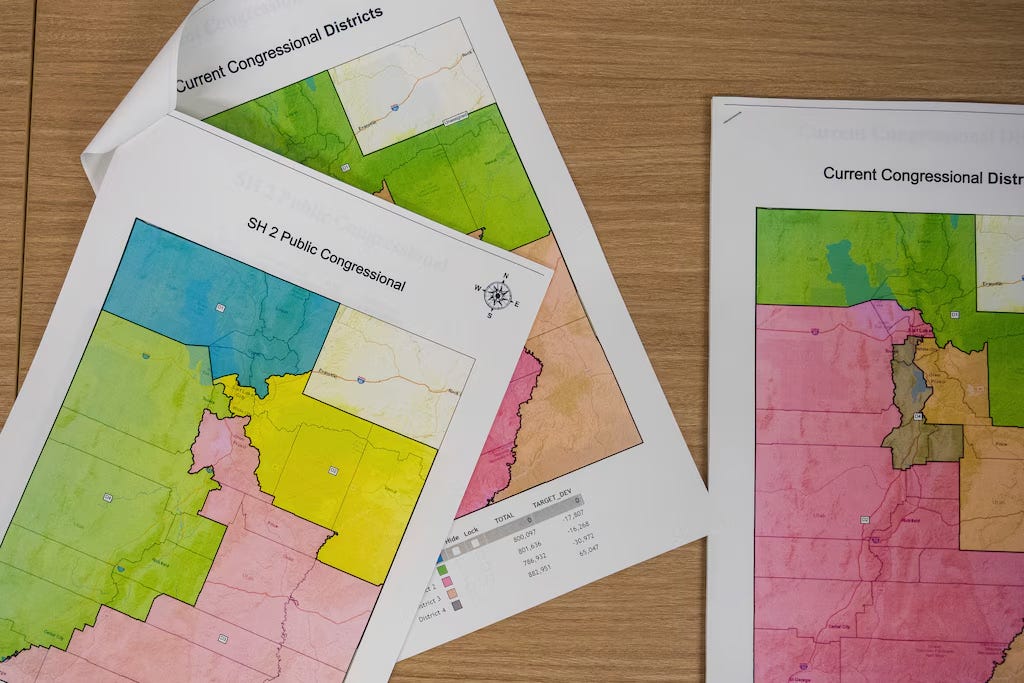
Salt Lake County was carved into four congressional districts, diluting Democratic votes and ensuring that every seat was safely Republican. It’s the political equivalent of cutting a pizza so everyone gets a slice—except Republicans get all the pepperoni, and everyone else just gets the crust.
2022: The Lawsuit
The League of Women Voters of Utah and Mormon Women for Ethical Government sued the state, arguing that the Legislature’s actions violated the Utah Constitution, which guarantees voters the right to alter or reform their government.
Their case: You can’t just overturn a voter-approved initiative because you don’t like it. That’s not how democracy—or the state constitution—works. (Or at least, that’s not how it’s supposed to work.)
2024: The Utah Supreme Court Steps In
In a major win for the plaintiffs, the Utah Supreme Court ruled that the Legislature does not have unlimited power to repeal voter-approved initiatives—especially when those initiatives involve reforms to how government functions. The ruling wasn’t vague or wishy-washy. The Court made it crystal clear: the people’s constitutional right to reform their government is real, enforceable, and can’t be casually tossed aside by the Legislature just because they don’t like the outcome.
The Court emphasized that while the Legislature has broad authority to pass, amend, or repeal laws, that power is not absolute—especially when it comes to initiatives passed directly by the voters. In other words, the Legislature can’t just hit “undo” on democracy whenever it’s politically inconvenient. If they want to repeal or weaken a voter-approved government reform, they need to have a compelling reason, and their changes must be narrowly tailored to serve a legitimate government interest.
After laying down that legal smackdown, the Court sent the case back to the lower courts for further review. Essentially, they said: “We’ve clarified the rules. Now, it’s up to you to figure out if the Legislature broke them.”
This put Judge Dianna Gibson in the hot seat, tasked with determining whether the Legislature’s repeal of Proposition 4 and replacement with SB200 actually “impaired” the people’s constitutional right to reform their government—and if so, whether the Legislature had any legitimate justification for doing it. (Hint: they probably didn’t.)
Friday’s Hearing: The Key Arguments
The Plaintiffs (a.k.a. Team “Respect the Voters”)
Represented by Aseem Mulji from the Campaign Legal Center (who really popped off).
Their argument was pretty straightforward:
Prop 4 was a government reform. The Legislature’s repeal impaired that reform. That’s unconstitutional, according to the Utah Supreme Court.
Just because the Legislature didn’t like Prop 4 doesn’t mean they had the right to dismantle it.
Favorite quote: “If they don’t like it, that’s not a good enough reason to impair a reform enacted by the people.”
In other words: You can’t throw out the rules just because you’re losing the game.
The Defense (a.k.a. Team “We’re In Charge, Actually”)
Represented by Tyler Green, arguing on behalf of the Utah Legislature. He really embodied the “well, actually” energy.
Their argument:
“Actually, Prop 4 violated the Utah Constitution because only the Legislature can handle redistricting.”
They claim SB200 was passed to address concerns that Prop 4 created a “constitutional conundrum”—basically that it forced the Legislature to follow new rules, which, according to them, is a problem because they are supposed to set the rules.
It’s like someone arguing they should referee their own game because they know the rules better than anyone else.
Judge Gibson’s Big Question: The Heart of the Case
At the center of Friday’s hearing was a deceptively simple question from Judge Dianna Gibson—one that cuts to the core of Utah’s constitutional tug-of-war:
Does the Utah Constitution give the Legislature exclusive authority over redistricting, or are there constitutional limits to that power—especially when voters have explicitly exercised their right to reform government through a ballot initiative like Proposition 4?
This isn’t just a legal technicality. It’s the question that could determine whether Utah’s voters have real power to influence how their government works—or whether the Legislature can override the will of the people anytime it feels politically inconvenienced.
What Happens If the Plaintiffs Win?
If Judge Gibson rules in favor of the plaintiffs:
SB200 could be struck down, meaning Prop 4 would be reinstated in its original form.
The Legislature would be required to consider fair, independent maps—and not just as a formality.
Utah’s congressional maps would likely have to be redrawn before the 2026 election. No more slicing Salt Lake County into four districts just to dilute Democratic votes. In fact, Lt. Governor Deidre Henderson requested new congressional maps by November 1, 2025. Love that for us.
There’s also the question of whether state legislative and state school board maps will be redrawn. Technically, if Prop 4 becomes law again, there’s an argument that those maps would need to be reassessed too.
However—and this is a big however—if the plaintiffs win, it’s highly likely that the Legislature will appeal the decision. That would kick off another round of legal battles, dragging the case through the courts once again and delaying any final resolution. So, while a win would be huge, we’d still be in for another fight before we see real change.
The Legislature’s Ongoing Power Grab: Enter Amendment D (and Friends)
Speaking of fights, let’s not forget about Amendment D. You know, the Legislature’s attempt to change the rules of the game after they lost in court? Yeah, that one.
In case you missed it:
Amendment D was an effort to give the Legislature even more power over ballot initiatives.
It was struck down by none other than—drumroll—Judge Dianna Gibson, who ruled that the Legislature failed to provide proper public notice before putting it on the ballot. (Oops.)
Now, the Legislature is not taking that loss well. In what feels like a case of legislative retaliation, they’re trying to change the rules again—this time with a trio of bills (so far) designed to make it harder for the people to hold them accountable:
SJR2 and SB73 are both aimed at making the ballot initiative process even harder.
There’s also an unnamed bill in the works that would get rid of the newspaper public notice requirement—the very requirement that led to Amendment D being tossed out. HA! If that doesn’t say “If we don’t like the rules, we change them” I don't know what does.
Call or email Representative Loubet and let him know we are looking out for legislators who are trying to change the rules to make themselves more powerful.
If this feels like the Legislature is trying to stack the deck in their favor, that’s because they are. They’re trying to make sure that even if they lose in court again, it’ll be harder for voters to fight back next time.

The Clock Is Ticking: Why This Matters Now

The timeline here is tight:
Lt. Governor Deidre Henderson has said that new maps need to be finalized by November 2025 to be used in the 2026 election cycle.
That’s why Judge Gibson acknowledged that “time is of the essence.”
But with the threat of appeals, new legislation designed to limit voter power, and the Legislature’s habit of moving the goalposts whenever they lose, this isn’t just about the next election. It’s about the future of democracy in Utah.
What Can You Do?
Stay informed. This case isn’t over, and the ruling will be a big deal. Pay attention but we will let you know too.
Contact your representatives. Continue to contact your representatives, especially on SJR2, SB73, and soon-to-come Rep. Loubet’s constitutional amendment. Tell them to vote no.
Get involved. Whether it’s supporting organizations fighting for fair elections, voting in every election, or even running for office, this is your government. Don’t let anyone convince you otherwise.
Final Thought
Utahns deserve elections where every vote counts and every voice matters—not just the ones that help certain politicians stay in power. Whether Judge Gibson rules next week or next month, one thing is clear:
The fight for fair maps isn’t just about lines on a page. It’s about the future of democracy in Utah. And that’s worth fighting for.
If you enjoyed this premium post, consider a paid subscription with two bonus Substacks per month featuring exclusive content like:
Hot gossip, hotter takes, deep policy analysis, and the nerdiest data analysis and dashboards.
Your subscription supports Elevate PAC’s mission to bring balance to our state—because the GOP is ~clearly~ not going to rein itself in.
Elevate PAC is working to eliminate single-party control at all levels of our state’s government by elevating inspirational leaders, activating the new Utah majority, and centering our shared values and common purpose.
Our blueprint is to recruit and train candidates, invest early, support strategically, and build relationships.
Paid for by Elevate PAC