

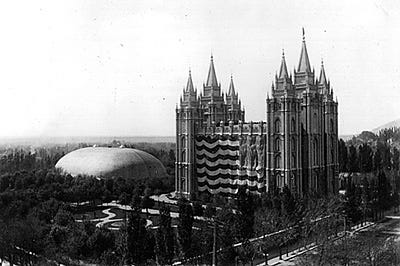
Mormon Temple, commemorating statehood, 1896. Courtesy: Special Collections Dept., J. Willard Marriott Library, University of Utah
Utah Walked So the IRS Could Shrug
The IRS just told churches they can endorse political candidates without losing their tax-exempt status. To most of the country, that’s news. In Utah? That’s Monday.
At first, we were like, “That sounds...off?” But then we dug in. And what started as a “flag it for later” moment turned into a full afternoon deep dive, and oh my goodness, we went down the rabbit hole. LDS church history. Tax law. Endorsements in sacrament meeting. Joseph Smith running for president. No biggie.
We’re not saying Utah invented this system, but we are saying it gave us a real-world case study of what happens when religion and politics get cozy enough to share a tithing slip. And now, the federal government is kind of saying... that’s fine. Go ahead. We won’t stop you anymore.
This piece isn’t about bashing religion or the LDS church, or even dunking on Utah (well, not entirely). It’s about power. What happens when some groups get to campaign tax-free, in sanctuaries, with no accountability, while the rest of us still have to follow the rules? It’s about the erosion of the wall between church and state, and why we should all be paying attention right now.
So, let’s walk through what the IRS just said, what it means for elections, and what Utah’s history can teach us about where this might be going. Because we thought we knew this story, but today, we learned a lot.
And trust us, this is WILD.
Time for a Classic Family Discussion??
Here’s what happened: in a court filing this week related to a case in Texas, the IRS said that if a church endorses a political candidate “through internal communication” like, say, a sermon or a message to congregants, it doesn’t violate the Johnson Amendment, the 1954 law championed by Lyndon B Johnson, that says 501(c)(3) nonprofits (including churches) can’t engage in partisan political activity if they want to keep their tax-exempt status.
The IRS’s exact phrasing was that it’s akin to a “family discussion.”
This new interpretation raises a lot of questions. What counts as “internal”? Is a pulpit announcement internal? What about a church newsletter? Or a live-streamed sermon? Or a 10,000-person email blast with a PS that says “Vote your values, especially for that one guy we mentioned by name”? Does this apply to social media? Instagram carousels from the Young Women’s president?
We don’t know. No one really does yet.
That’s part of what makes this so wild. It’s not a formal policy change, but it’s a flashing neon sign that says: hey guys, we’re not enforcing this anymore. And it effectively gives churches the green light to wade into elections with no clear guardrails, while still enjoying full tax-exempt status.
Most 501(c)(3)s (think soup kitchens, after-school programs, health clinics, literacy campaigns) live in constant fear of crossing the line because one wrong move, one offhand comment at a community event, one accidentally spicy voter guide, and you risk losing your tax status. We know because we’ve worked in that world. It’s intense. Lawyers are involved. You basically have to take a vow of political silence in exchange for being able to operate without paying federal taxes.
But now, apparently, if you’re a church, you can endorse a candidate as long as you do it in-house.
To be clear: this doesn’t just affect tiny rural churches or your grandpa’s Bible study group. It includes organizations like the Church of Jesus Christ of Latter-day Saints, which brings in $7 billion a year in tax-exempt tithing and holds $293 billion in assets. That’s billion, with a B. (We’ll get into that more later, don’t worry.)
The point here is that churches are already incredibly powerful institutions. Now, the federal government is signaling they can use that power to influence elections without the rules that apply to literally everyone else.
Joseph Smith for President: The Prequel
Here in Utah, we’ve been living in the gray area between church and state for a long time. We are pretty sick of sharing ways that Utah is leading the nation but we’ve got to say, we’re uniquely qualified to show how this stuff plays out when the line between church and state becomes blurred.
So let’s rewind. Not to 2016. Not to Mitt Romney. All the way back to 1844, when Joseph Smith, the founder of the Church of Jesus Christ of Latter-day Saints, decided he wasn’t just a prophet. He was also a presidential candidate.
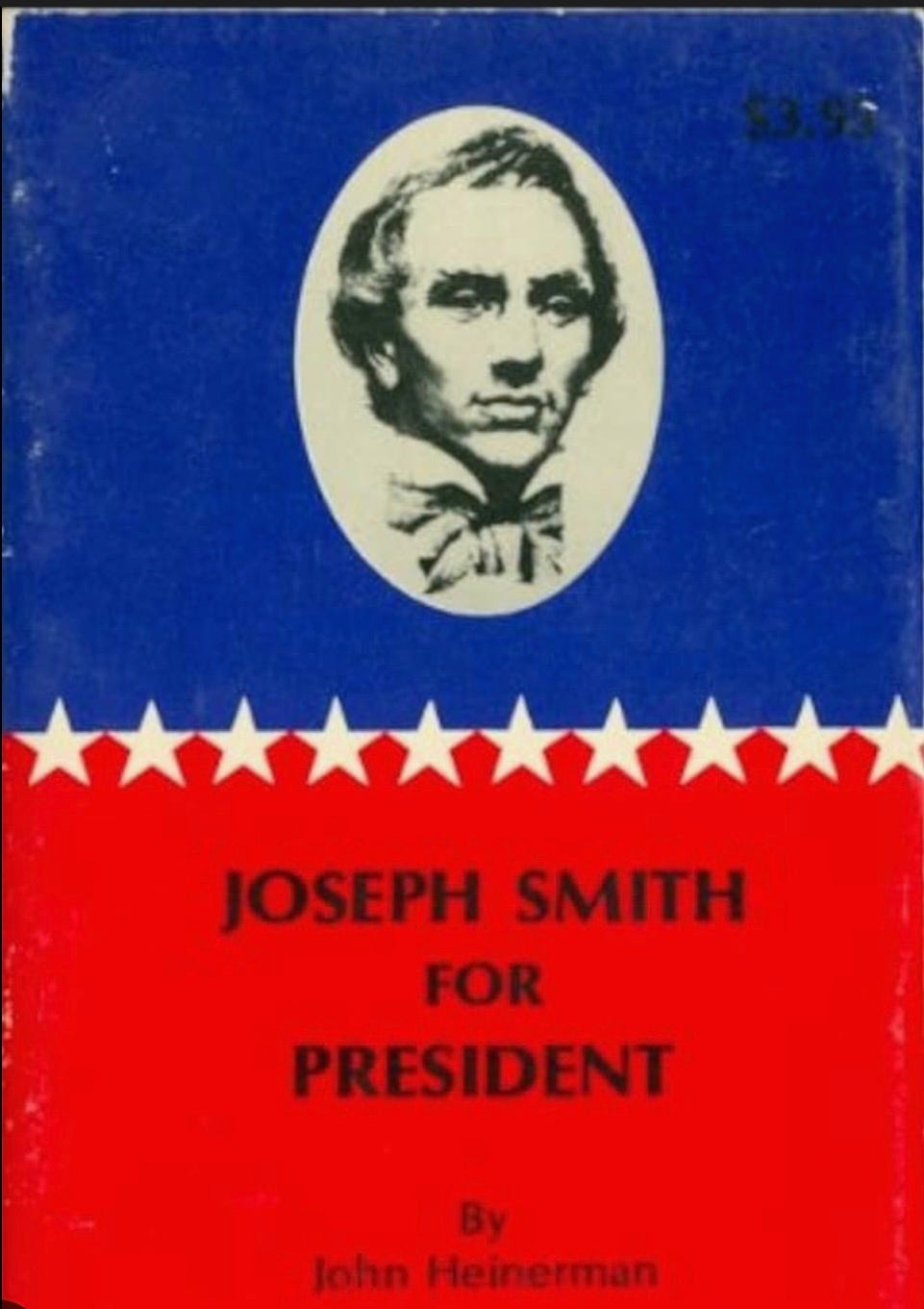
His platform was (shockingly progressive for the time): abolish slavery, reform the criminal justice system, reduce congressional salaries, and, why not, build a government rooted in righteousness. Smith believed the Constitution was inspired by God but poorly executed by mortals. He wanted to fix that.
Before his campaign could get traction, he was killed in an Illinois jail by an anti-Mormon mob.
And that’s how Utah’s church-state story starts.
Manifest Deseret
After Smith’s death, Brigham Young took over and led the Saints west in search of freedom and isolation. In 1849, they proposed their dream society: the State of Deseret, a massive, Mormon-led territory stretching from modern-day California to Colorado.
Congress took one look at the polygamy and theocracy and said, “Absolutely not.” Instead, they created the Utah Territory in 1850 and appointed Young as Governor, but kept real power in federal hands. (That tension didn’t go great. Google “the Utah War” sometime.)
This Territory Isn’t Big Enough for the Both of Us
Fast forward to 1870. The transcontinental railroad was completed (Golden Spike! Go Utah history!), and suddenly, Utah was no longer isolated. Miners, merchants, missionaries, and opportunists started pouring in, many of whom were... not super into the whole “God runs the government” thing.
So they formed the Liberal Party, which was basically just: “Not Mormons.” And the Church formed the People’s Party, which was: “Yes Mormons.”
That was Utah’s political scene. Not Democrat vs. Republican. Mormon vs. anti-Mormon.
And not in the vague, proxy way it is now. We mean like directly.
Rated PG for Polygamy
Throughout the late 1800s, the U.S. government ramped up its crackdown on the Church, especially over polygamy, but also over its outsized political power.
The Morrill Act (1862) outlawed plural marriage and capped Church property holdings.
The Edmunds Act (1882) made “cohabitation” a crime and banned polygamists from voting or holding office.
The Edmunds-Tucker Act (1887) went full scorched-earth: dissolved the Church’s legal status, seized its assets, and disenfranchised Utah women (who had been among the first in the country to gain the right to vote).
The Cullom-Struble Bill (1889) had even stricter anti-polygamy provisions, but the Mormon church killed it in Congress by committing to end polygamy.
By the 1890s, the Church was facing existential threats. Its leaders were being jailed or going into hiding. The federal government was not playing.
And most of this crackdown came from Republicans.
This meant that for a long time, most Latter-day Saints leaned Democratic. (Democrats weren’t exactly pro-polygamy, but they weren’t out campaigning on shutting it down either.)
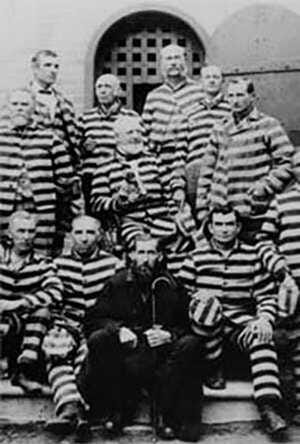
Mormons imprisoned for polygamy, 1886. Courtesy: Special Collections Dept., J. Willard Marriott Library, University of Utah
How to Win Friends and Influence Republicans
By the 1880s, the LDS Church was very ready to become a state. They were tired of federal officials being parachuted in to run their courts, their elections, and basically their lives. And with both national parties looking to gain seats in Congress by admitting new states, Church leaders figured now was the time to make it happen.
At first, Democrats seemed like the natural ally. Most Latter-day Saints leaned Democratic, especially since it was the Republican Party that had led the anti-polygamy crusade. To sweeten the deal, LDS leaders even tried to woo President Grover Cleveland during his first term. They offered to help deliver votes for Democrats not just in Utah, but also the surrounding western states. Cleveland didn’t bite.
So the Church pivoted. In 1890, Church President Wilford Woodruff sent Apostle George Q. Cannon to Washington, D.C. to advocate for Utah’s admission. When the Democrats kept dragging their feet, Cannon turned to the Republicans. He started building relationships, made backroom deals, and even helped defeat a Republican-led bill that would’ve disenfranchised all Latter-day Saints.
It worked. Republican leaders began to see Utah as an opportunity, not a threat. If they could be the ones to bring Utah into the Union, maybe they could win over the Saints too.
But the Church had to prove it could play nice in a two-party system. So it dissolved the People’s and Liberal Parties, sent leaders on speaking tours to promote the Republican Party, and encouraged members to split between the two national parties. This is where the long-time lore of Bishops splitting congregations down the aisle into party affiliations comes from.
And when Utah finally became a state in 1896? All three of its new members of Congress were Republicans. (Though to be fair, Democrats won those seats back in the next election. Utah really was a political toss-up for a while… foreshadowing perhaps? Hmm…)
Called to Influence
When Utah finally achieved statehood in 1896, it came with a shiny new Constitution and the appearance of pluralism. But behind the scenes, the Church hadn’t disappeared from politics. It had simply gone... quieter.
Instead of running its own party, it cultivated influence in both. It no longer had to pass laws directly. It could shape them indirectly. And it learned that informal power is often more durable and less visible than formal control.
Today, we call that “neutrality.”
Choose the Right
Officially, the LDS Church doesn’t endorse candidates. Unofficially? It doesn’t have to.
Over the last century, the Church has perfected the art of influence without making headlines. No campaign donations. No party affiliations. Just carefully worded statements about “principles” and “values,” delivered through internal communications, newsroom releases, and Sunday talks with the unmistakable subtext of: You know what to do.
And many Utahns did.
From ballot initiatives to legislative pressure, the Church’s impact on public policy is massive. It often doesn’t even require direct involvement – just a nod, a letter, or a stance. That’s the power of centralized messaging in a religious culture built on deference to leadership and deep communal trust.
Let’s take a quick tour:
Prop 8 (2008): The Church mobilized tens of thousands of members in California to oppose same-sex marriage, donating time, money, and institutional resources. They didn’t say “vote for this” from the pulpit. They said, “We ask that you do all you can to support this,” and suddenly, volunteers flooded the state and campaign donations surged to the tune of over $20,000,000 from church members. This came after their opposition to same-sex marriage in Hawaii in 1998, California in 2000, and Utah in 2004.
The Utah Compromise (2015): LDS leaders supported the anti-discrimination law to protect LGBTQ people in Utah, which carved out religious liberty protections.
The Respect for Marriage Act (2022): While reiterating their stance “related to marriage between a man and a woman is well known and will remain unchanged,” the church supported the federal law that protects same-sex marriage, adding “We are grateful for the continuing efforts of those who work to ensure the Respect for Marriage Act includes appropriate religious freedom protections while respecting the law and preserving the rights of our LGBTQ brothers and sisters.”
School vouchers, immigration, medical marijuana, abortion, and LGBTQ+ rights: Whether it’s quiet lobbying at the Capitol or suggested Sunday curriculum topics, the Church has influenced policies across nearly every social issue in Utah over the past 25 years.
Although in 2023, the Church made a fascinating move with a letter that was read at every pulpit. They reaffirmed their commitment to political neutrality, but noted,
“Members should also study candidates carefully and vote for those who have demonstrated integrity, compassion, and service to others, regardless of party affiliation. Merely voting a straight ticket or voting based on “tradition” without careful study of candidates and their positions on important issues is a threat to democracy and inconsistent with revealed standards.”
(emphasis on the “straight ticket voting” part, please!)
So yes, the Church is “politically neutral.” It just happens to move mountains when it decides something matters. And when the IRS now says a church can talk about candidates in sermons or internal communications, Utahns don’t have to imagine what that looks like. We’ve already seen it.
The only difference now is that the IRS is blessing it, and everyone else might start doing it too. And we’re not saying that the LDS church will do anything differently. Only that, now, they could.
Lessons Learned from the State of Deseret
At this point, we feel like anthropologists who accidentally became witnesses. Utah isn’t just a case study in what happens when church and state get too close. It’s a long-running beta test for how to do it quietly.
We’re not saying anyone’s sitting in a smoky backroom drawing up conspiracy plans. (Utah doesn’t do smoky anything, obviously.) What we are saying is: when you’ve lived under a system like this long enough, you learn to see how it works, even when it’s not technically breaking any laws.
Here’s what we’ve learned:
You don’t have to say a candidate’s name to make the message clear. If your entire religious community has been primed to vote based on “family values” and allegedly one candidate supports those values and another doesn’t… congratulations, you’ve endorsed someone. Verbally laundering endorsements through the language of morality is still campaigning.
You don’t need donations when you have dedication. Most campaigns would kill for the kind of message discipline and turnout infrastructure churches already have. Weekly gatherings, hierarchical leadership, built-in distribution networks, and a culture of “follow the prophet” or “sustain the bishop”? That’s a political strategist’s dream.
“Neutrality” isn’t neutral when power flows one way. The Church says it’s neutral. It doesn’t endorse candidates. But when policies, bills, and ballot measures get shaped behind closed doors in coordination with legislators and when entire campaigns are derailed by a well-timed statement from the top, it doesn’t really matter if the word “endorse” is ever used. The influence is real. The results are real.
No one talks about it openly. That’s the final trick. In Utah, the church’s political power is so normalized that people forget it’s not like this everywhere. The lack of transparency becomes part of the system. And when no one names it, it just keeps growing.
So when the IRS now says, “Sure, go ahead, treat candidate endorsements like a family discussion,” we don’t have to imagine what that means. Because when churches are allowed to function as campaign headquarters – unregulated, unaccountable, tax-free – what you get isn’t democracy.
And if the rest of the country wants to understand what that looks like, Utah can tell you.
Faith Without Works Is Dead (So Make Some Calls)
Let’s be clear: no one is trying to stop people from going to church.
No one is banning worship or punishing belief. This isn’t about religion. It’s about what happens when religion becomes a political weapon, regardless of political leaning, that’s shielded from taxes, from scrutiny, and now, from campaign law.
And we’re telling you now: don’t ignore this. Because it’s not staying in Utah. And it’s not hypothetical.
What You Can Do
Ask your representatives: Do you support this IRS interpretation? Do you believe all 501(c)(3)s should be treated the same? If not, why are churches getting a pass?
Call for clarity: The IRS needs to answer exactly what this ruling means. What counts as “internal”? How will this be monitored? Who decides when the line is crossed?
Talk about it: Especially in places like Utah, where religious influence is so baked in that it feels impolite to name it. Name it anyway. Not in a hostile or bashing way, but in a way that protects religious liberty and the Constitution.
Vote. Vote. Vote.
If the IRS won’t enforce the wall between church and state, then it’s up to the rest of us to recognize when it’s already come down.
And then start rebuilding.
That was interesting and informative. Thank you!
This is a good article about LDS history but a bit of a strange approach to take in the beginning given that the modern church is almost scrupulously (and uniquely) opposed to political endorsements: they even famously refused to endorse Mitt Romney for president. I have visited Catholic and evangelical churches in New York, Texas and Wyoming which are far more openly political and partisan, a pattern which tends to be the case for most non-LDS religious organizations.