


The GOP didn’t just let Sundance leave. They pushed it out the door, lit the welcome mat on fire, and left a note that said, “We never liked your movies anyway.”
For more than four decades, the Sundance Film Festival wasn’t just a week of movie premieres and celebrity sightings—it was Utah’s most beloved annual identity crisis. It made Park City glamorous, Salt Lake cosmopolitan (for like, ten days), and Utah the unexpected epicenter of indie cinema.
And it wasn’t just fun, it was profitable. Sundance injected over $130 million into Utah’s economy annually, creating thousands of jobs, fueling restaurants and hotels, and generating millions in tax revenue.
It was one of the few things that united ski bums, city slickers, tech bros, and artsy eccentrics in mutual appreciation.
But now it’s gone.
In 2027, the Sundance Film Festival will leave Utah for Boulder, Colorado. And despite what certain Utah politicians might spin, this wasn’t some tragic accident, an unfortunate scheduling conflict, or a matter of Colorado offering slightly trendier oat milk.
Sundance didn’t outgrow Utah.
Utah pushed it out.
Deliberate. Calculated. Self-inflicted.
Sabotage.
What Just Happened?
Today, the Sundance Institute announced that it had officially selected Boulder, Colorado, as the next home of the festival after its current contract in Park City ends in 2026. The decision came after a year-long national bidding process that drew interest from over 60 cities across the country.
The finalists were Boulder, Cincinnati, and a joint bid from Salt Lake City and Park City.
Boulder won.
Not because the skiing’s better. (It’s not.)
Not because it’s easier to get to. (It’s not.)
And not just because of Park City’s housing crunch or gridlocked traffic during peak snow and cinema season. (Though… yeah, that’s real.)
Boulder won because Utah self-sabotaged.
While Sundance’s leadership has been diplomatic in public, saying politics “wasn’t the deciding factor”, let’s be adults here. You don’t lose a major cultural institution weeks after your legislature bans Pride flags and a State Senator tells the departing festival “Bye Felicia” without connecting some dots.
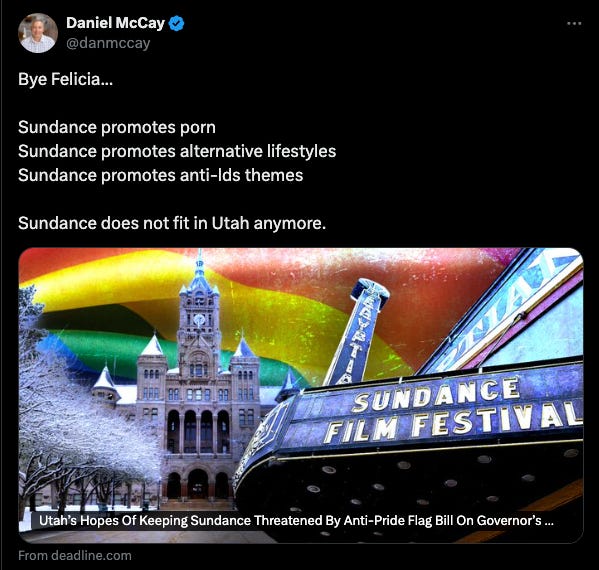
Let’s be crystal clear: This wasn’t a slip-up. This wasn’t some rogue intern on Dan McCay’s account. This was the cosponsor of the pride flag ban bill that helped push Sundance out of the state, gloating about the damage.
This wasn’t a coincidence.
It was the outcome of policies designed to exclude—and they worked.
This is how our own lawmakers sabotaged one of Utah’s most iconic and economically significant institutions.
Let’s Talk About “Alternative Lifestyles”
You know what’s spookier than any horror film at Sundance? Dan McCay’s obsession with “alternative lifestyles.”
We’d like a definition, Daniel. Go on. Say it with your whole chest.
Are we talking about:
LGBTQ+ Utahns?
Artists who don’t paint temples and mountains?
Unmarried women who drink cold brew and have opinions?
People who don’t go to church—or worse, go to the wrong church?
Men in eyeliner? Men who perform in drag? Men who... emote?
Folks who enjoy French cinema and aren’t afraid of subtitles?
Seriously, what does “alternative” mean in your book? Because from where we’re sitting, it sounds like you mean anyone who doesn’t fit your church-first, khakis-only, multi-level-marketing-core worldview.
It’s not just vague. It’s deliberate. “Alternative lifestyles” is dog whistle language—designed to draw a line between who belongs and who doesn’t. Between what’s “normal” and what’s “dangerous.” Between who gets the full protection of the state, and who can be casually tossed aside or targeted when it's politically convenient.
But here’s the truth: those “alternatives” are the reason Sundance exists.
They’re the filmmakers, volunteers, small business owners, shuttle drivers, bartenders, hotel staff, and midnight performers that make the festival — and the economy around it — hum. They’re not just in attendance. They are the infrastructure.
You want to know what doesn’t fit? Fanatical legislators who exclusively watch PG-rated movies through VidAngel and pass bills that scream, “We don’t want your kind,” while cashing checks from the very people they’re villainizing.
Let’s be blunt: this is bigotry in a poorly fitted Mr. Mac sports coat. It's extremism with a smile and a “golly gee” tone. And it’s driving away the very people who made Utah vibrant in the first place.
And on top of being deeply offensive, it’s economically idiotic.
If “alternative lifestyles” brought $132 million to Utah last year, maybe we should be building them a parade instead of banning their flags.
The $132 Million Mistake
Utah just walked away from $132 million annually.
That’s what the 2024 Sundance Film Festival brought to the state—in one year. According to Sundance’s own economic impact study, the festival generated:
$132 million in gross domestic product
1,730 Utah jobs
$69.7 million in wages
$13.8 million in state and local tax revenue
Nearly 73,000 attendees, one-third from out-of-state
That’s not just a win for Park City. That’s a win for every shuttle driver, bartender, Airbnb host, restaurant server, and local business owner.
About That $3.5 Million “Cost”...
After Dan McCay offended absolutely everyone who was different from him, he tried to spin the message that it was about the economy. Specifically, that the state was “spending” $3.5 million on it.

Let’s be very clear: that number was not a blank check.
It was economic development investment—a common and widely accepted strategy states use to keep high-impact events.
Cities pay for Super Bowls. States offer tax breaks to filmmakers. Utah is currently bending over backward to land the 2034 Olympics. Why? Because these events make money for everyone. You spend a little to make a lot. That’s not wasteful. That’s the economy, baby.
So when Dan McCay suggests that Sundance was “costing” us money? He’s either being misleading on purpose or has never read a tourism budget in his life.
We’re no economists, but let’s do the math: spend $3.5 million to keep an event that brings in $132 million in GDP and nearly $14 million in tax revenue? That’s not a “cost.” That’s a return on investment that even Wall Street would envy.
But instead of closing the deal, Utah leaders poisoned the well, legislating and tweeting their way out of one of the best investments we had.
Meanwhile... Spencer Cox and the Weird Ex-Boyfriend Energy
Let’s not forget the Governor in all of this. Governor Spencer Cox responded to the news with a statement that managed to be both noncommittal and deeply cringe:
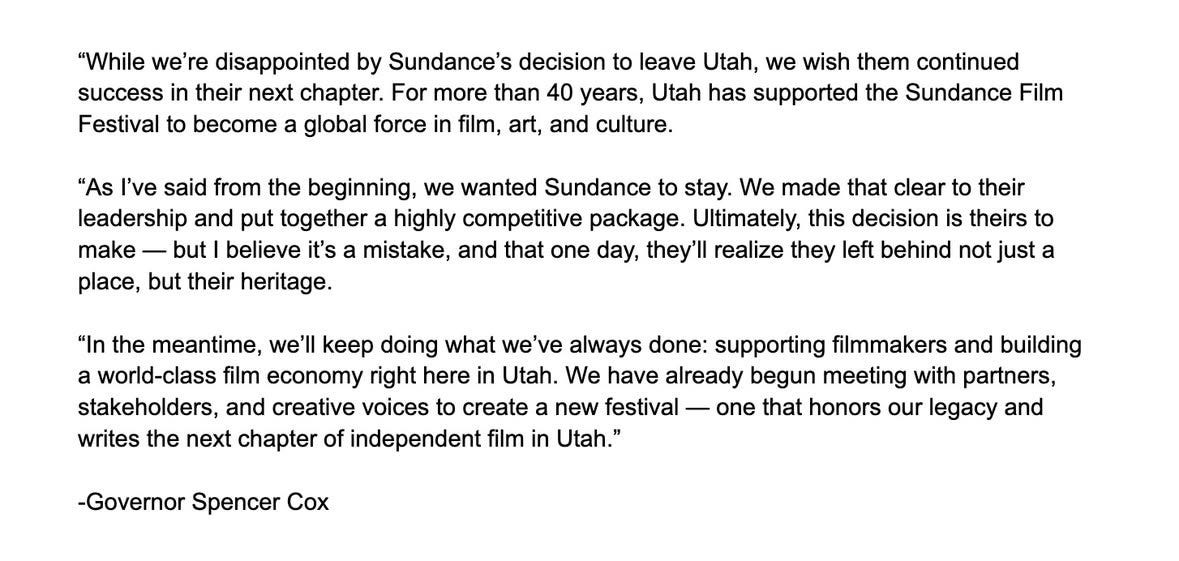
Sir. Please be serious.
It’s giving “Well, I didn’t want to be with you anyway” energy. Like Sundance packed its bags and Cox is on the porch yelling, “Good luck finding someone else who supported your indie short film phase!”
Heritage?? Come on. That’s a weird thing to say about a film festival. Especially one your party just chased off the mountain with flag bans and backhanded tweets.
Sundance may have lived in Utah for 40 years, but its identity was built by artists, not by geography. It doesn’t owe its soul to the state. And pretending that it does—while passing laws that actively reject everything Sundance stands for—is the most delusional ex-boyfriend behavior imaginable.
If the Legislature wanted to protect Sundance’s legacy, they would have fought for it. Not attacked it. Not mocked it. Not sabotaged it. You don’t get to claim “heritage” while slamming the door on the very people who built the thing. While trying to play moderate-in-chief, Cox stood by and watched his party torch the bridge.
This Isn’t the First Time
The Utah Cycle of Self-Sabotage:
Pass a wildly regressive policy.
Double down with public mockery.
Alienate a beloved national institution.
Watch millions in economic activity walk out the door.
Pretend it’s someone else’s fault.
Pretend that Utah Republicans are the ones saving our economy.
If this whole debacle is giving you déjà vu, you're not wrong. We’ve seen this Sundance-premiered movie before and spoiler alert: it doesn’t end well for Utah.
In 2017, Outdoor Retailer, one of the largest trade shows in the country, packed up and left the state because Utah politicians launched an ideological crusade against Bears Ears National Monument and public lands more broadly. Brands like Patagonia, REI, and The North Face said, “Yeah, no thanks,” and yanked their multimillion-dollar event out of Salt Lake. The estimated loss was about $45 million a year in economic activity.
Now, yes, Outdoor Retailer eventually limped back to Utah. The show is a shell of its former self. Many of the most iconic outdoor brands are still boycotting and making it very clear why.
And now we’ve added Sundance to the list. Another nationally respected, economically vital institution driven out by the Legislature’s obsession with punching left, even if it means punching Utah’s economy in the face.
So let’s call it what it is: a pattern. A toxic one. A self-defeating, self-sabotaging, deeply forced error that we keep committing in the name of some imagined culture war victory. It’s a strategy that values ideological purity over economic prosperity. One that sees inclusivity as a threat.
And it’s costing us. Again.
Brands notice. Investors notice. Artists, musicians, tech companies, and young people—they all notice. They watch our leaders tweet "Bye Felicia" at diversity and turn their backs on art and culture, and they don’t think, “Wow, what a principled stand.” They think:
“This is the place? Nah, this place isn’t worth it.”
What Boulder Offered—And Why They Won
Utah didn’t lose to Hollywood. We didn’t lose to New York. We didn’t even lose to Cincinnati (bless their hearts).
We lost to Boulder, a mid-sized mountain town with a population of just over 100,000. A college town. A bike-paths-and-bagels kind of place. And they absolutely wiped the floor with us.
Why? Because Boulder didn’t just offer logistical infrastructure. They offered alignment. Philosophically, politically, and culturally, they signaled that Sundance does belong there.
Here’s what they brought to the table:
A state government that sees the arts as an economic driver, not a liability.
Local leaders who didn’t pass a Pride flag ban mid-negotiation.
A legislative proposal for $34 million in tax credits to help Sundance grow.
A welcoming, engaged community that already supports year-round film and arts programming.
And no one—literally no one—tweeting in all caps about porn.
Meanwhile, Utah came in with $22 million on the table. And that’s the kicker. Utah’s bid was serious — a legit full-court press:
$5.53 million in public funding (from the state, city, and county)
$6.65 million in in-kind support (like shuttle services and venues)
$10 million in private fundraising
A tech conference partnership with $2.5 million attached
A dedicated SLC-to-Park City shuttle line
And a proposed 10-year commitment
...and then threw a moral panic about rainbow flags like it was 1987. We showed up with the money and the infrastructure — and then undercut our own offer with performative cruelty.
So yes, Boulder won. But let’s be honest — they didn’t have to fight that hard. Utah handed them the win.
This Is Bigger Than Sundance
This isn’t just about losing a film festival. It’s about what we’re telling the world.
That if you don’t fit a narrow, idealized 1950s mold, you’re not welcome. That culture is expendable. That $132 million annually isn’t worth tolerating a rainbow flag.
And that’s terrifying — not just for artists, but for small businesses, investors, tourists, and every Utahn who counts on Sundance season to stay afloat.
Because if even Sundance isn’t safe here, who is?
This didn’t happen because of traffic, snow, or oat milk preferences. Sundance left because Utah’s Republican supermajority made it impossible to stay.
That’s not just bad politics. That’s sabotage — ideological, economic, and cultural.
And you, dear taxpayer? You get to foot the bill.
So What Now?
We fight smarter.
We stop pretending this is normal.
We reject the myth that you have to choose between loving Utah’s values and loving its artists, entrepreneurs, and weirdos (shoutout to the weirdos—we love you most). And we continue to be loud and proud about who we are as Utahns with the “alternative lifestyles” that we love.
We stop pretending this was inevitable.
And we stop electing people who confuse cruelty with conviction.
We rebuild our reputation.
And we fight like hell for a Utah that’s vibrant, inclusive, and economically smart.
Because if we keep handing the mic to people like Dan McCay, we won’t just be a red state. We’ll be an empty one.
Want to Help Turn This Ship Around?
Get involved. And, support Elevate PAC.
Utah doesn’t have to keep sabotaging itself.
We can be smart and inclusive. We can have innovation and integrity. We can be true to our roots without turning our backs on each other. We can balance a budget without burning a bridge.
But only if we change who’s at the table.
If you enjoyed this post, consider a paid subscription with two bonus Substacks per month featuring exclusive content like:
Hot gossip, hotter takes, deep policy analysis, and the nerdiest data analysis and dashboards.
Your subscription supports Elevate PAC’s mission to bring balance to our state—because the GOP is ~clearly~ not going to rein itself in.
Elevate PAC is working to eliminate single-party control at all levels of our state’s government by elevating inspirational leaders, activating the new Utah majority, and centering our shared values and common purpose.
Our blueprint is to recruit and train candidates, invest early, support strategically, and build relationships.
Paid for by Elevate PAC
Sadly, this mirrors the national landscape.