

We covered the full HB88 backstory — Trevor Lee’s background, the committee hearing, the white nationalist/eugenics of it all, on our podcast episode. You can watch it on YouTube or listen on podcast apps.
This piece picks up where that recording ended, with some new developments. We would highly recommend listening to that for the full picture.
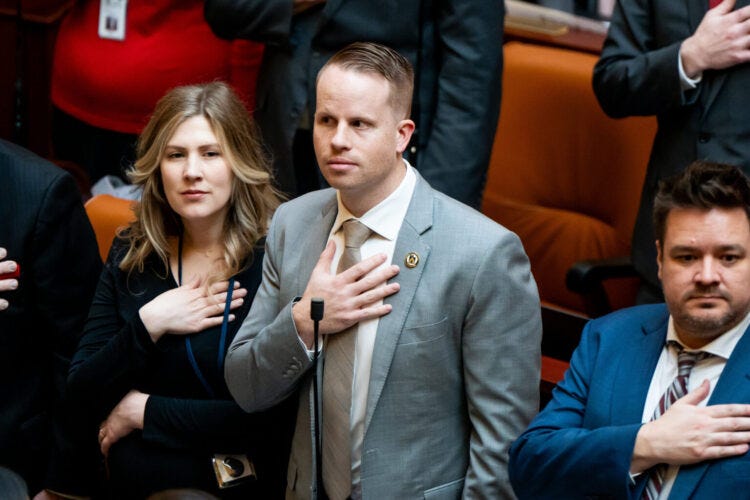
Trevor Lee’s L’s
Thankfully, Trevor Lee has not been having a great session.
His Harvey Milk → Charlie Kirk street naming bill hasn’t made it out of Rules. His Social Emotional Learning ban was killed in committee. His ivermectin bill died. His vaccine exemption bill died. His pregnant women parking pass bill — which he clarified was not about supporting women, but about Utah’s fertility crisis, because apparently the path to solving a fertility crisis is a closer parking spot— was held in committee. He had a perfectly fine voter registration bill that he somehow turned into a voter data-selling scheme on the floor, and the Senate killed it immediately — and we’ll be returning to that particular habit shortly. His bill that would have legalized hate crimes and discrimination against transgender Utahns and more – one of the most hateful pieces of legislation in the country – was watered down and then reassigned twice to other legislators because he was too toxic to its passage.
Which made HB88 — his signature immigration bill, the one he’s been nursing through seven substitutes all session — the win he needed. The thing that would make the rest of it worth something.
The bill has now been substituted seven times. The substitution process is, in part, a sign of bad legislating. Whether that means disagreement from legislators, technical mistakes, or confusion, it’s not a great sign. What HB88 has consistently done across those seven versions is strip existing exemptions from Utah’s immigration verification requirements — exemptions that currently allow state agencies to serve people regardless of immigration status for things like immunizations, crisis counseling, domestic violence shelters, food banks, and more.
Lee’s stated goal: “If we do our job and get rid of these incentives, then many will self-deport without us having to forcibly do it.”
At least he’s honest, and we’re clear on what this is.
The Human Cost Heard in Committee
As we discuss at length in the podcast, this bill is cruel. With the first iteration of this bill, the House committee hearing included devastating testimony such as:
A pediatrician described a child with cancer who loves Elephant and Piggy books and prays each night for a cure — currently receiving treatment through the CHIP program that Utah Republicans voted to create in 2023, and that this bill would end for children like him
A social worker asked: Where do I send an undocumented child who has been sexually abused? She didn’t get an answer
Emmy Gardner, CEO of Holy Cross Ministries (4,700 clients annually, 85%+ survivors of domestic violence, sexual assault, or trafficking), testified that the services this bill eliminates are the specific pathways out of those situations
A pediatrician noted that measles, whooping cough, and flu don’t check documentation, and that people exposed to heightened immigration enforcement are 12% less likely to accept vaccines
The kind of hearing where you leave needing to sit in your car for a while.
Lee’s response to the vaccine point: “If we’re so worried about these people needing our vaccines, they shouldn’t be here.”
Airtight. Moving on.
In the committee presentation, he didn’t spend much time discussing what the bill did and instead focused his entire argument through a fiscal lens, citing his statistics from a single FAIR report claiming a $931 million annual cost of “illegal immigration in Utah”.
We covered FAIR’s white supremacist and eugenics funding history and the report’s methodological problems extensively in the podcast. And that shit is genuinely crazy.
The First Floor Fight: “A Simple Bill to Clean Up Code”
HB88’s 5th substitute passed committee and hit the House floor. Lee introduced it — and I need you to appreciate this HILARIOUS joke he made, presenting it as “a simple bill to clean up code.”
On the floor, he released the 6th substitute, which had dropped the private right of action provision and removed the mental health care exemption. It also clarified that the bill no longer applied to minors.
A few Republicans moved amendments:
Rep. Clancy: made a change that child nutrition services should remain available regardless of status. That passed.
Rep. Snider: made a change that domestic violence services should remain available regardless of status. Also passed.
Rep. Cheryl Acton, a conservative, said she couldn’t believe they were “hiding behind a bureaucratic shield to deny people food” and called it a violation of the Sermon on the Mount.
Rep. Stoddard invoked the Statue of Liberty and reminded the chamber that undocumented immigrants were paying over $250 million into the state. “It’s not being born here that makes you an American. It’s an attitude. A desire.”
Rep. Dunnigan asked whether, under this new version of the bill, someone walking into a homeless shelter in a snowstorm would need to prove citizenship. Lee confirmed: yes.
Then Rep. Karen Peterson moved to circle the bill. Circling means the bill gets placed on hold on the board — the sponsor can bring it back later, but they don’t have to, and bills can quietly die there. It’s procedurally gentler than killing a bill outright, but it can accomplish the same thing. Peterson said her phone was blowing up with stakeholders — cities, counties, service providers — who hadn’t understood how this would hit them on senior meal programs, emergency services, and more. They needed more time to figure out what they were even dealing with.
Lee rejected the motion: “It would just be reason that they don’t want the bill to pass.”
Voice vote (everyone yells their vote to be the loudest). The yeses had it. The bill was circled.
There was a rumor, and then a genuine exhale across the building: we thought HB88 might actually die on the board. Trevor Lee’s signature bill would join the graveyard of his other work this session: the ivermectin dreams, the parking passes, hunters registering to vote, legal transgender hate crimes, all of it.
That exhale lasted about 72 hours.
The Zombie Bill
On Friday afternoon, we heard HB88 is coming back. Curiously, though, in another bill.
Enter HB386, Rep. Lisa Shepherd’s bill. It was genuinely fine, unglamorous legislation — repealing outdated guest worker program provisions that Utah had no legal authority to enforce anyway, the kind of thing that exists on the books because nobody got around to cleaning it up. It had passed committee unanimously.
On the House floor, Trevor Lee moved to substitute the contents of HB88 with language nearly identical to HB88’s 7th substitute into HB386. This version, while not as bad as the original versions, contains restrictions for undocumented immigrants for access to: resident tuition for qualifying students, state retirement benefits, housing loans, professional licensing, and scholarships for Utah high school graduates.
This was not Lee’s first attempt at this strategy. Earlier this session, he had a fine voter registration bill, also passed unanimously, and on the floor, he substituted in language allowing the Lieutenant Governor to contract with outside vendors to sell voter data. The Senate was so disgusted by that maneuver that they killed his bill in committee. And they gave him a (satisfying for us) verbal lashing while they were at it.
The Floor Debate
When Lee proposed the amendment, Rep. Jen Dailey-Provost (D) rose immediately:
“This amendment is nothing more than HB 88 sub[stitute] seven substituted into another bill and is not entirely germane. I am deeply opposed to HB 88 and offended that this bill would be substituted into another bill.”
Rep. Ray Ward asked Lee: if a child was brought here very young, has lived here their whole life, and is now in college, do they pay in-state tuition under this bill?
Lee: “If you are here and you do not have citizenship, you will not be able to receive a grant or tuition that is subsidized by the taxpayers.”
Ward: “So out-of-state tuition is much more expensive to the point that many of those students would have to drop out... The school would forego that tuition money... the state would lose that tuition money. It’s really clear to me that we’ve hurt that person. It’s not clear to me at all that we have benefited the rest of us.”
Lee, on who benefits from blocking these students from college: “Utahns would benefit from this, people like our own children who are paying a ton for their college.”
Then Rep. Hoang Nguyen stood up. Of her own admission, she doesn’t share her story often.
Nguyen is the first Vietnamese American and the first refugee ever elected to the Utah state legislature. Then she told the chamber what that meant:
Her family fled Vietnam after the war. Her father was killed on the street in Oakland when Hoang was five, robbed and murdered by two young men with a gun. Her mother was 35, with seven children between the ages of three and fifteen. They went on Medicaid, food stamps, and housing assistance. A cousin in Utah told her mother it was a better place to raise a family. In 1992, they moved to the west side of Salt Lake. Her mother saved enough to buy a small house in Glendale. Her older siblings sacrificed their educations to help raise the younger kids. She was one of the lucky ones — young enough to go to college, which she did on Pell Grants and in-state tuition.
“My family and I, through the grace of God, through the programs that were in place to get us through the hard time, have been able to create a business where we’ve employed thousands of Utahns.”
She talked about Utah’s record — leading the nation in economic mobility, the bottom 20% able to reach the top 20% over a lifetime, and said that didn’t happen by accident. It happened because of a specific Utah way: supporting your community regardless of where people came from.
“Utahns are one thing. Citizens are one thing. People is the first thing… I fear that what we’re doing here in Utah is eroding what truly makes Utah special.”
The Procedural Nightmare
Rep. Norm Thurston (R) moved to circle again. He said he’d been on the phone with the drafting attorneys of the bill throughout the debate and could not determine what the substitute actually did.
“There is a reasonable chance, colleagues, that this bill makes it easier for undocumented kids to get in-state tuition because we don’t know what it really does. There’s a reasonable chance that it makes it harder for undocumented kids to get in-state tuition because we don’t really know what it does. So if you’re gonna vote on this bill, you better figure out for yourself whether you’re voting to make it easier or harder for those kids. I don’t know.”
Lee rejected the motion to circle, along with Thurston’s concerns. He knew any delay meant this bill could die on the board with his precious HB88.
What followed: 4 minutes and 30 seconds of representatives voting, changing votes, leadership whipping the floor.
Initial tally: 34-29 to circle (Motion winning, we had hope, things might be okay)
Call of the house: absent members are physically located and brought back to vote (why they aren’t there in the first place, we do not know)
Tied 35-35 (cue team Elevate screaming at our computers)
Then two Representatives (Shallenberger and Welton) who were originally yeses, switched their votes to no (Maybe leadership got to them, maybe it was peer pressure, maybe it was threats of their legislation never getting funded. We don’t know, but certainly something happened)
Jordan Teuscher: 38th no vote
Motion to circle failed: 35-38.
So the bill lives, but it still has more votes. Back to the substitute. The Speaker ran a voice vote and ruled it passed this time. Division was called — meaning instead of yelling, they were going to take a recorded vote, on the board, on the record.
This vote went down in a similar way:
Initially- 27 yes, 29 no. (Hope again!)
Then: 30-30. (Screaming at computers, again)
Then 34-31. (Not looking good)
Then, ANOTHER call of the house (Unclear how they would’ve had time to leave since the last call of the house, but that’s neither here nor there)
Welton — who had voted against Lee on the circle motion — flipped again at the last second to vote for the substitute (he ultimately voted against the final bill, though).
The bill was substituted with a vote of 40-31.
Forty-five minutes to turn a unanimous bill into a partisan one.
And we are still not done. The House still had to vote on the bill itself (now including the new HB88). It went down similarly to the above votes, but I think we have covered that.
That vote passed 39-33.
At the end of floor time, when asked if the Minority Caucus had any announcements before they recess, Rep. Angela Romero was in tears:
“There’s nothing from the Minority Caucus, and I want people to be mindful when we discuss things here, how it impacts people in this body.”
Rep. Casey Snider continued to make jokes.
The Vote Breakdown
While the vote was open, you could watch legislators’ thinking play out in real time on the board. Votes going up, coming back down, going back up. That’s not typically entirely indecision. It’s also a text message. It’s a conversation happening on the floor. Sometimes it’s leadership moving people into line while the clock runs.
A few standouts worth noting.
Clancy and Snider both moved amendments to the original HB88 to make it less cruel — protecting child nutrition services, protecting domestic violence services. Then both voted for the substitute and the final bill anyway. Whether that’s pragmatism or cover is a question only they can answer.
On the other side, a handful of Republicans broke against their party on both votes: Acton, Albrecht, Ballard, Barlow, Cutler, Defay, Dunnigan, Eliason, Kohler, Loubet, Tracy Miller, Monson, Okerlund, Karen Peterson, Sawyer, Thurston, Ward, and Watkins — having 18 Republicans vote against a bill like this doesn’t happen all that often in a supermajority state.
Shallenberger and Welton originally registered as yes votes to circle the bill — meaning they initially supported pausing it — then switched to no before that vote closed. Shallenberger then voted yes on the substitute, moving the bill forward. Welton voted yes on the substitute but flipped to no on final passage.
Worth paying particular attention to the Republicans in competitive seats. Okerlund, Loubet, Dunnigan, and Eliason all voted no on both the substitute and final passage — a meaningful signal from members who have real electoral incentives to think about how this plays outside the caucus. Ivory, MacPherson, and Koford went the other direction, voting yes both times, despite also being in competitive seats.
The Hat Trick, Explained
HB386 — now carrying HB88’s 7th substitute like Rosemary’s Baby — goes to the Senate, where it will get a committee hearing likely early next week.
So, let’s recap what Trevor Lee accomplished this week.
He took a bill that was dying. He found a bill that was fine. He put the dying bill inside the fine bill and walked it onto the floor on day 38 of 45 — a vote where the people who drafted it couldn’t explain what it did, in a process where the Speaker made a procedural error, in a chamber where the computer froze mid-vote.
And it passed.
It wasn’t good legislating. It wasn’t a careful refinement of policy. And it wasn’t the product of broad agreement or newly resolved concerns. It was desperation.
This is a legislator who has lost every single match this session, finding a way to pawn his racist, hateful, irresponsible legislation off to someone else because his brand became too toxic. And it came with no acknowledgment of the people affected. No reflection. No pause. Just more tweets about “Heritage Americans” and warnings about the “consequences of incentivizing illegal immigration.”
The reason the original bill was struggling wasn’t the message and policy mechanics. It was honesty.
He said the goal was self-deportation. He said compassion stops at the door of irresponsibility. He didn’t wrap it in technical corrections or neutral fiscal language. He stood at the mic and told the chamber exactly what he was trying to do. And that honesty — clarifying as it is for those of us watching — made it genuinely harder to build a majority around the thing. You could see it on the floor. Some Republicans were uneasy. About the students who grew up here. About the professional licenses and housing pathways. About what it looks like to vote yes on something when the sponsor has already explained that the point is to make people leave.
This does not have to be what Utah politics looks like. There is no law requiring that we pass policy aimed at making people afraid, that harms the communities we’ve spent decades building, that costs the state money it doesn’t have to spend, in service of goals its own sponsor can’t defend with accurate numbers. We are choosing this. Some members chose it because they agree with it. Some chose it because they couldn’t stand up to their own party. Some — you could see it on their faces — chose it because the clock ran out before they could figure out what else to do.
The Senate has seen this move before. They killed his last bill over it. Whether they do it again is now the only real question.
You can find your Senator’s phone number here. They’re hearing from people who think this is perfectly reasonable. They should hear from people who don’t.
Contact your state senator before HB386 gets a committee hearing.
I really appreciate Ray Ward! His actions show genuine care and his questions you share here were very thoughtful and extremely relevant!
I was always pleased to vote for him when I lived in his district. I would love if Utah voted in more legislators like Ray Ward and less of the Trevor Lee sort!
Trevor Lee is an ignorant, hateful throwback to WW2 Germany. He is obviously held in contempt by his fellow legislators, as well as a good number of Utah’s citizenry. I pray that his Layton constituents wake up and get rid of him come election time. He is certainly wasting their tax dollars. I pray there are not that many low IQ haters in his district—he was elected simply by being white, republican and mormon.