

We know there has been no shortage of America 250 and Fourth of July takes this year.
But as we looked at this milestone, we wanted to say something anyway. Not because the country feels simple to celebrate right now. The line between full patriotism and full doom feels pretty thin these days, and neither one felt especially honest.
So we each wrote our own reflection. The three of us came at this from different places and different experiences, but we kept circling the same idea: loving a country does not mean pretending it has kept all of its promises. It means believing those promises still matter enough to fight over.
Jackie’s Reflection
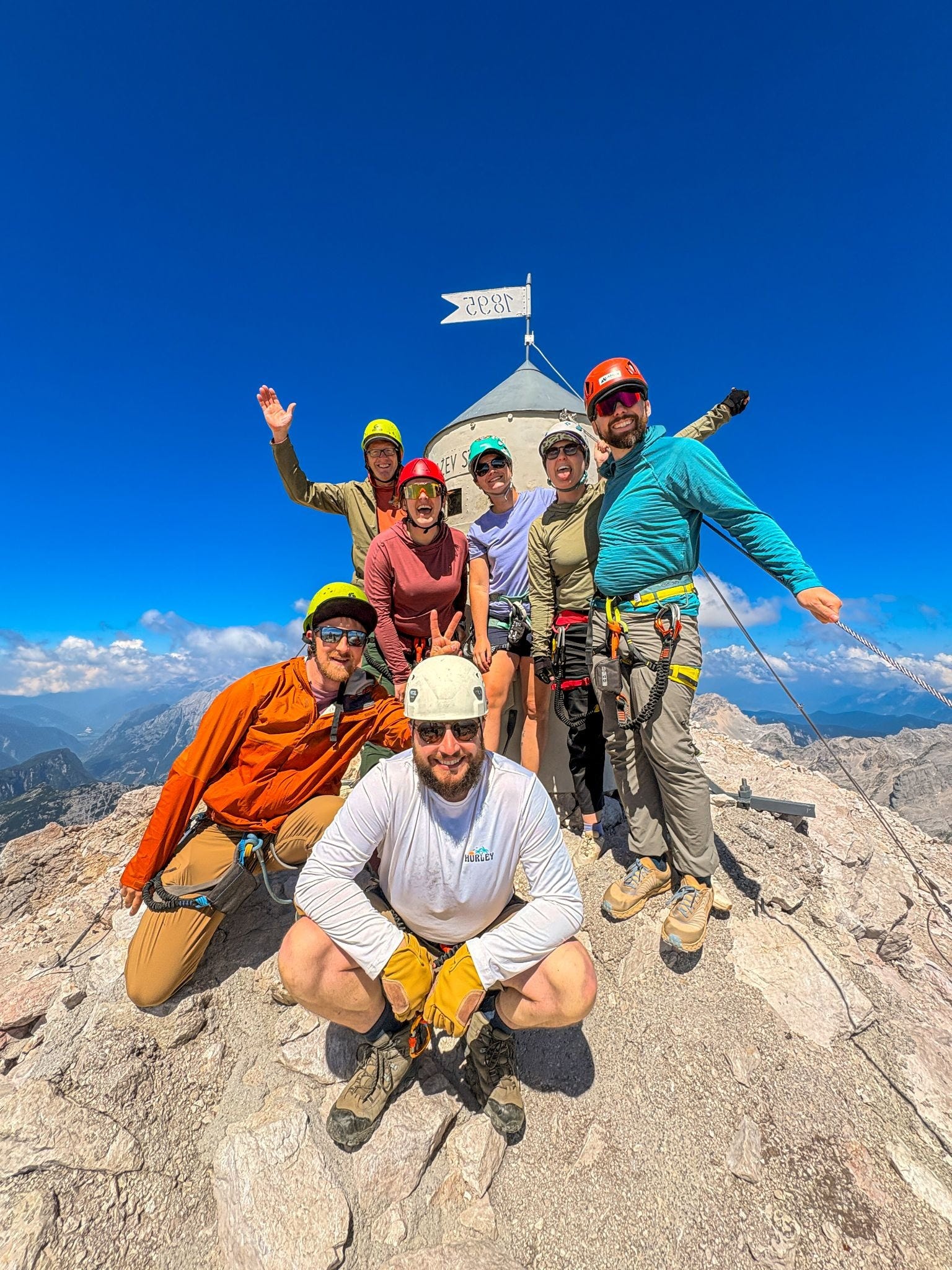
On July 3rd I flew home from Europe after a much needed vacation. And because I apparently don’t believe vacations should include rest, I’d spent part of the trip hiking Mount Triglav, the highest peak in Slovenia.
In Slovenia, there’s a saying that you have to climb Triglav once in your life to become a true Slovenian. It’s a national symbol, a real source of pride, and, as several Slovenians were eager to point out, a status not automatically granted to every Slovenian export. Melania Trump, for instance.
I hadn’t trained enough. It was a tough climb and yet I still made it. At the summit, I expected the usual mountain top things: a view, a photo, a snack. Instead I was met by a man playing the accordion.
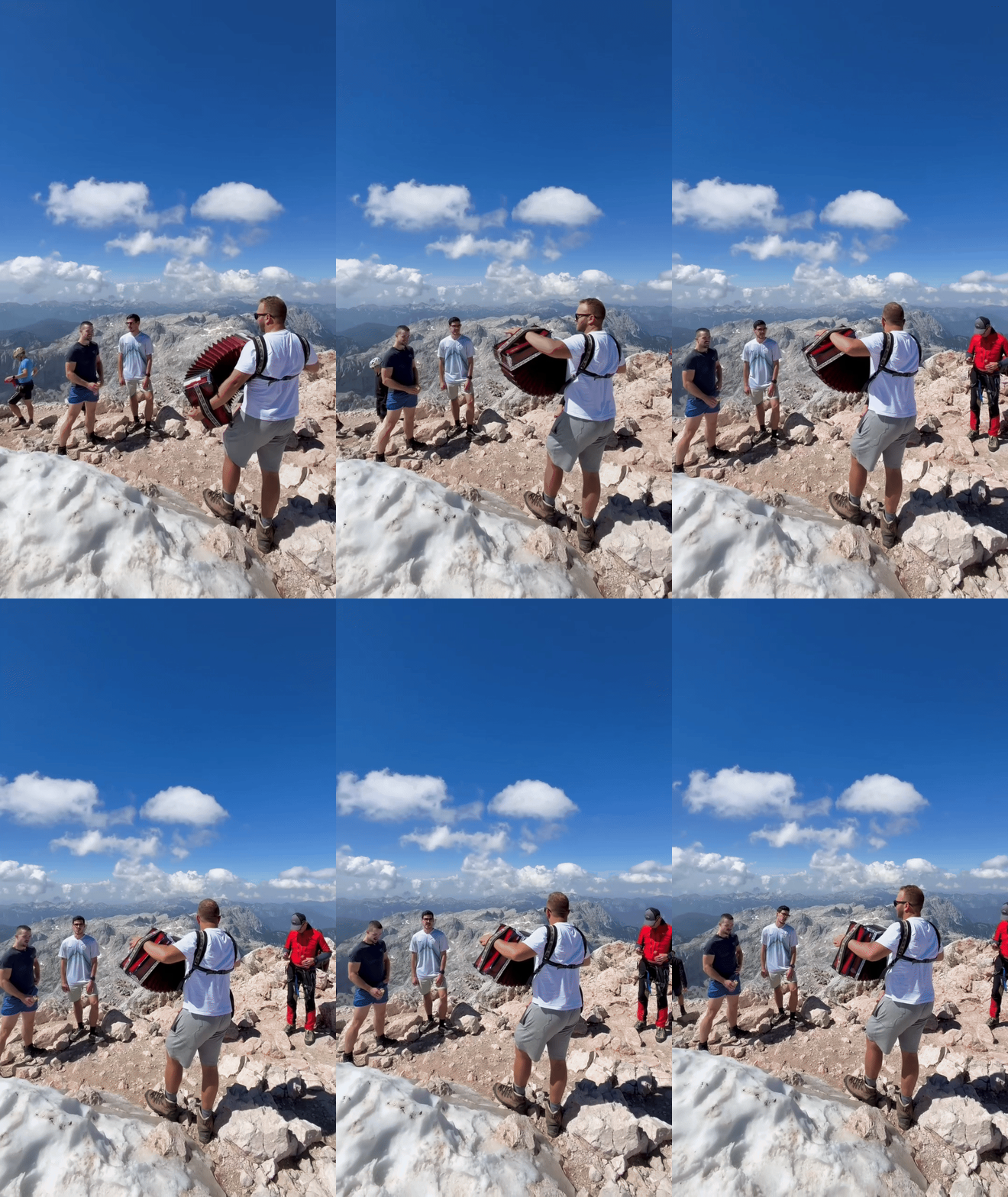
As someone who had barely carried herself to the top, I cannot overstate how impressive this was. He and his friends played Slovenian songs. They sang together, arms around each other, waving flags, passing around medica, a local honey liqueur, with shot glasses they’d also hauled up the mountain because why not once you have the accordion. A couple nearby took each other’s hands and danced.
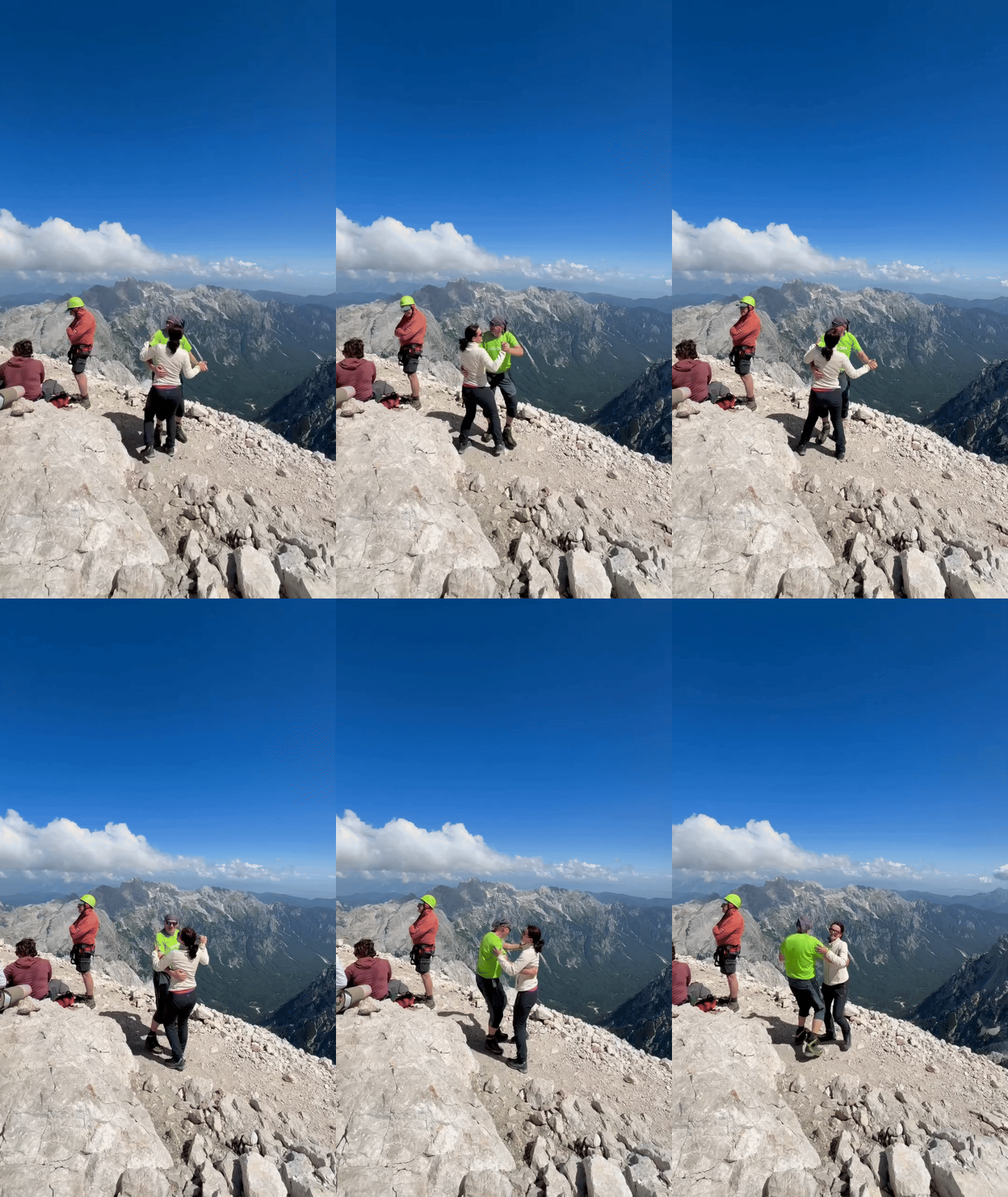
I got emotional. Watching them sing on the highest point in their country, I thought: this is what patriotism is supposed to feel like. They loved where they were from enough to climb something hard and beautiful and sing and dance about it at the top.
And frankly, I was jealous. Not because I wanted to be Slovenian, though they made a strong case. I wanted that same uncomplicated pride in my own country. I wanted to be the kind of person who could carry a flag and a warm PBR to a summit and sing “America the Beautiful” without also feeling like I needed to explain myself.
I want patriotism I’m proud of. Not the kind that asks me to ignore history, excuse cruelty, applaud corruption or corporations, or pretend the people yelling loudest about America are doing anything to make it better.
I want to love this country out loud. For me and for a lot of people, that feels hard right now. It’s hard to travel and get apologies or jokes when you say where you’re from.
Patriotism seems to have been flattened into performance of who can be loudest, fly the biggest flag, set off the biggest firework, say “freedom” the most times while doing the least to protect anyone else’s.
And then those same people tell the rest of us that criticizing the country means hating it.
I don’t hate it. That’s the problem.
I love this place enough to be heartbroken by it. I love Utah enough to be furious when people treat it like a resource to extract from instead of a place to protect.
The opposite of patriotism isn’t criticism. It’s abandonment. I’m not interested in abandoning this country to people who think loving it means never asking it to be better.
That’s what I kept thinking about on that mountain. The Triglav tradition isn’t just about standing somewhere beautiful. It’s really about the climb. Nobody hands you a flag at the bottom and tells you to feel something. You do the climb. You sweat. You complain. You keep going, with other people, and if you’re lucky, someone brings an accordion.
Maybe that’s the patriotism I can still believe in. Not the performance of patriotism. The effort.
We prefer the clean version of American history: hot dogs, apple pie, heroes already known, speeches already written. But nobody living through history knows how the chapter ends. Congresswoman Sarah McBride made this point well by saying: someone enslaved in the 1850s had no reason to think emancipation was coming. A worker in the early years of the Great Depression had never heard of a New Deal. Gay and trans people in the 1950s had no reason to believe they’d ever get to live openly and legally as themselves. They had every reason to give up, and yet people kept going anyway.
Neither did the suffragists. Neither did the labor organizers. Neither did the civil rights workers. Neither did the people who lost the first vote, the first lawsuit, the first campaign, and kept going anyway.
History only looks inevitable after someone else survives it. Which means if this moment feels confusing and unfinished, we’re not outside of history. We’re in it. And if we’re in it, we’re not just watching. We’re participants.
That’s what I want to remember on America’s 250th. Not because I feel uncomplicated pride. I don’t. Not because America has lived up to its promises. It hasn’t. But because there’s still something worth carrying. A version of this country that shows up in public libraries, national parks, and neighborhood parades. In election workers, firefighters, local reporters, and neighbors who share eggs over the fence.
That’s the country I want to love.
So no, I’m probably not climbing the Empire State Building with a flag and a PBR anytime soon. But I want a patriotism I’m not embarrassed to carry. One that can say this is broken and this is beautiful in the same breath, because love was never the same thing as approval.
Loving a country is like climbing a mountain you’re not fully prepared for. You don’t get to skip the hard parts. You climb because the view might still be worth it, because other people are climbing too, and because someone has to carry the music.
And when you get to the top, if you’re lucky, you remember that pride doesn’t have to be cruel, joy doesn’t have to be naive, and patriotism doesn’t have to belong to the loudest person with the biggest fireworks.
It can belong to the people still willing to do the work. It can belong to us.
Gabi’s Reflection:
Lawrence, Kansas, a small college town about 40 miles from Kansas City, became the Algerian national team’s official base camp for the World Cup. Nobody made them, but the municipal government and the local tourism board decided to fully adopt a team from a country that most of the town had likely never really thought about. They had a massive Algerian flag created in the grass of City Hall. They hosted public watch parties for every match until Algeria went out in the Round of 32. About 800 people showed up to watch that flag get raised, and the man who’d organized it said afterward that the crowd had goosebumps, that he’d never seen people that joyful over a ceremony, and that none of it was really about the flag or the game. It was the embrace of the community and trying to make the team from a small African nation feel as welcome as possible in a midwestern city.
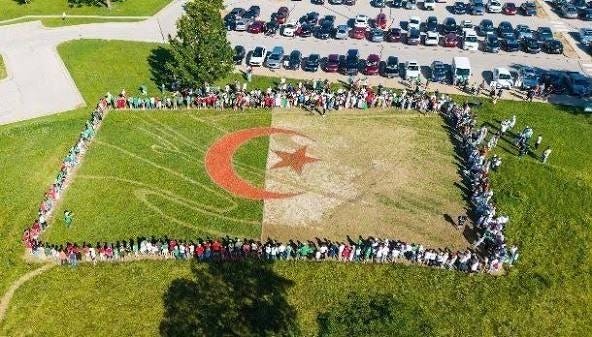
A town in Kansas learned to care about a country most of its residents couldn’t have pointed to on a map, and did it loudly enough that the players, the coaches, and the country noticed.
That’s the version of this country I’ve been watching this summer, and it’s the version I want to write about today.
Hosting the World Cup during America's 250th has produced some of the best evidence I've seen in years for what this country can be. I watched two Congo fans in a bar get pulled into a chorus of cheers by strangers in Mexico, Colombia, and Croatia jerseys when their team scored, none of them knowing each other's names, some of them not speaking the same first language, all of them deciding in the moment that a goal is a goal and joy doesn't have opponents. My friends in Boston have been sending me videos of them drinking the bars dry with the Scotts, learning Scottish phrases, and planning trips to go visit their new friends. Boston even got a new sister city: Glasgow.
And all over the country, I’ve watched immigrants and the children of immigrants wear the jersey of the place their family came from, in public, in the United States, because this country, whatever else it’s done to them or for them, is also the place that lets that be true, and they are what have made this country the best of what it can be.
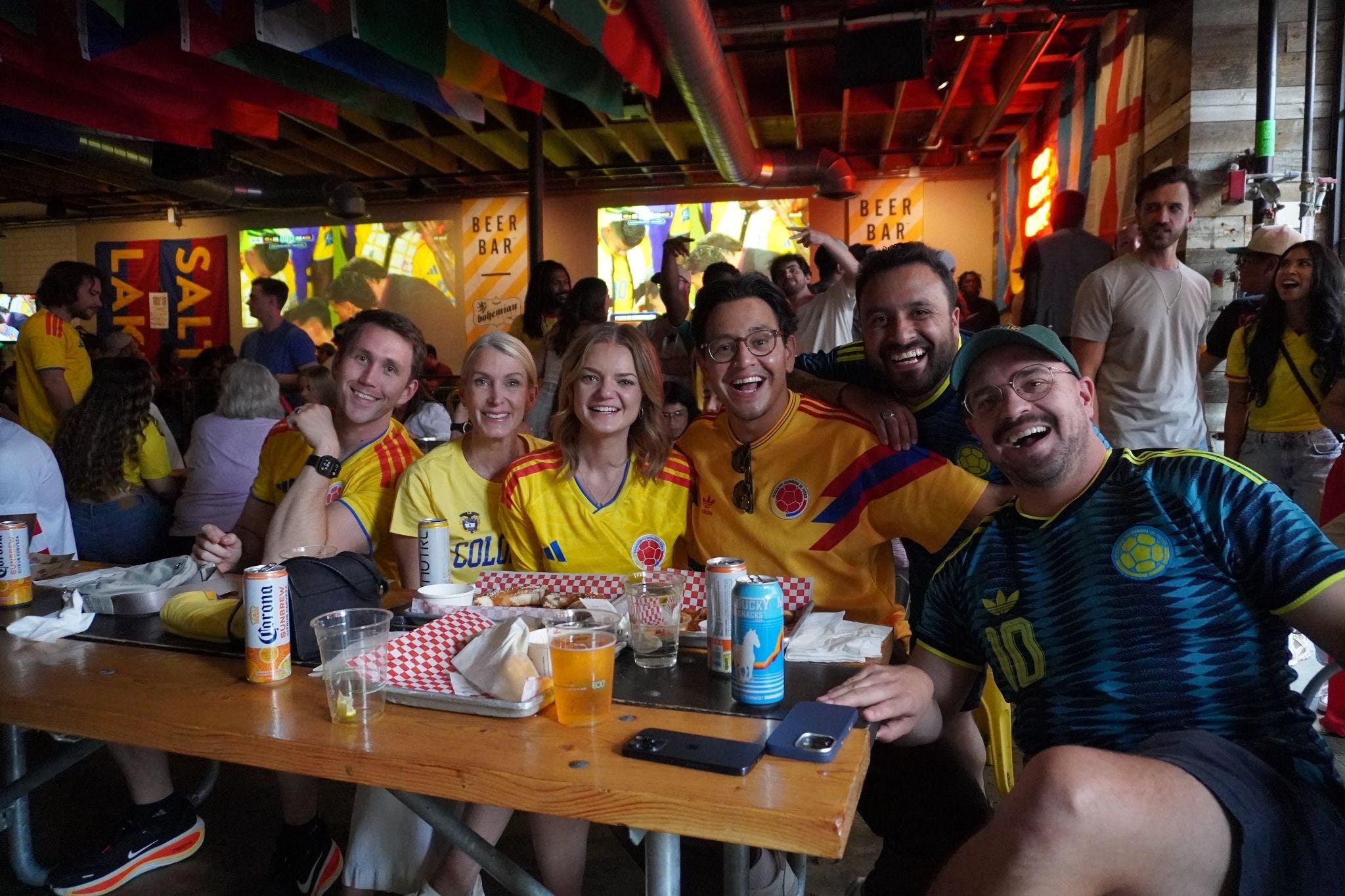
I’ve spent some rowdy and wonderful afternoons watching the Colombia men’s national team with my partner, who came to the U.S. from Colombia at eleven years old, at a bar in Salt Lake that fills up with yellow jerseys covered in butterflies each time they play. I’ve watched him find dozens of strangers who understand something about him instantly, and he them, without explanation, in a way that doesn’t happen for a lot of people who come here from somewhere else. I’ve watched the pride, the joy, the way total strangers look out for each other’s drinks and toes and flags. It’s a kind of belonging I don’t think I’d ever really seen up close before, and it’s made me think a lot about what I actually mean when I say I love this country, especially on the days I don’t feel it at all.
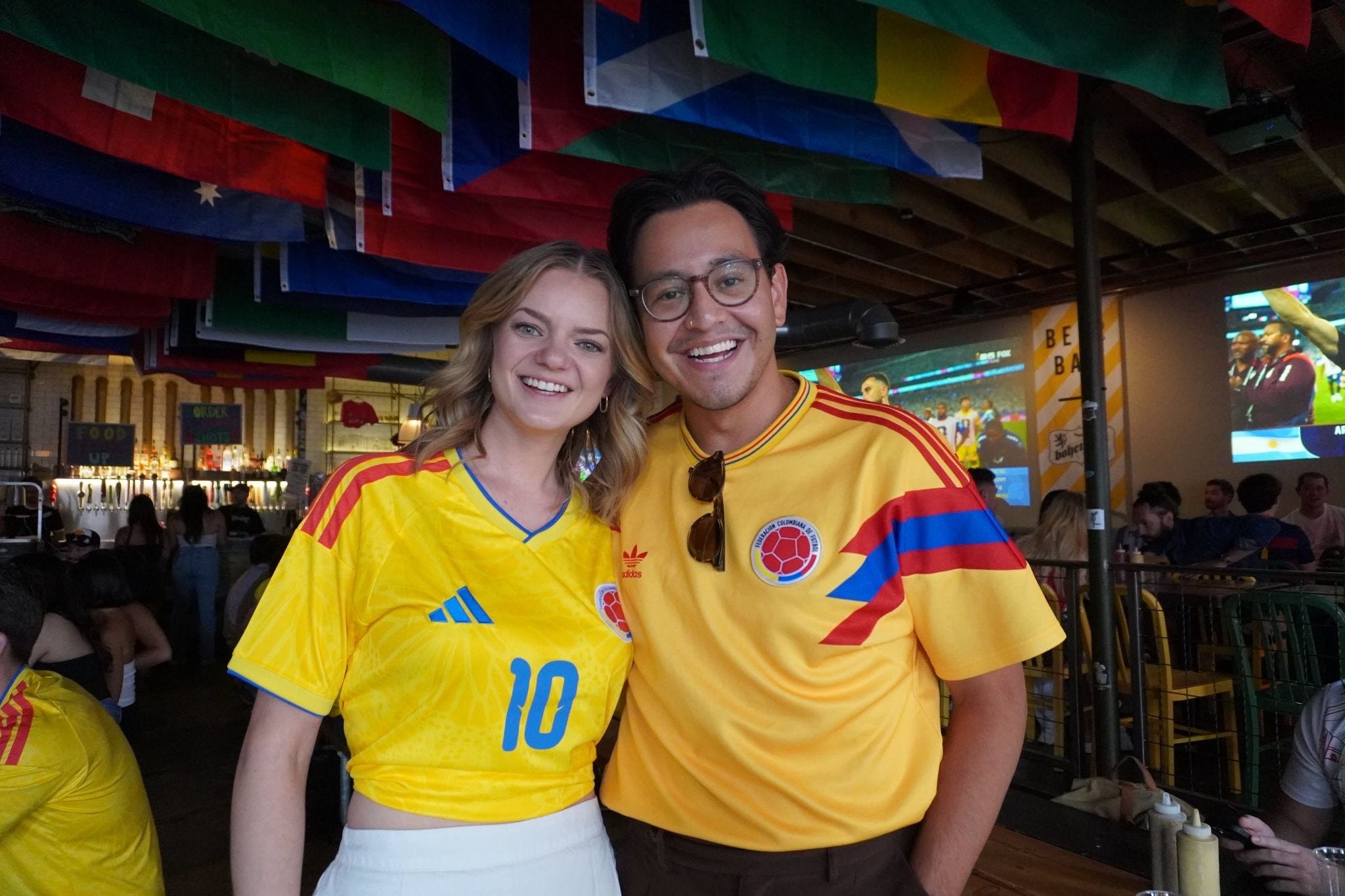
So when the U.S. men played on July 1st, I went looking for that same feeling. I wanted what he’d had at the Colombia games: pride, excitement, a room full of people who felt connected to something bigger than themselves.
Instead, I got a watch party that looked like a fraternity formal with a flag theme, and by the second half, I mostly felt embarrassed. Some of that isn’t fair to the room. I don’t know who anyone voted for, or whether they voted at all. But there’s a specific kind of anger that shows up when you watch people chant USA while the government currently running the USA is busy gutting the freedoms the chant is supposed to be about. “Freedom 250” hats worn by people who’ve never had to think about the two and a half centuries this country spent making sure freedom didn’t apply to everyone. Two of the goals that night were scored by players on the U.S. roster because of immigration and birthright citizenship, while the flag stitched onto their own kits is currently being used by a government trying to make sure that can’t happen again. And after the game, some Bosnia and Herzegovina fans told me they’d been booed and heckled for cheering for their own team, a few days after I’d watched fans from three continents adopt each other’s goals as their own.
The gap was impossible not to see. But I don’t think the gap is the story. I think the story is that both rooms exist in the same country, in the same week, and only one of them requires you to already belong to be welcome in it.
Two hundred and fifty years ago, fifty-six men signed a document that starts with a claim most of them didn’t actually believe applied to everyone in the room, let alone everyone in the colonies: We hold these truths to be self-evident, that all men are created equal, that they are endowed by their Creator with certain unalienable Rights, that among these are Life, Liberty and the pursuit of Happiness. They also wrote that governments exist to secure those rights, deriving their just powers from the consent of the governed, and that when a government stops doing that, it is the Right of the People to alter or to abolish it.
I love American history, and I love this document. I love it the way you love something you’ve actually read closely enough to argue with. And what gets lost every year, especially from people who want to wave it at protestors while ignoring what it says, is that it isn’t a monument. It’s an instruction manual for when things go wrong, written by people who had just decided their own government had gone wrong.
We’ve spent 250 years being a country that enslaved, displaced, imprisoned, deported, and legislated against the majority of the people living inside its borders. That’s not an unpatriotic thing to say on the Fourth of July. It’s the precondition for the actual patriotic thing, which is this: every real expansion of who gets to be free in this country came from people, not from the government handing it down out of generosity. Emancipation. Women’s suffrage. Civil rights. Workers rights. Marriage equality. None of it was a gift from Washington. It was extracted, argued, marched, and sued into existence by people the country wasn’t built to protect.
Sojourner Truth. Ida B. Wells. Inez Milholland, who collapsed on a suffrage stage and kept speaking, then died on the campaign trail before the 19th Amendment passed. Dolores Huerta, who spent decades building the farmworkers’ movement alongside Cesar Chavez and only this year told the country what he did to her, decades after the fact, at 95 years old, and is still standing. Zitkála-Šá, fighting for Native citizenship and sovereignty while being told she wasn’t American enough to have opinions about America. Martin Luther King Jr. Malcolm X, who wanted the same freedom by a different road. Sylvia Rivera and Marsha P. Johnson, two trans women of color who started a movement that eventually got us Jim Obergefell’s name on a Supreme Court case that made marriage equality the law of the country. None of these people waited for permission. All of them were told outright, by the government of the day, that what they were asking for wasn’t on offer. They asked anyway. Most of them didn’t live to see the answer.
That’s the founding principle nobody put on a hat this summer: when a long train of abuses and usurpations, pursuing invariably the same Object, evinces a design to reduce them under absolute Despotism, it is their right, it is their duty, to throw off such Government. The people who wrote that weren’t instructing future generations to sit quietly and trust the process. They were telling us what to do when the process stops working. Reading the Declaration closely, on purpose, on the day designed for flag-waving instead of reading, is itself a small act of taking the document more seriously than the people currently invoking it.
So here’s where I’ve landed, a few days removed from standing in a room that made me feel like a stranger in my own country. The America I actually believe in isn’t the one in the stadium chanting USA at people who came to cheer for their own team. It’s a Kansas town flying a flag most of its residents had never seen before, for a team almost nobody there had a personal reason to love, because loving it anyway was the whole point. It’s the bar full of butterflies and yellow jerseys where my loved one gets to be fully, proudly Colombian and fully at home at the same time. It’s fifty-six men who wrote something more radical than they were personally willing to live up to and left it lying around for the rest of us to finish. And it’s every name on that list above, and every name that never made it into a textbook, who did the work of making that promise real instead of waiting for someone in power to get around to it. We owe it to them not to let that work die.
From many, one. Not one man. Not one president. Not one party. One country, built and rebuilt over and over by people who refused to wait. That’s the version I’m celebrating this year. Happy Fourth.
Ben’s Reflection
I love the 4th of July. Still do. Growing up, with a birthday on January 3rd, I would celebrate in July.
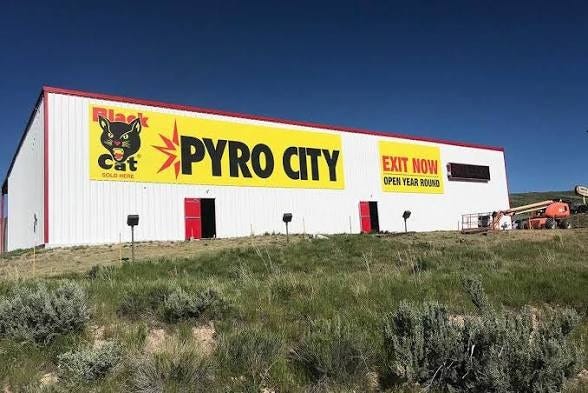
My dad used to drive me up to buy illegal fireworks, and then we’d put on what we called the “cul-de-sac of fire”. Those are some of my favorite memories: driving from American Fork to Evanston, Wyoming, playing the license plate game, walking into a giant warehouse of fireworks that seemed almost too cool to be real. As a kid, knowing I was breaking the rules with my dad gave the Fourth of July an excitement I do not think most kids got. We had to be careful on the drive back from Wyoming.
Later, Park City showed me it also knows how to go all out for the Fourth: the Canyons on the third, the parade and City Park on the fourth, then ending the day on the golf course watching fireworks with all your friends. It was the kind of holiday that made everything feel bigger and louder and more magical than normal life.
I learned to shoot bottle rockets out of a PVC pipe with the other dads in the neighborhood once everyone had gone to bed. There was a cop who lived down the street who looked out for us. He would use the lights on his city car to help everyone clean up before bedtime, which now feels like the most Utah version of law enforcement possible. We stuck smoke bombs in places they definitely did not belong, mostly in the name of science. And the best part was that, because of the 24th, we had the whole month of July to do fireworks.
So yes, I am a little conflicted about the fireworks ban.
Not because I think the ban is wrong. It is not. Please do not buy or light fireworks this year. Utah is too dry, too hot, and too flammable for anyone’s patriotic nostalgia to become a group project for firefighters.
But I am conflicted because I know what the Fourth of July feels like when fireworks are part of your childhood. I know how much people love the noise and the glow and the ritual of it. I know there is a real loss in having to say, “Not this year,” to something that has always been tradition.
And that is exactly why the ban matters. Loving a place means knowing when the tradition has to change. It means admitting that something can be a beloved childhood memory and still be a bad idea right now. Hope is not lighting the fuse and assuming someone else will handle the consequences. Hope is protecting the hillside so there is still somewhere beautiful to watch the sunset tomorrow.
As a reminder, if you see illegal fireworks, report them through your local non-emergency line or your city or county’s reporting form. If there is an active fire, injury, or immediate danger, call 911. Otherwise, let’s reserve emergency lines for actual emergencies.
But, in the middle of all of this, a Utah legislator told people to go ahead and light up anyway because he happens to own a fireworks company and a fire ban is bad for business. He has since walked these comments back, after backlash.
I’m writing this after watching Cape Verde almost beat Argentina, and celebrating Colombia winning and making it to the Round of 16. I’m watching Independence Day as I write my section for this piece.
250 years is a big deal. I moved my flight home to DC to spend the 4th in Salt Lake, because being in DC during the saddest fair known to America seemed like too much. We’ve come a long way as a country, and I feel like hope is hard to find these days. I’m a big believer that cynics are full of shit. I do not mean people who are scared, angry, exhausted, or realistic. Those are all reasonable responses to the current situation. I mean the people who confuse hopelessness with intelligence. The people who think sounding detached makes them sound smart. The people who have already decided nothing can get better and want everyone else to join them in the emotional basement.
We do not need more people who sound smart without any hope. We need people who believe something better is possible and are willing to act like it.
If I were 22, or freshly graduated from college, I would understand why it might feel impossible right now. I was talking to a dear friend the other day whose kid does not see the point. Why try? AI might take their job. Climate change might ruin their future. Politicians do not listen. Everything feels shaped by forces so far outside their control that effort can seem almost embarrassing. I get that.
But I also think giving up is exactly what the worst people are counting on.
I think America offers things no other country does, and I’d like to set the fascism aside for a second. Because yes — we’re on stolen land, built on genocide, and forced to say the Pledge of Allegiance every day as kids, which I can assure you is not normal. Things are grim, fully acknowledged. But there are still reasons to have hope.
So here are a few reasons I still believe in this country, even when it is testing me personally.
Hot dogs exist
People are still welcoming to strangers, despite what our government seems determined to prove.
Air conditioning
The World Cup (even though we’re the first host to bomb a country that’s participating in it while it’s happening)
Hollywood still has it. Going to see a movie in a theater remains one of the best things in the world.
Tex-Mex. Read this Japanese fan’s take on being in America for the World Cup (bottomless chips and salsa slap)
Going to Target
Portion sizes
A road trip or driving coast to coast, seeing the vastness of our country
However far apart our politics get, most people still want roughly the same things for their kids
There are still people trying to make it better despite everything
The list could be much longer, and honestly, I would love to hear what is keeping you hopeful right now.
But here is what I know: we are going to keep trying. We are going to keep telling the truth. We are going to keep showing up. We are going to keep fighting for a country and a state that can be better than this.
And sometimes, tragically, patriotism is not the fun thing. Sometimes it is not the giant box of fireworks from Wyoming. Sometimes it is not the bottle rocket in the PVC pipe. Sometimes it is not the cul-de-sac of fire, however iconic the branding may be.
Sometimes patriotism is doing the boring, responsible thing because the place you love is dry as hell and full of people, animals, homes, hillsides, firefighters, and memories worth protecting.
That is not anti-fun. That is pro-future-fun. So yes, I still love the Fourth of July. I still love the hot dogs, the movies, the parades, the World Cup, the road trips, Target, and the fact that most people, despite everything, are still trying to build a life with each other.
Happy Fourth of July. Happy America 250.
Thanks to all of you! All the points are presented well. It is not politicians that are the backbone of any country. It is not the wealthy either. It is the general population of the country that work together, have fun together, and recognize that having an open heart and an open mind allows us to love each other and bridge our differences for most of have the same goals.
Teared up, Gabi. So well said.