

There’s a version of rural Utah that Governor Spencer Cox loves to talk about.
Small towns. Family farms. Hay bales. A tractor in soft lighting. A wholesome Ballerina-Farm-fantasy where everyone has sourdough starter, pioneer grit, and no inconvenient questions about water rights. Maybe a child running through Cox’s alfalfa fields while someone off-camera whispers, “Yes, perfect, now look more values-based.” The campaign-ad Americana that never really existed in the first place.
That rural Utah is really useful for politicians. That’s Spencer Cox’s Utah.
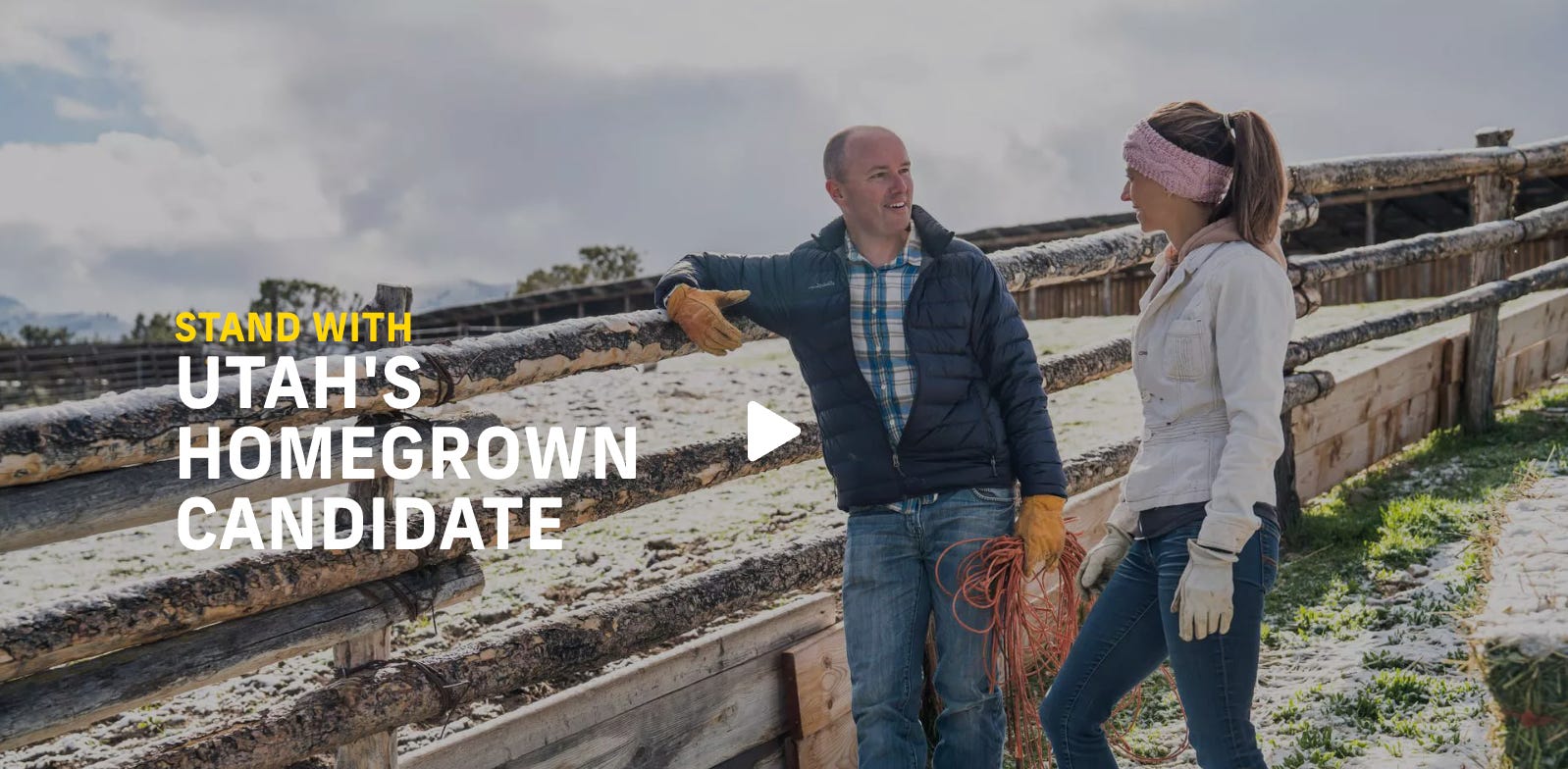
But then there’s the Utah that got handed a data center. You know, the one with actual wells, actual lungs, actual bills, actual farms, actual kids, and actual consequences. The one that has to live downstream from decisions made by people who call it “economic development” when what they really mean is “we already made the deal, so let’s all just disagree better now.”
This week, more than a thousand people packed the Box Elder County Fairgrounds after learning that a 40,000-acre natural gas data center — bigger than Manhattan, powered by a private gas pipeline, and sitting directly on the Great Salt Lake watershed — had already been approved and just needed to be rubber-stamped by the Box Elder County commission.
The commissioners voted yes, then fled through a side door.
And just like that, rural Utah went from sacred political symbol to inconvenient obstacle. Funny how fast that happens.
Meet the 40,000-Acre, Gas-Powered Elephant
The Stratos Project is a proposed 40,000-acre hyperscale data center campus in unincorporated Box Elder County — on land that is part of the ancestral territory of the Northwestern Band of the Shoshone Nation. The project is backed by Kevin O’Leary — Shark Tank‘s “Mr. Wonderful”: investor in cat DNA testing and wine for dogs, recent Timothée Chalamet co-star, and whose personal brand is asking entrepreneurs on TV why they haven’t monetized their own grandmother yet. He is now the man who wants to permanently reshape northern Utah’s water and energy landscape. Diversified portfolio, Kev.
At full buildout, Stratos would generate 9 gigawatts of power. Utah – the entire state of Utah – currently uses about 4. Very casual. Very “just popping by with a few servers and the power demands of a small nation.”
It would run entirely off the public grid, powered by natural gas — meaning one private development would more than double the state’s entire energy footprint. According to University of Utah atmospheric sciences professor Kevin Perry, that’s a 50% increase in Utah’s carbon emissions.
It sits directly on the Great Salt Lake watershed — you already know, the lake that has already lost roughly half its surface area, whose exposed lakebed releases toxic dust into the air people breathe, and toward which Utah has directed a billion dollars in restoration funding that still hasn’t been enough.
The MIDA Touch
Utah’s Military Installation Development Authority (MIDA) is a state agency created to support economic development around military bases. Very official and acronym-y. The kind of thing you assume exists for reasons involving spreadsheets, land use, and some guy probably named Brad.
But MIDA is not some sleepy little board that meets quarterly to discuss parking lots near Hill Air Force Base.
Its board is appointed, not elected. The governor appoints five members (even though he said he “thought” he only appointed one), and the Senate president and the Speaker of the House each appoints one board member. And the Senate president (more on him later) currently chairs the same board he helps appoint.
Cozy little setup, no?
MIDA can issue bonds, approve development agreements, offer tax incentives, and steer hundreds of millions in public financing into private projects, all without a single public vote. It wields enormous power and operates with limited public accountability, which makes it very useful if you’re trying to move quickly on something that might not survive public scrutiny.
On April 24, MIDA’s board approved the Stratos Project. They granted O’Leary Digital a 92% cut on the standard energy use tax — from 6% down to 0.5% — and structured the property taxes so that 80% flows back to the developer. The public upside MIDA touts is $30 million a year for Box Elder County and hundreds of jobs once the project is running. The private upside is considerably larger, and it goes to a Canadian TV personality billionaire, whose job, until recently, was telling cupcake companies they were overvalued.
Meanwhile, the Box Elder County commissioners — who had to sign off for the project to proceed — said they first heard about it through “rumors” during the last legislative session. They were then given days to decide on a multi-billion-dollar project affecting the Great Salt Lake watershed.
But that didn’t slow down our cowboy-hat-wearing commissioners! They heard “rumors,” received “days,” saw “massive irreversible industrial development,” and said, “Well, saddle up.”
No shade to cowboys or their hats. Tremendous shade to whatever the hell this process was.
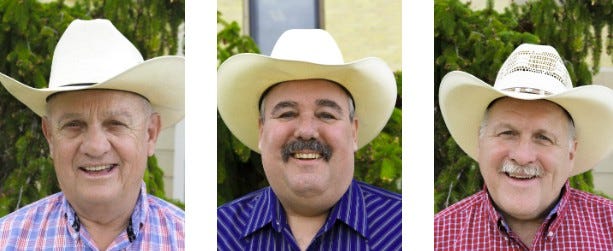
At the commission meeting on May 4, Commissioner Lee Perry (middle cowboy) said that the decision had “nothing to do with water or air quality” because those issues are handled at the state level.
Huh. A vote on a 40,000-acre natural gas facility on the Great Salt Lake watershed that would massively increase carbon emissions had nothing to do with water or air quality?? Those, apparently, are someone else’s problem. The commissioners were just there to hold the door open. And then, fittingly, left the meeting through a side door.
Farmers, Doctors, Professors, and Other Alleged Agitators
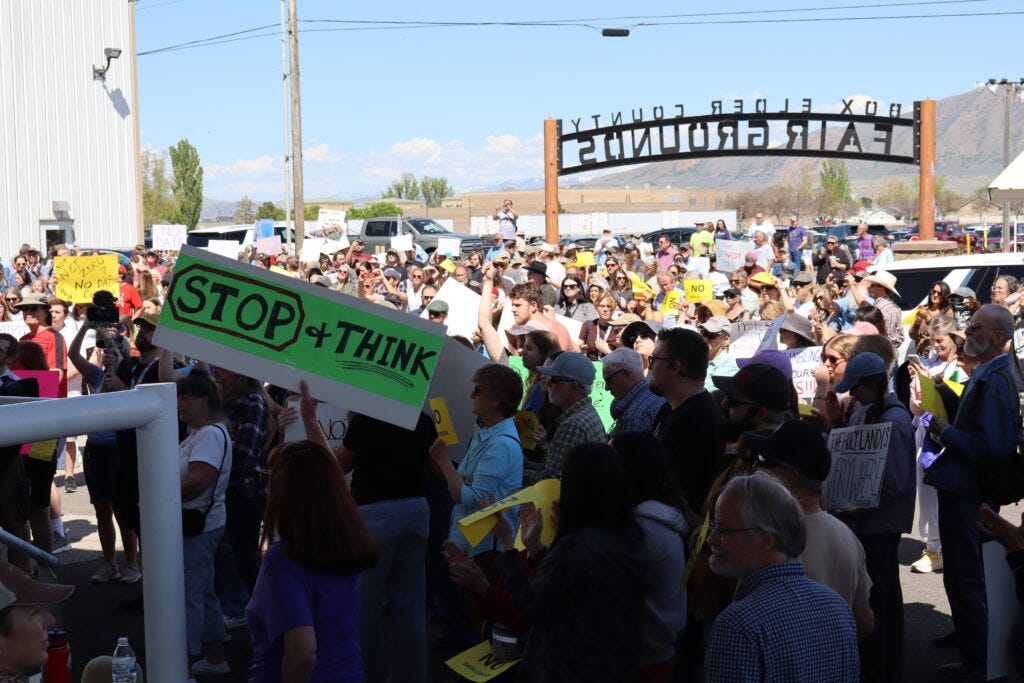
In the ten days between when this project became public and when the final vote happened, Utah did what Utah does when it pays attention: it showed up.
Eighty people packed the first meeting on almost no notice. By the second meeting, 1,100 had filled the Box Elder County fairgrounds after rallying outside. Over 3,700 formal protests have been filed with the Utah Division of Water Rights, which cost $15 each. Utah Physicians for Healthy Environment stood on the Capitol steps and called the approval process “highly suspicious.” Native American activist Darren Parry compared it to the Nevada nuclear tests: decisions made by a small group, consequences borne by everyone else, for generations.
Scientists have been equally clear. MIDA claimed the 3-gigawatt first phase would use just 24 acre-feet of water. USU physics professor Robert Davies ran the numbers and found that it would make Stratos 97% more water-efficient than the most efficient gas plant in the United States. So, either the laws of thermodynamics have been quietly repealed somewhere between Shark Tank tapings, or someone isn’t being straight. Another USU professor, Patrick Belmont, said the project would wipe out every restoration gain Utah has made on the Great Salt Lake.
There is no completed environmental impact analysis. The project was approved before it was required. The commissioners voted and said the environmental review would happen later, at some point, but they weren’t sure when.
Kevin O’Leary responded with the subtlety and emotional intelligence of a man who has spent years telling small business owners their dreams are stupid on national television. He posted a video claiming 90% of protesters were paid out-of-state agitators being bused in. He provided no evidence unless “trust me, I’m rich” counts as a source now, which, in economic development circles, it sometimes appears to.
He also claimed the facility would be powered partly by “solar, wind, and batteries.” It is powered entirely by natural gas. This location was chosen because of its proximity to natural gas pipelines. He added that he is “the only developer of data centers on Earth that graduated from environmental studies,” which is an incredible sentence because it manages to be both irrelevant and smug, the Shark Tank house blend.
Two false claims and one impressive non sequitur, from the man who received a 92% tax discount from the state of Utah. Mr. Wonderful, indeed.
Old MacCox Had a Farm, E-I-E-I-Oops
Alleged alfalfa farmer and confirmed Governor of Utah, Spencer Cox, kicked off his April 30 press conference acknowledging that 100% of Utah is in drought, 59% of it extreme, and that the Great Salt Lake is still not recovering fast enough. Then he called the scientists and residents raising concerns about a natural gas facility on the Great Salt Lake watershed, “people operating off of models and technologies that have changed drastically,” and dismissed their concerns as “disinformation.”
He also said this:
“We’ve let the people against virtually everything destroy our country, destroy our industrial base, destroy our mining base, destroy our housing base, because we can’t build anything in this country anymore. And those days are over.”
The people he was describing drove many miles on a work night to a fairground in Tremonton. They were farmers, ranchers, doctors, professors, parents, and everyday Utahns. They are not against everything. They are against this specific thing, for specific documented reasons, and the governor of Utah called them a threat to the country.
So why, you might ask, is the Governor throwing a temper tantrum over a project he has no say over? So glad you asked.
Originally reported by the Salt Lake Tribune in 2024, Cox’s family founded and ran CentraCom, a telecommunications company based in Fairview, for generations. He served as VP and general counsel there before entering politics in 2013. The company was sold to LICT Corporation in 2001, but family members, including his father and cousin, have continued to manage it. Since Cox entered politics, CentraCom has expanded its fiber network from roughly 900 miles to over 2,400 miles, becoming the second-largest fiber network in the state. The Tribune reported that CentraCom’s growth has tracked closely with Cox’s political rise.
CentraCom has already connected Utah’s major data centers to its fiber network. MIDA’s own executive director cited the Stratos site’s “redundant fiber availability” as a key selling point for the location. Hyperscale data centers don’t just need power and water. They need fiber — lots of it. Simultaneously, CentraCom has been actively expanding its rural fiber footprint across Utah, including in the kinds of remote rural areas where projects like Stratos get built.
To be extremely, legally, please-do-not-send-us-a-letter clear: we are not claiming a conspiracy, illegality, or even a contract exists between CentraCom and Stratos. None has been announced.
We are saying that when the governor’s family-linked telecommunications company is structurally positioned to potentially, maybe benefit from the kind of rural fiber infrastructure a project like this needs, and the governor is also out here scolding actual rural Utahns for asking questions about the project, it is fair to raise an eyebrow. Maybe even both eyebrows.
This is the problem with Spencer Cox’s rural Utah brand. It works beautifully as long as rural Utah stays symbolic.
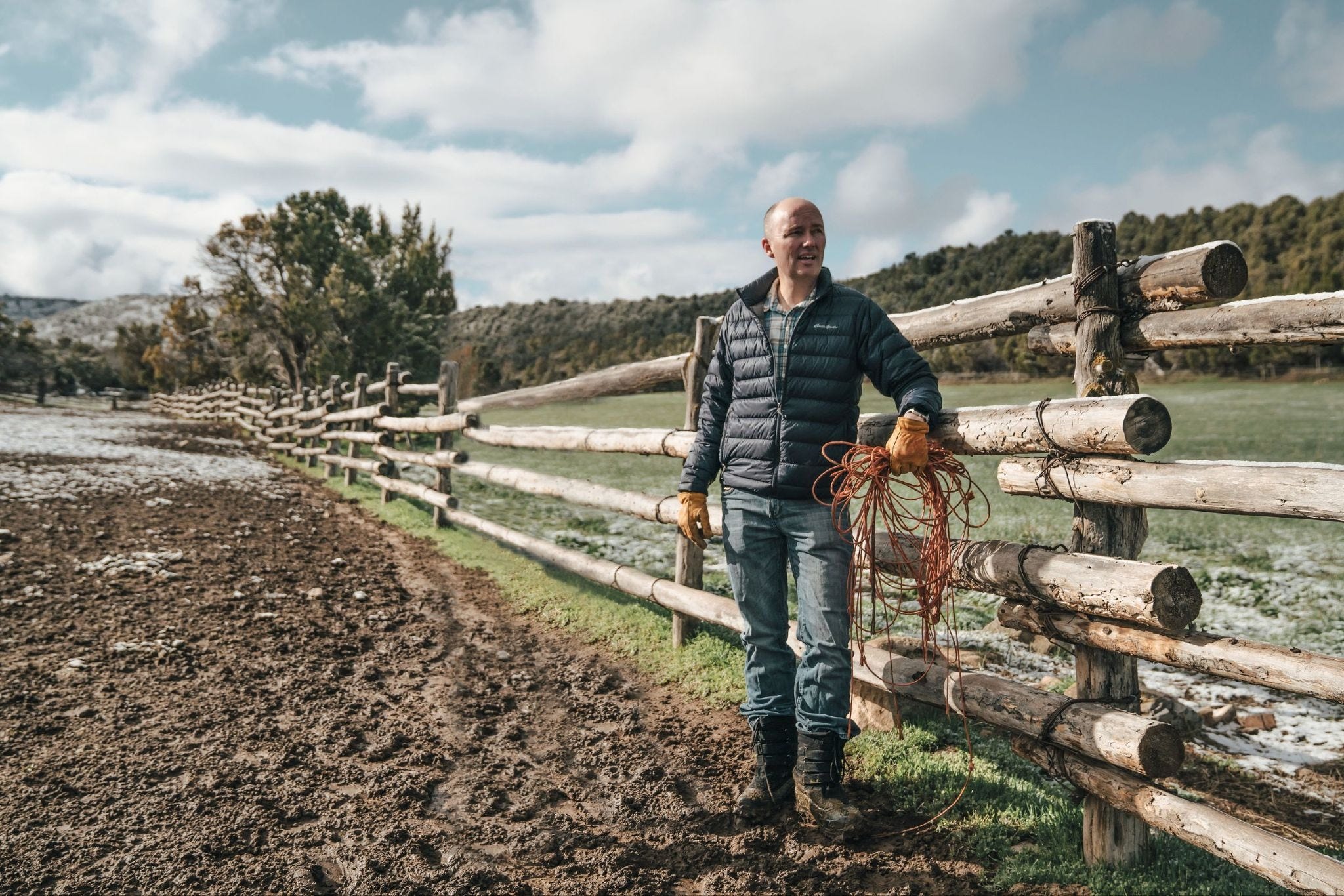
Rural Utah as origin story? Perfect.
Rural Utah as campaign backdrop? Gorgeous.
Rural Utah as proof that he understands “real people”? Ugh, yes. Put it in the ad. Get the rope and those brand new work gloves for Spenc, stat!
Rural Utah as actual people with water rights, land, lungs, questions, and the audacity to disagree with a billionaire-backed project? Suddenly, they’re “misinformed.”
How dare they confuse living there with understanding it?
Who Among Us Has Not Received $135,000 From Interested Parties?
As you might recall, Stuart Adams chairs MIDA. He is also the Utah Senate President and currently in the fight of his political life — his first-ever primary election, against two Republican challengers.
On April 24, Adams, chairing the MIDA board, approved Stratos. They issued a statement calling it a project that “supports the free world.” Quite a spin for a 40,000-acre gas-powered data center in Box Elder County, Utah, but sure, Captain America, save the day with server racks.
And by what can only be chalked up to pure coincidence, seven days later, five entities with business before MIDA made donations totaling $135,000 to his political action committee — all on the same day. As Utah Political Watch reported, these are the five largest donations in the Adams Leadership PAC’s six-year history. Combined, they nearly doubled the PAC’s existing cash on hand. The donors are tied to MIDA-overseen projects at Deer Valley and Jordanelle — not to the O’Leary deal specifically. Utah Political Watch is careful to note that there is no direct evidence linking the donations to the data center approval.
Just a tiny, little, bitty, $135,000 coincidence. Barely worth noticing. Please avert your eyes from the giant money piñata.
So to put a bow on it, the Senate President and chair of an agency with enormous power over development in Utah, approved a major project meant to be kept under wraps. One week later, companies with business before that same agency wrote the largest checks in his PAC’s history. Adams is in a primary he needs to win. Utah law permits him to transfer PAC funds directly to his campaign. If he does, as Utah Political Watch notes, MIDA-connected donors will have effectively financed his political survival.
Just a very clean, very legal, very Utah-shaped structure where the people making development decisions can also raise money from people with business before the development board they chair. Cool system. Working exactly as it was designed to work for the people who designed it.
Congratulations, You’re a Water Rights Advocate Now
The county commission vote was round one. The fight is not over.
The project still has to clear water rights approval, where 3,700+ formal protests have already been filed. It needs environmental permits. It faces potential litigation. MIDA is required to form a public design review committee with public meetings at every phase.
So what we’re saying is: there is still so much bureaucratic fun to be had. The outrage and the attention need to stay in motion. Here’s where to direct it:
Sign Alliance for a Better Utah’s petition calling on the Senate Ethics Committee to investigate Senate President Adams. As Better Utah pointed out, this is not the first time Adams has used his position of power for personal gain. And here’s the important part: the Senate Ethics Committee is one of the rare legislative committees that is evenly balanced by party. That means Democrats on the committee have real power here. Maybe a tiny miracle?
You can also reach out to the Senate Ethics Committee members directly and ask them to investigate Adams’ role in MIDA, the timing of the PAC donations, and whether Utah’s current ethics rules are remotely adequate for this level of overlap:
Sen. Ann Millner (R), Chair – 801-900-3897; amillner@le.utah.gov
Sen. Luz Escamilla (D), Vice Chair – 801-550-6434; lescamilla@le.utah.gov
Sen. Keith Grover (R) – 801-319-0170; keithgrover@le.utah.gov
Sen. Karen Kwan (D) – 385-249-0683; kkwan@le.utah.gov
Sen. Michael K. McKell (R) – 801-210-1495; 801-798-9000; mmckell@le.utah.gov
Sen. Jen Plumb (D) – 801-870-0228; 801-870-0228; jplumb@le.utah.gov
Sen. Kathleen A. Riebe (D) – 801-599-5753; 385-222-1742; kriebe@le.utah.gov
Sen. Scott D. Sandall (R) – 435-279-7551; ssandall@le.utah.gov
Contact your state legislators. MIDA is a state authority, and the legislature has oversight power. Ask them why an unelected agency was able to approve something this consequential before the affected county knew it existed. Ask what accountability mechanisms exist. Ask why there aren’t more. Ask why they aren’t already doing something about it. Ask them how this squares with the resolution they passed after Trump said that we need to, and we’re quoting here both from the resolution and, ahem, a Truth Social post, make “the Great Salt Lake Great Again.”
Because if they are going to put that phrase into an actual legislative resolution, they can answer why a massive gas-powered data center on the Great Salt Lake watershed got rushed through before the public could meaningfully weigh in.
Track the water rights process. The Utah Division of Water Rights is where the next real fight happens. File a protest if you haven’t. It costs $15, because even civic resistance now comes with a processing fee. Make them answer the questions the county commissioners didn’t have to.
Keep showing up to MIDA’s public meetings. They’re required to hold them. Fill the room every time. Bring your friends.
This is the Utah we actually love.
Not the one with the tractor in soft lighting and the alfalfa fields arranged neatly around a politician’s origin story. Not the one where rural communities are praised in speeches and then managed around when a billionaire-backed project shows up.
The real Utah is messier and better than that.
It is people who disagree on plenty but still understand that water is not a partisan issue. Air is not a partisan issue. The Great Salt Lake is not a partisan issue. And being able to trust that massive decisions are not being made for us before we even know they exist should not be a partisan issue.
That is what makes this so insulting.
They keep selling a version of Utah built on family, land, faith, stewardship, and community, while running a government that too often works like a members-only club for the well-connected and well-off.
But the rest of us live here, too. We breathe the air. We pay the taxes. We raise the kids. We drive past the lake and wonder if it will still be there when they grow up.
That Utah deserves more than side doors, sweetheart deals, and lectures about being misinformed.
It deserves a government that remembers who this place belongs to.
Thank you for this article! It is so informative. I live in Logan. This helped me understand the issue of the data center so much more clearly. I signed the petition!
Thank you for this! I appreciate the specific numbers and facts. Thank you for focusing the lens on the right personalities in this disaster. This has felt so immensely upsetting at a core level! Thank you for the info on ways to push back. I've been watching organizing spaces for things I can do.