

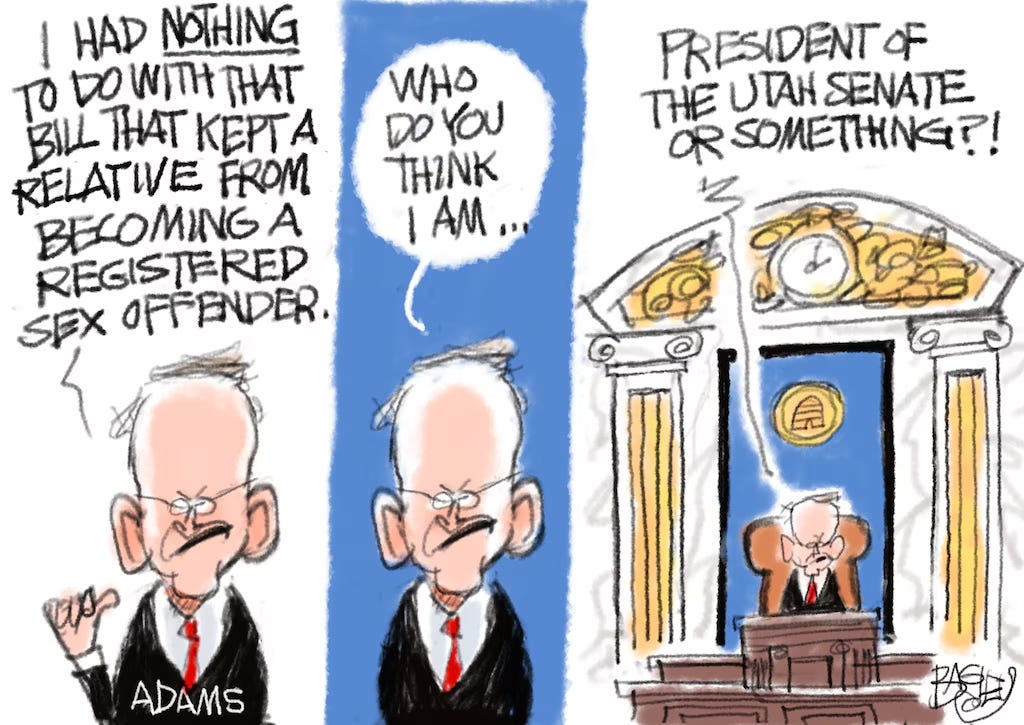
(Cartoon Credit Pat Bagley)
The great thing about being Senate President is that you can work on any issue. Whether it's education, health care, transportation. The other great thing is you can work on very specific issues… like a billboard across the street from your parents’ house or your grandchild’s criminal charges.
Welcome to our guide of what happens when political influence becomes personal. Welcome to the Stuart Adams Handbook.
Before we get into it and get you really fired up, we need you to put these events on your calendar. Join us for a letter writing event this week to call on Stuart Adams to resign. RSVP by clicking the link of the event.
Bountiful – Wednesday August 13th, 6 PM at Wingers (255 N 500 W, Bountiful, UT 84010)
Salt Lake City – Thursday August 14th, 5:30 PM at Policy Kings (79 W 900 S, Salt Lake City, UT 84101)
We’ll bring the talking points, paper, envelopes, and stamps. You bring your righteous indignation, your best penmanship, and a friend who is mad about politics right now.
And lastly, a special shout out to Robert Gehrke and Bryan Schott for their reporting on many of these stories referenced and doing the hard work of bringing the facts to light. Their consistent investigation and commitment to journalism is the reason that we know these things to begin with.
How to Write a Law for One Person
In a story originally reported by Robert Gherke in the Salt Lake Tribune that has since gone nationally viral, we learned that in 2023, an 18-year-old Utah high school senior, the step-grandchild of Senate President Stuart Adams, was charged with two counts of child rape and two counts of sodomy on a child. The alleged victim was 13 years old. Under Utah law, 13-year-olds cannot consent. These were first-degree felonies carrying mandatory prison sentences of 25 years to life and mandatory sex offender registration.
For nearly a year, plea negotiations stalled. Prosecutors held firm on the charges. Then, in spring 2024, the Utah Legislature passed Senate Bill 213, a 49-page omnibus criminal justice bill sponsored by Senate Majority Leader Kirk Cullimore. Most of the bill contained sentencing reforms recommended by the Utah Sentencing Commission. But buried inside was a new provision that the Commission had not recommended.
That provision:
Created a new third-degree felony (“unlawful sexual activity”) for 18-year-olds who are still in high school and engage in sexual contact with a 13-year-old, if the contact was “mutually agreed to” (despite 13-year-olds being legally unable to consent).
Eliminated mandatory prison time and sex offender registration for that charge.
The kicker here is that provision was written by none other than the defense attorney representing Adams’ step-grandchild, prominent criminal defense lawyer Cara Tangaro. Cullimore included the language after conversations with Adams, who has admitted to telling him about the case.
The new law was not retroactive. But in court, Tangaro told the judge:
“We all agree that’s not retroactive, but the government did change their offer based on that.”
Two months after the bill passed, prosecutors offered a new plea deal:
Guilty to one count of aggravated assault (second-degree felony) and three counts of sexual battery (misdemeanors).
No additional jail time.
No sex offender registry.
Probation, treatment, fines, and community service.
The victim’s mother said she was blindsided by the law change and called the outcome “a gut punch,” saying her child was “an afterthought.”
Adams denies requesting the provision or interfering in the case, calling criticisms “misinformation” and “political grandstanding.” But the sequence of events, personal connection, private conversation, custom legal carve-out, and favorable plea, speak for themselves and are a little too perfect.
Senator Nate Blouin started the call for Adams' resignation. He was the first elected official to publicly do so and he will certainly pay for it in the Senate. Afterwards, Adams released a statement that read less like a measured response and more like someone dumping every thought and feeling into a press release with no advisor to say, hey, maybe stop at one paragraph, you’re only digging deeper.
Let’s take a second to acknowledge some courage. Senator Nate Blouin, for being the first elected official to call on Adams to resign, and to newly elected Salt Lake County Council Member Jiro Johnson, a defense attorney, for joining him. Both know the Supermajority doesn’t take kindly to dissent, but did the right thing anyway. In a place where political survival usually comes first, it’s worth saying: sometimes doing the right thing really does transcend politics. Thank you for serving your constituents!
How to Break Campaign Finance Law (and Still Win)
Accountability group Alliance for a Better Utah accused Adams of violating state campaign finance laws. The issue was how he reported hundreds of thousands of dollars in campaign spending. Instead of listing the actual vendor or recipient of the money, as Utah law clearly requires, Adams’ disclosures repeatedly listed credit card companies as the payee.
When you list “American Express” instead of “XYZ Political Consulting” or “ABC Printing,” the public has no idea where the money actually went. It hides the details that campaign finance laws are supposed to make public. You must list the actual person or business who got the money. Adams didn’t. And he didn’t just slip once or twice, this was a years-long practice.
The Lieutenant Governors office (which oversees campaign finance compliance) agreed Adams had violated the law and simply issued new guidance to candidates. Adams said he’d gotten “conflicting guidance” about how to report expenses.
Now listen, we will give this to him. This is probably the least egregious of the cases. Utah elections have never been all that competitive (shocking, I know) and so there are many, many campaign finance violations that never go anywhere.
But it’s still a familiar theme in Utah politics, the rules apply to you, but for them, it’s a matter of “confusion” and “interpretation” while accusing the outside organizations of “misinformation” and "deceitful tactics.” Ironic, huh?
How to Take a Luxury Trip and Keep It Quiet
In late 2022, Adams and two of his grandchildren jetted off to watch the U.S. face England at the FIFA World Cup in Qatar. It wasn’t a family vacation in the traditional sense, the trip was mostly paid for by the Qatari government. Former Attorney General Sean Reyes made the trip too.
What’s even better is, Utah law doesn’t prohibit elected officials from accepting travel or gifts from foreign governments. There’s also no requirement to disclose those trips to the public. And just months before Adams boarded the plane, the Utah Senate (ya know, the branch of government that he controls), blocked a bill that would have required disclosure of foreign government gifts and travel. It was stripped of that provision when it got to the Senate. That bill was sponsored by Rep. Candice Pierucci.
Pierucci tried again in 2023. And in 2024. And in 2025. Each time, the bill died.
So instead of Utahns being able to see when their elected officials are taking all-expenses-paid trips courtesy of foreign governments, the practice stays hidden (and completely legal), unless, like the Qatar trip, a reporter catches wind of it.
But legality isn’t the same as transparency. And when the man benefiting from those rules also helps ensure they never change, it’s hard to see it as anything other than deliberate.
How to Fail a COVID Test Twice in One Day
Let us take you back to January 18, 2022: Opening day of the Utah legislative session. Stuart Adams takes the podium and proudly announces he’s tested negative for COVID-19 that morning. It’s meant to be a reassuring moment. Except it wasn’t true. Like a blatant lie.
In reality, Adams had tested positive for COVID twice earlier that same day. This came just a week after another positive test, meaning he was well within the recommended isolation period. Despite that, he spent hours in close contact with other lawmakers, staff, and members of the public, much of the time without a mask. He was photographed shaking the hand of one of the Twelve Apostles for the Church of Jesus Christ of Latter-day Saints, unmasked.
The truth only came out after reporters started asking questions. Senate staff eventually admitted the earlier positive tests, but by then the optics were set: the state’s top lawmaker had misled the public and ignored basic public health guidelines in the middle of a pandemic.
It wasn’t just bad judgment, it sent a clear message that the rules everyone else was expected to follow didn’t apply to him.
How to Push $800K in Fake Medicine
Yes, there is more. In the chaos of early COVID, while public health experts were looking for real, evidence-based treatments, Senate President Stuart Adams was working the levers of power for a debunked Trump’s “miracle cure”: hydroxychloroquine.
Adams was part of an informal network of lawmakers and business leaders shaping Utah’s early pandemic response. One member of that circle, Dan Richards, owner of Meds in Motion, had a problem: a massive stockpile of hydroxychloroquine and no way to sell it. Richards, it would later turn out, was accused by federal prosecutors of importing hundreds of kilograms of the drug from an unregistered manufacturer in China, mislabeled as herbal supplements.
The state quietly purchased 20,000 doses from Richards’ pharmacy for $800,000, without telling the Utah Department of Health, without a competitive bid, and outside the normal procurement process.
When the shipment got stuck at a California port, Richards called Adams. Within days, Adams was on the phone with the Utah Inland Port Authority director to push it through.
The deal collapsed only after the FDA and multiple studies confirmed what medical experts had been saying for months: hydroxychloroquine doesn’t work against COVID-19. The state got its money back, but not before taxpayer dollars, political influence, and government time were burned on an unproven treatment that looked far more like a political favor than a public health solution.
How to Be China’s Favorite Senate President
When the Associated Press dropped its investigation into China’s surprisingly robust influence in Utah, one name kept coming up: Senate President Stuart Adams.
Under his leadership, Utah lawmakers became frequent participants in China exchanges, sitting for interviews with Chinese state-run media and delivering carefully worded praise about Utah being "a friend" with "a long history" of ties to Beijing. They worked closely with Utah-based advocates linked to what experts identified as front groups for the Chinese government, blocking resolutions critical of Beijing and promoting symbolic gestures that aligned with Chinese propaganda goals.
One example came in early 2020, after Chinese authorities faced public anger following the death of Dr. Li Wenliang, a young doctor who had been reprimanded for warning about COVID-19's dangers. At the request of Shanghai government officials, Utah lawmakers recorded video messages offering encouragement to Shanghai residents, a gesture amplified in Chinese media to demonstrate international support for the government during a crisis of confidence. Around the same time, President Xi Jinping sent a letter to Utah fourth graders, which Utah officials treated as a charming diplomatic gesture but which Chinese state media leveraged as a PR victory, reporting that Utah students had called Xi a kind "grandpa", a familiar propaganda trope.
None of this violated US law. But it illustrates how foreign governments work around Washington by cultivating state-level leaders, where the scrutiny is lighter, the relationships more personal, and the political payoff can be substantial.
How to Make a Billboard Disappear
Finally, all the way back to 2011. The Utah Department of Transportation (UDOT) had approved a plan to put up a billboard near South Main Street and I-15 in Layton. It was on UDOT-owned land, the location had been selected after meetings with city officials, and construction was about to start.
Then, some constituents complained. Not just any constituents, Stuart Adams’ parents, who lived directly across the street from where the billboard would go.
Adams, at the time the former chair of the Utah Transportation Commission and a sitting member of the Senate Transportation, Public Utilities and Technology Committee, picked up the phone. He called UDOT officials. He called city officials. And just like that, the billboard was blocked.
Adams’ defense was that he claimed his parents didn’t even know the billboard was coming until construction was about to begin, and that he would’ve done the same for any concerned constituent. Maybe. But in this case, the “constituents” were his parents, the billboard was on track to be built legally, and the law didn’t even require public hearings for billboard placement.
No laws were broken. But also no mistaking that the power of the Senate President (or in 2011, a senior legislator) can move mountains (or billboards) when it’s in the family’s front yard.
Listen, we are not here to champion billboards. They have more rights than most women in this state. But let’s be honest, this wasn’t a statewide policy debate. It wasn’t a public safety issue. It was a personal favor dressed up as constituent service, the kind of “small” perk that’s invisible unless you know where to look. And once you do, you start seeing it everywhere.
How to Turn Public Power Into Personal Perks
Taken one at a time, each of these incidents could be written off as a bad call, a lapse in judgment, or a “misunderstanding.” But together, they tell a much clearer story.
When Stuart Adams has the choice between using his position to serve the public or to serve himself and his circle, he chooses himself. Every time.
None of this is accidental. It’s what happens in a one-party system where the top lawmaker faces no real checks on his power, where “ethics” is only applied to some, and where insiders can quietly shape policy to protect themselves.
If you don’t think this is how our elected officials should govern, join us.
📅 Letter-Writing Events
Bountiful – Wednesday August 13th, 6 PM at Wingers (255 N 500 W, Bountiful, UT 84010)
Salt Lake City – Thursday August 14th, 5:30 PM at Policy Kings (79 W 900 S, Salt Lake City, UT 84101)
We’ll have everything you need to tell Stuart Adams and every lawmaker watching, that Utah deserves leaders who work for the public, not for themselves.
Because the pattern doesn’t stop until we make it stop.
hear key details:
https://podcasts.apple.com/us/podcast/city-cast-salt-lake/id1599782608?i=1000721169352
The victim was in MIDDLE SCHOOL, and probably in 7th grade. The Senator is ok with Middle School kids and high school seniors having sex? And with setting in motion the process that changes age of consent for his relative?
The victim wanted the crime reported. Adams and his allies/enablers, imply something completely different.
This is a massive and flagrant abuse of power. Specifics of the bill only FIT this relative's specific case. Listen to Gerke interview on City Cast Salt Lake.
Merits of the law could and should perhaps be openly debated.
Resignation for abusing power is only just outcome-- given the long history of "problematic" behavior.