

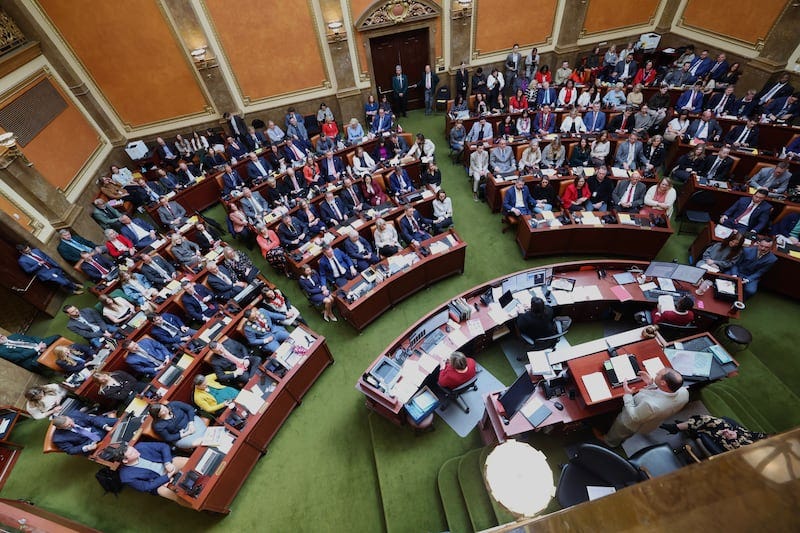
We’re now at Day 19 of the 2026 Legislative Session, which means we’re somehow still in week three despite being nearly halfway through the 45-day sprint.
If week one was posture and week two was acceleration, week three was… quieter. Fewer bills moved. Floor sessions felt almost routine. And committee meetings droned on and on into the 6 PM hour.
But that’s exactly when you need to pay attention.
Because when the pace slows down, when the cameras aren’t rolling quite as hot, when the room isn’t packed with people testifying, that’s when they introduce the bills that show you what they’ve been planning all along. That’s when they say the quiet part out loud. That’s when the mask doesn’t just slip; the full costume comes off.
This week, the story isn’t exactly what passed. It’s what got introduced and what those bills reveal about where all of this is heading.
We’ve covered a lot of ground in our first two weekly recaps (week one and week two). The court packing, the constitutional court scheme, the attacks on trans people, the budget cuts, the election bills. If you want the full breakdown of everything that’s moved so far, start there.
This week, we’re focusing on what’s new, what they’re planning, and what’s simmering.
As always:
See our full session guide resource before doing anything
Bookmark elevateutah.news for bill explainers, trackers, and action alerts
Follow us on YouTube, Instagram, TikTok, Facebook, Threads, for daily legislative breakdowns
Subscribe here for weekly recaps (paid subscribers get a gold star)
Check the bill tracker for what we support, oppose, and are deeply concerned about
Come to Our Weekly Hill Talk with Better Utah and Better Boundaries. Wednesdays at Church & State (6–7:30 PM) for live breakdowns and more partner organizations each week
Email us at hillyeah@elevateutah.news when something looks… suspicious
Quick Wins
We are always real downers in your inbox, so in an attempt to keep our open rates high, we thought we should give you some good news! We are tracking 90+ GOOD bills this session. We promise a full breakdown on those soon, but if you want to see for yourself, check out our bill tracker.
So, now the small victories:
SB23 (chemtrails) failed in committee. Yes, a chemtrails bill made it far enough to get a committee hearing. That alone is a problem. But it’s dead now, and the testimony was, as always, top-tier entertainment.
HB85 (asserting our state sovereignty over international organizations like the UN and WHO) died on the Senate floor. It passed the House, and yet it did not survive the Senate because it was “unnecessary.” On that, we can agree.
HB188 was held in committee. This was Rep. Nicholeen Peck’s bill to increase school reporting of drug offenses to police. But don’t celebrate too much, we have a feeling this one is coming back soon.
The graveyard is slowly growing. But remember, nothing is ever dead dead in the legislature. Zombie bills always come back to haunt us.
What Moved
As we said, this week seemed slow on the surface. After last week’s sprint that saw SB134 signed into law within 24 hours of its final passage, one of the only controversial bills we saw speed through this week was HB392, the constitutional court bill that got amended to be slightly less bad (now a three-judge panel instead of an entirely new court) and then immediately rushed through its House floor vote and Senate committee. It now awaits its final step on the Senate floor.
In fact, some of the controversial bills we were expecting to have committee hearings were skipped altogether this week. That doesn’t mean much other than leadership might have been looking for a break from all the bad media.
The things that did make progress: Trans Utahns, targeted in rapid succession. Three bills attacking trans people were voted on and moved off the House floor one right after another in what can only be described as legislative torture:
HB174 strengthens Utah’s existing ban on gender-affirming hormones for minors by removing the old grandfathering carve-out and forcing most remaining youth who are still on treatment to taper off within 6 months. The bill eliminates the earlier “diagnosed before Jan 28, 2023” pathway and requires providers to immediately start reducing doses and end treatment within 6 months. There’s only a very narrow exception for teens who are almost 18 or already 17+ and have been on hormones for 2+ years with parental consent.
HB193 bans the use of public funds for gender-affirming medical care in Utah. It prohibits any state or local government entity from paying for or reimbursing hormonal transgender treatments, primary sex characteristic surgeries, or secondary sex characteristic surgeries. The ban applies broadly: Medicaid, public employee health plans, and any other government-administered or government-funded program cannot cover these treatments, either directly or indirectly.
HB258 requires that if an insurance plan covers gender transition care, it must also cover any treatment or therapy meant to “reverse” that transition. Because apparently, we’re legislating insurance coverage based on regret narratives now.
All three passed the House and moved to the Senate.
BYOB passed the House floor. Moving to the Senate side for the second half of its journey, our favorite name of a bill is making progress. HB156 forces hospitals to allow “directed blood” transfusions, meaning a patient can bring their own blood or blood from a chosen donor for a procedure, as long as it’s done through a federally compliant blood bank and it’s not an emergency. The bill also shields hospitals and providers from liability if something goes wrong with that patient-provided blood. Seems likely that soon you may finally be able to bring your own pure, unvaccinated blood to the hospitals after Kristen Chevrier’s push on this bill for 2 years.
HB84 (campus concealed carry) passed House committee after being substituted. Turns out last year’s session accidentally broke the code and made it technically illegal to conceal carry on campuses. This restores the law to what it was before. Everyone seems fine with it now.
SB73 (the proposed “porn tax”) passed Senate committee. It’s no longer structured as a fee; it’s now an excise tax on online providers of content harmful to minors who fail to perform age verification. Also creates new civil penalties for noncompliance. The new money will go into a teen mental health fund, which it seems like they could have just created and funded independently, but we digress.
The slower pace doesn’t mean they’re done. It means they’re loading the chamber.
What They’re Planning: The New Bills
Just because fewer bills were passing this week doesn’t mean the Legislature took a break. If anything, they used the slower pace to get creative. And by creative, we mean they introduced some of the most brazen, conflict-ridden, and constitutionally questionable bills of the entire session.
This is what happens when you have a supermajority with no meaningful opposition and 27 days left to do whatever you want: flood the zone with all the crazy pet projects and wild ideas in the last few weeks, and surely one or two will slip through. So here is some of the new stuff:
SB233: Let the Legislature Rate Their Judges
Brady Brammer (because, of course, it’s Brady Brammer) introduced a bill this week that makes changes to the Judicial Performance Evaluation Commission (JPEC), the body that reviews and rates judges when they’re up for retention.
Currently, JPEC includes lawyers and other people who work with judges regularly – people who can evaluate judicial temperament, legal knowledge, and courtroom conduct from direct professional experience.
SB233 changes that to open up the evaluation process to “anyone who’s been seen in front of a judge.” Plaintiffs. Defendants. People who won. People who lost.
And you know who’s been a defendant in a lot of cases lately? The Utah Legislature.
So now the Legislature, which has been losing cases against judges who ruled their laws unconstitutional, would get to formally influence the ratings of those same judges. Ratings that now appear on the ballot when judges are up for retention.
This creates a mechanism to punish judges who rule against the Legislature and reward judges who don’t. Hmm. Crazy.
SB233 was introduced and scheduled for a committee hearing this week, but was not ultimately heard yet.
SB242: Who Runs the Streets? The State (to the sound of Run the World by Beyonce)
SB242 is a state takeover of Salt Lake City’s streets. Despite claims otherwise, it strips the city of real control and requires UDOT approval for major decisions on local roads.
The bill uses vague language about “mitigation” to disguise what is actually a major design mandate. Buried in the text is a requirement for 12-foot lanes – a standard used on freeways, not city streets. While we are very proud of our pioneer handcard turnable streets, twelve-foot lanes are designed for high-speed traffic. They prioritize cars over safety. They make streets more dangerous for pedestrians, cyclists, and transit users. And they lock cities into car-centric design permanently.
That matters because UDOT-managed roads are already the most dangerous in the state. Handing more city streets over to UDOT and UDOT design standards would entrench unsafe infrastructure across Utah’s urban core.
But wait, it gets worse.
SB242 would also require tearing out major recent projects, including the 200 South bus lanes and the 300 West bike lanes. Those lanes are central to Salt Lake’s transit system. They represent the biggest transit upgrade since TRAX. They’re already built. Already in use. Already working. The bill would force the city to rip them out and replace them with wider, faster car lanes.
It would also threaten future bus rapid transit expansion, waste years of planning, waste millions in public investment, and obliterate any remaining trust that local governments have authority over their own infrastructure.
They’re dismantling infrastructure they don’t use and don’t understand, and they’re doing it with the confidence of people who will rarely, if ever, experience the consequences.
If you care about this issue, follow Sweet Streets. They’re working hard on safer streets and have action alerts on this bill. This could be heard in committee as soon as Monday.
HB452: No Guns? No Grant Money.
HB452, introduced by Candice Pierucci, prohibits any private entity that receives $1 million or more in public funding from banning concealed firearms in spaces they own, lease, or operate – if those spaces are open to the public.
Unless a specific state or federal law says otherwise, these entities must allow concealed carry by permit holders. Even though they’re private organizations. Even though it’s their property.
So if you’re a nonprofit, a university, a museum, or a performing arts center that gets state money, oh, you know, a venue that hosts basketball, hockey, and concerts, you no longer get to set your own policies on firearms. The state sets them for you.
HB452 is in House Rules.
SB270: An Eviction Court, Brought to You by an Eviction Attorney
Senate Majority Leader Kurt Cullimore – who formerly (though he might still doing contract work for them) used to run, along with his father, the largest eviction law firm in the state – introduced a bill this week that creates a brand-new “Collections and Housing Court” to handle evictions and debt collection cases statewide.
It shifts power toward landlords and debt collectors – Cullimore Sr.’s clients – while making it harder for tenants and low-income defendants to navigate the system.
The new court would pull eviction and debt cases out of local district courts and centralize them under a single statewide structure. These cases would be handled by a single judge with statewide jurisdiction appointed by the governor. The process would move faster.
And speed just happens to benefit the party with resources and legal representation, not the party scrambling to respond on short notice while trying to figure out how to keep a roof over their head.
This is a massive conflict of interest. Kurt Cullimore’s family makes money on these cases. And now he’s redesigning the court system that processes those evictions in ways that make the process faster, more centralized, and more favorable to repeat institutional players like the landlords and debt collectors they represent.
This bill might create a functional system. Maybe it’s even efficient. But when the person designing the system is benefiting from how it operates, it’s self-dealing.
SB270 is in Senate Rules.
HB495: Fast-Tracking the Death Penalty
HB495 dropped this week, and it’s one of those bills where it’s genuinely hard to come up with a joke because the stakes are so high and the intent is so clear.
This bill overhauls Utah’s death penalty process with one goal: speed over fairness.
Here’s what it does:
Weakens protections for intellectually disabled defendants by forcing early IQ “pre-screening”
If a defendant objects to the screening, they waive the right to later claim intellectual disability as a reason they shouldn’t be executed
If the screening finds an IQ above 75, the defense gets just 10 days to challenge the results with evidence
Failure to provide that evidence in 10 days precludes any further examination, and the court enters an order saying the death penalty is on the table
Makes automatic Supreme Court review conditional rather than guaranteed
Creates steep barriers to raising competency claims later in the process
Sharply limits ineffective assistance of counsel appeals
Taken together, these changes don’t improve justice. They don’t make the system more accurate. They make it faster and harder to stop.
The goal is to move capital cases quickly to execution with minimal oversight while creating the appearance of “streamlined” due process that could help Utah qualify for faster federal review under the death penalty certification process.
This is what happens when efficiency becomes the priority over getting it right. And in capital cases, getting it wrong is irreversible.
HB495 is in House Rules.
HB471: Papers, Work, and Paperwork
HB471 adds new eligibility requirements for Medicaid and SNAP. Specifically, it adds work requirements and requires citizenship verification for both programs.
And if someone who is not a citizen applies for either program and is discovered during the verification process, the bill requires reporting to ICE. So applying for food assistance or healthcare could result in deportation.
HB471 is in House Rules.
HB479: Signed, Sealed, Delivered (In Person Only)
Because we haven’t had enough voting bills this session, HB479 showed up this week with new restrictions on how ballots can be returned.
The bill requires all ballots to be returned in person – meaning no more mailing your ballot for nearly everyone.
It also limits when and where drop boxes can be located, and mandates that all drop boxes must be fully staffed by election workers at all times.
Utah has one of the highest vote-by-mail participation rates in the country. This bill would make voting significantly harder for people who rely on mail returns, including rural voters, elderly voters, people with disabilities, and anyone who works during the limited hours during which drop boxes could be staffed.
HB479 is in House Rules.
HB488: Sunday School Civics
HB488 changes curriculum requirements for civics education to mandate that schools teach “American exceptionalism documents” including the Bible and the Ten Commandments as historical documents.
Get rid of your textbooks, kids. Just bring your quad.
HB488 is in House Rules.
The Week Three Takeaway
We are in that phase of the session that really sets in during the slower weeks. The simultaneous exhaustion and dread. It’s not the frantic energy of trying to track everything at once. It’s the slow realization that the worst bills are being introduced quietly, almost casually, while most people are looking somewhere else.
And all of it moving at a pace designed not to overwhelm, but to slide past. That the people in charge are pulling every puppet string behind the scenes, and they have a plan.
We’re simmering. It’s when things cook so slowly that you don’t notice until it’s too late and burnt.
We’ve got 26 days left. That’s enough time for them to do more damage. And it’s enough time for us to stop some of it.
Why was Rep. Miller's bill (HB53) passed unanimously through standing committee and both houses and then pulled back from the Senate Sec to the 3rd reading calendar table on a motion to reconsider. I can't find mention in the journal for that action??? See this status: https://le.utah.gov/Session/2026/bills/static/HB0053.html