

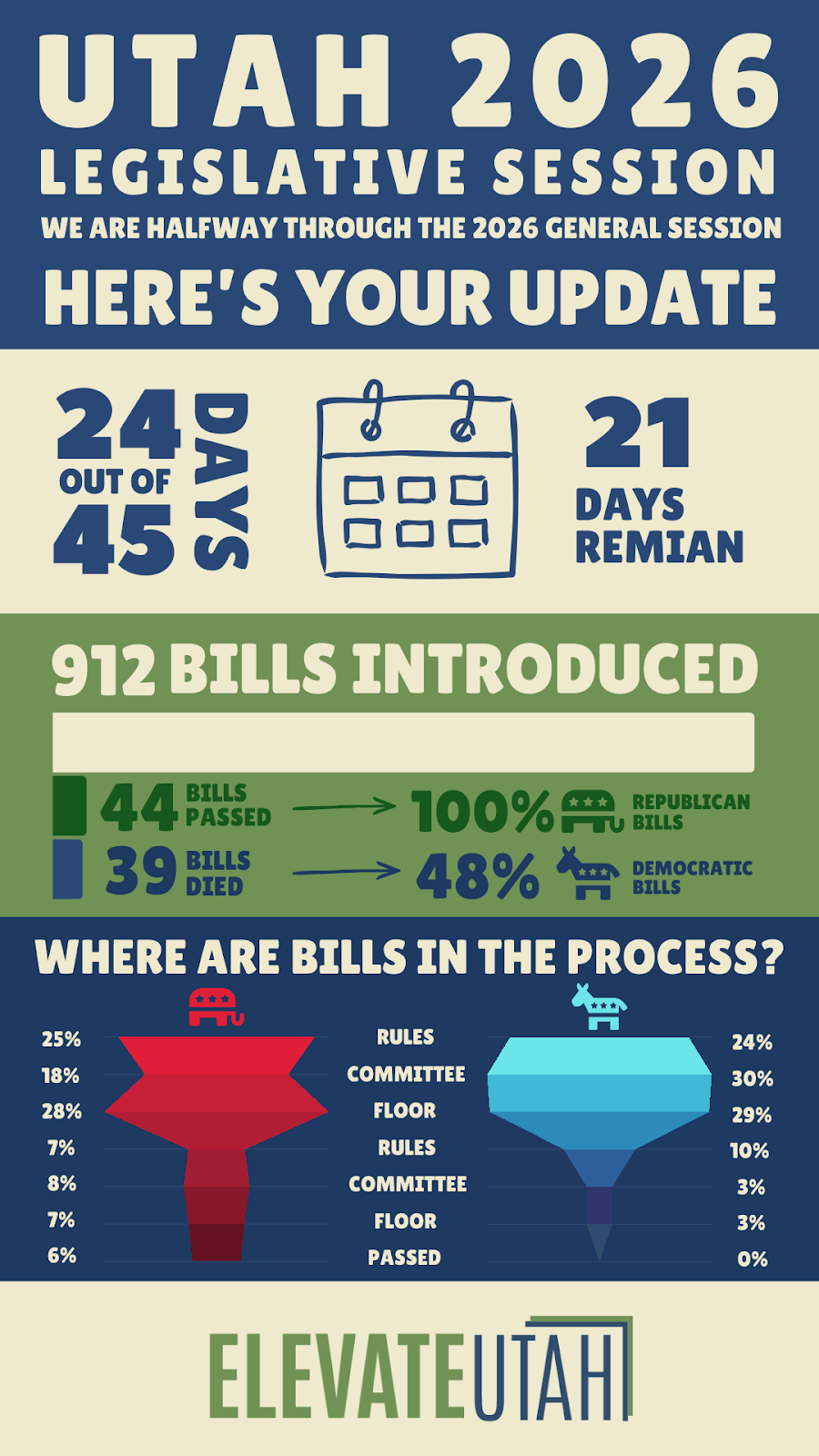
We are officially on Day 24 of the 45-day legislative session. Which means we’re past halftime. The taffy is going stale, the energy is weird, and the real power plays are underway.
So where are we? A staggering 912 bills have been introduced so far. That feels record-breaking, and honestly, it probably is. Of those, we’re actively ‘tracking’ 207 bills, both good (93) and bad (67).
Despite the avalanche of legislation, only 4.8% of bills have actually made it all the way through the process and officially passed. Which means there’s still a ton to go for the majority of the bills.
But here’s a really not so fun fact: every single bill currently sitting on the governor’s desk or already signed into law, has been sponsored by a Republican. We’re at the halfway mark and not one Democratic bill has made it through.
On the flip side, about 4.2% of bills have died somewhere along the way and nearly half of those were Democratic bills. Now, there are significantly fewer Democrats in the legislature (and therefore fewer Democratic bills introduced), but this is still significant because we’re looking at percentages here. When you look at what proportion of each party’s bills have been killed versus what proportion have passed or even just moved at all, the disparity becomes stark.
And while bills are never really actually dead (there are many ways they can revive a bill and bring it back in zombie form) these numbers still tell you everything you need to know about who controls the process.
The Funnel
As a quick reminder on the process, bills must move through rules, committee, and floor in one chamber, then repeat those same steps in the other chamber. When you combine all House and Senate bills by party, the pattern becomes stark: Republican bills are moving. They’re being heard on the floor, advancing through the first chamber, making steady progress. Democratic bills are backed up in rules and committees, stuck at the very first gates of the process.
This is how the supermajority controls what even gets discussed.
Look at the Republican funnel: it’s thicker at the bottom. Bills are moving through committee, hitting the floor, and even passing.
Now look at the Democratic funnel: it’s thick at the top. Bills are stuck in rules (24%) and committee (30%). Only 16% have made it to the other chamber. The supermajority controls the gates, and it seems they’re keeping them closed.
This isn’t about Democrats sponsoring bad bills that deserve to die. This is about a procedural stranglehold that prevents the minority party from participating in governance at all.
When 100% of passed legislation comes from one party in a body, you don’t have a functioning legislative process. You have a rubber stamp operation.
That’s why paying attention to the process itself is one of the most important things you can do. It can feel complicated and overwhelming and that’s often the point. When the system is confusing enough, people stop watching. And when people stop watching, the supermajority can do whatever they want.
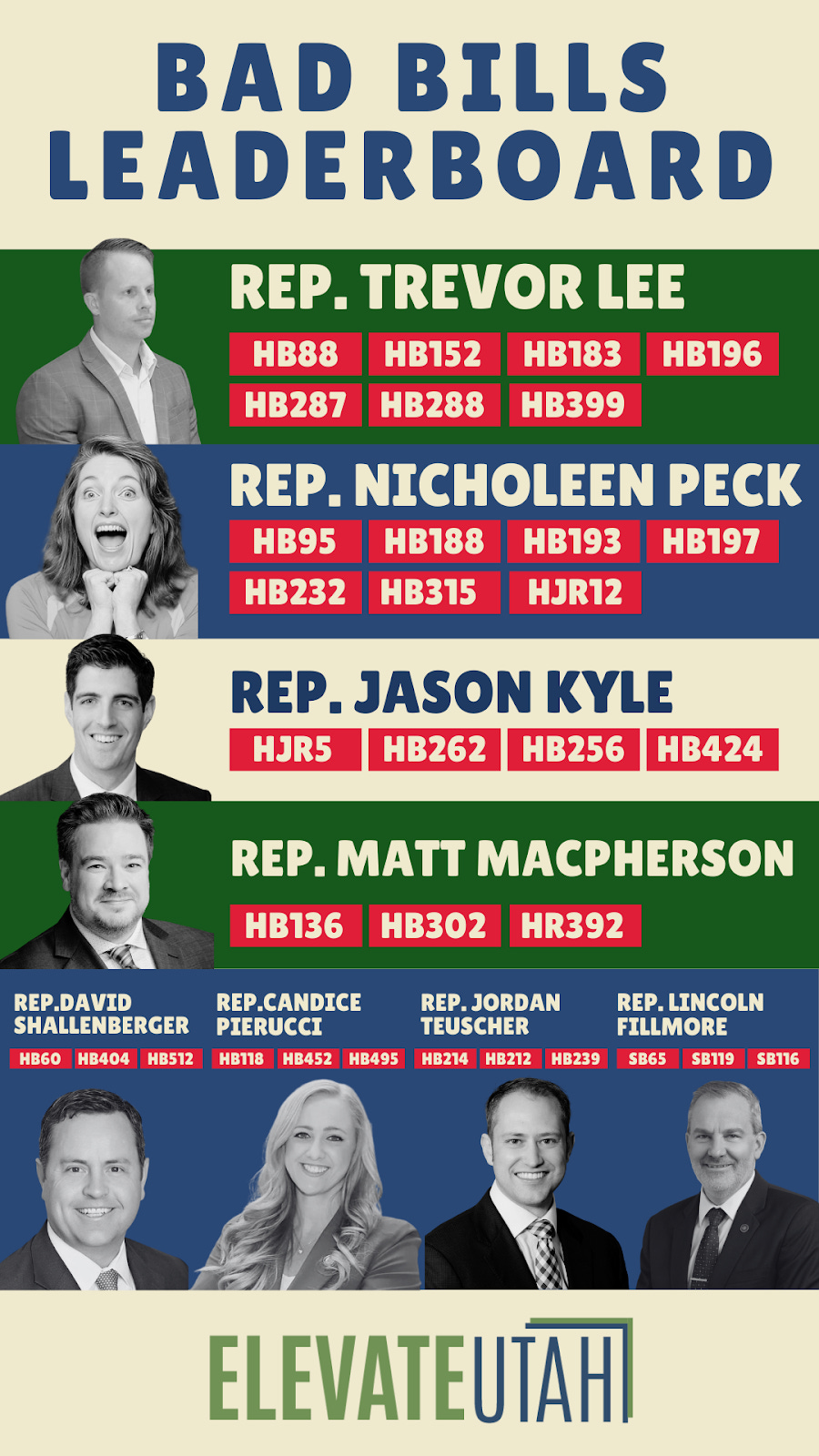
Out of those 912 bills, we’re tracking 67 that we’ve scored as “bad bills.” And yes, that’s Elevate Utah’s totally not unbiased and not impartial opinion. But some legislators have shown a truly impressive ability to run a huge number of these problematic bills.
Rep. Trevor Lee and Rep. Nicholeen Peck are leading the pack with 7 bad bills each.
Trevor Lee’s Greatest Hits:
HB88 - Tightens immigration verification for public benefits
HB152 - Removes vaccine exemption education requirements for parents
HB183 - Eliminates transgender protections and bans birth certificate changes
HB196 - Lets Legislature rename city streets; renames 900 South “Charlie Kirk Boulevard”
HB287 - Eliminates driving privilege cards for undocumented residents
HB288 - Voter registration via hunting/fishing licenses (with privacy concerns added on floor)
HB399 - Bans schools from teaching or tracking character education/social-emotional learning
Nicholeen Peck’s Collection:
HB95 - Protects employees who refuse to use students’ preferred pronouns
HB188 - Expands school-to-police pipeline and limits juvenile diversion programs
HB193 - Bans all public funding for gender-affirming care
HB197 - Mandates AI book-banning tools with automatic statewide removals and parent lawsuits
HB232 - Blocks abortion providers from Medicaid
HB315 - Requires anti-abortion fetal development videos in grades 3-12
HJR12 - Resolution promoting marriage before having children
Close behind are Reps. Jason Kyle, Matt MacPherson, David Shallenberger, Candice Pierucci, Jordan Teuscher, and Lincoln Fillmore—all tied with their own concerning collections of legislation.
Want the full picture? Check out our complete bill tracker to see every bill we’re tracking, detailed descriptions, and where they are in the process. You can filter by category, see sponsor information, track status in real-time, and get detailed breakdowns of what each bill actually does.
What You Can Actually Do About This
We have heard from a lot of people and we understand that sixty-seven bad bills is overwhelming. You don’t know where to start, what to prioritize, or if your voice even matters when the system is this rigged.
Here’s the good news: you don’t have to track all the bad bills. You don’t even have to track all 207 bills we’re monitoring. We’ve built an Action Alert page that we keep updated with a small number of bills that are currently moving and need immediate attention. You can start there.
Beyond that, here are the most effective ways to actually influence this process:
1. Thank Your Representatives
If you live in a Democratic district and feel like your representative already supports your stance and votes how you like, tell them that. It’s hard up there. They’re fighting an uphill battle every single day against a supermajority that won’t even let their bills get hearings. Telling them they’re doing good work and to stay strong actually matters. Send them an email. A text. Show up to their community meetings. They need to know you see them.
2. Contact Bill Sponsors Directly
You can always reach out to the sponsor of a bill—especially if you have:
A personal story related to the issue
Expertise related to the issue
Specific technical changes they could make to improve the bill
These can be productive, respectful conversations that lead to real amendments. Legislators are more likely to listen when you’re offering solutions, not just opposition. And sometimes, especially on less ideological bills, you can actually move the needle.
3. Testify in Committee Hearings
If a bill is scheduled for a committee hearing, you can testify in person or online. This is where most bills die and where you can influence the most.
Here’s how it works:
Many legislators have never heard a real person explain how their legislation would actually affect someone’s life. Be that person.
You can attend committee meetings in person at the Capitol. You can find the calendar here.
If you want to join virtually, you can do that as well. Click participate in virtual meeting, raise your hand when they ask about public comment here. And make sure your camera is on when you are called on to speak.
4. Talk to Your People
This might be the most important one: contact your friends and family and let them know about important bills and what they actually do. Start conversations. Send them links to our bill tracker. Forward this newsletter. The supermajority thrives when people aren’t paying attention. Every person you bring into this conversation is someone who might call their legislator, testify in a hearing, or just understand what’s happening in their state government.
We’ll Make It, I Swear
So, we’re halfway through, which means the pace is about to accelerate dramatically.
As always, remember: quiet weeks are when the most dangerous things move. They’re counting on you to think “only 21 days left, we’re almost done” and stop paying attention. Try not to.
We’re all living on a prayer but we ARE halfway there. <3
Quick Links:
Whiteboard-like Full Bill Tracker - All 207 bills we’re tracking with scores and status
Detailed dashboard with stats, charts, and all the nerdy info.
Action Alerts - Current priority bills that need immediate attention