

It’s back to school! We have spent the past few months trying to enjoy our summer vacations, pretending the scorching heat is just a “dry heat,” watching half the state catch fire, and taking a slight break from Utah political drama. Very slight.
But the school bells are ringing, summer is over and we are officially back. And what better way to begin a new school year than by reviewing the first report cards for Utah’s political class?
Utah politicians might have been hoping for a fresh start to this electoral season, but unfortunately for them, voters remember last semester. The Deseret News/Hinckley Institute of Politics released a poll on Monday. Here is what it found:
Spencer Cox: 41% approve, 49% disapprove. In January, he was at 51/37 — that’s a 10% difference.
Mike Lee: 39% approve, 46% disapprove. He was at 47/37 in February — 8% drop.
John Curtis: 37% approve, 38% disapprove.
The Utah Legislature: 44% approve, 45% disapprove.
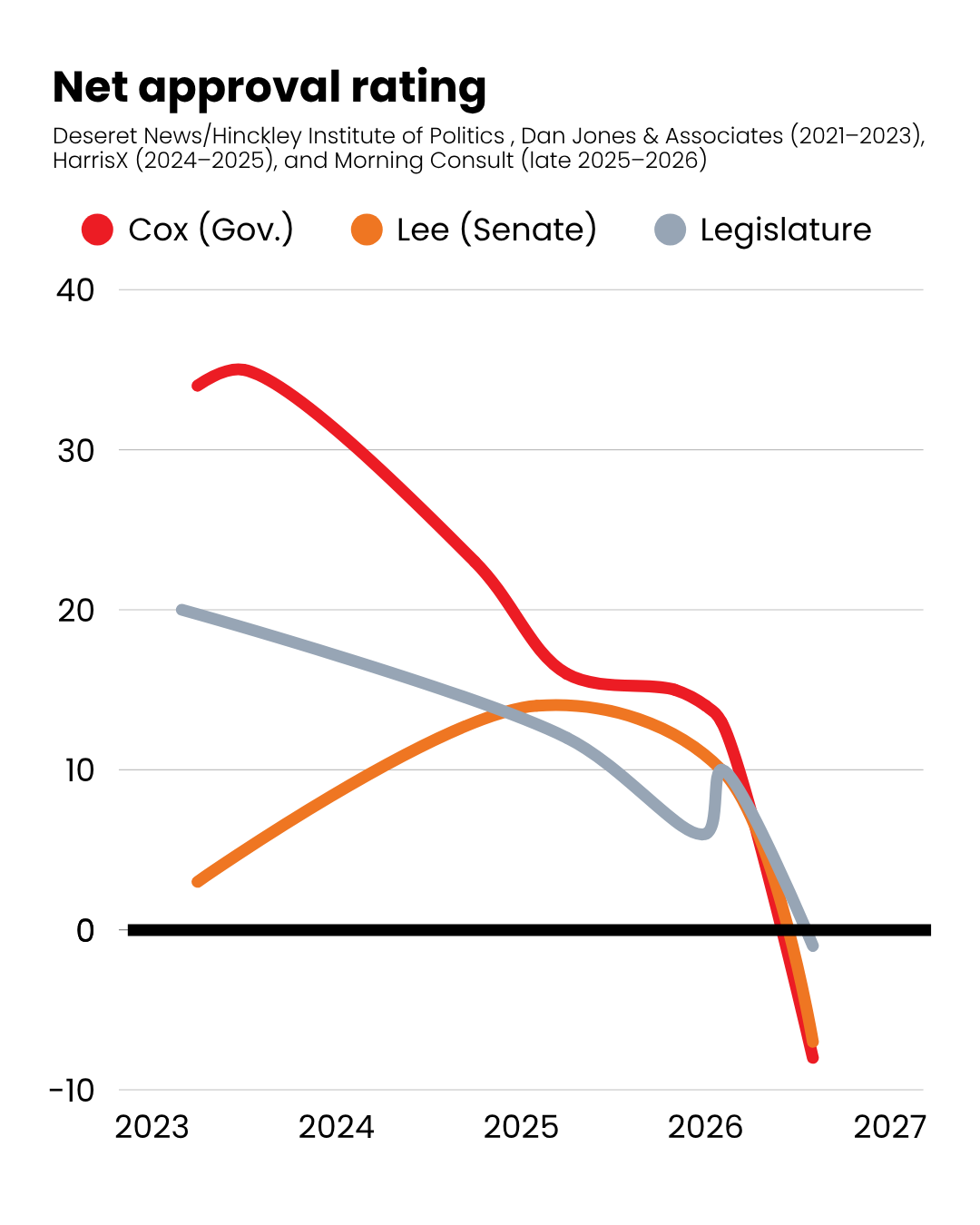
Every Utah elected official polled is now, what we in the business call, underwater.
Now, some of this is clearly just a universal feeling. Donald Trump went from a net-positive five points to a net-negative seven in Utah. Congress sank from negative 21 to negative 30. The economy is unstable, the cost of living is high, and data centers have become the one issue that can apparently unite everyone from Box Elder County ranchers to retired NFL centers (aka Taylor Swift’s brother-in-law). Garage Beer and Liquid Death launched an actual ad campaign this week asking fans to mail their urine to AI data centers to help cool them down, with one of America’s most famous football players, Jason Kelce, as the spokesman. That is a sentence we never thought we would type, let alone in a Utah politics newsletter.
But Cox lost ground with everybody. Republican approval of Cox fell from 69% to 61%. Democratic approval went from 26% to 18%. And the biggest change came from independents who dropped him from 45% to 26%. That is a 19-point collapse in seven months. Oof.
Even more striking, the share of Utahns who strongly disapprove of Cox nearly doubled, from 17% to 31%. His strong approval is now just 14%. That means, more than twice as many Utahns strongly disapprove of Spencer Cox as strongly approve of him. That’s tough.
So, while we love polling data and numbers as much as the next guy, in honor of back to school, we thought we deserve a little fun. And we just happen to have four sets of numbers sitting here that look suspiciously like test scores…
So let’s hand out report cards
Okay… before we turn the approval data into letter grades and everyone yells at us for unfair math, we know no politician is going to receive 100% approval. In this day and age, that’s impossible.
If we graded on a normal scale, every politician in America would fail and Congress would be sent to an alternative school in a portable building behind the building that Paris Hilton is probably protesting.
So we are going to be a generous teacher and grade on a curve. And this is our own special, made up curve so we can do whatever we want.
We need an A to actually mean something. Morning Consult ranks all fifty governors, and when Cox was sitting at 62% approval, FOX 13 reported he was the sixth-most-popular governor in America. Sixth out of fifty. So roughly 60% approval demonstrably lands you in the top ten in the country, which is an A. That seems fair. Sure. Math. We are making all of this up.
Everything scales down from there:
60% or higher is an A. Top ten in the nation.
55% to 59% is a B.
50% to 54% is a C. Makes sense. Passing. Neutral.
45% to 49% is a D. D’s get degrees, you know.
Below 45% is an F.
All this to say, while we can be accused of a lot, this is a generous curve. A curve so generous the Utah Legislature might have drawn it for itself, then passed it in a special session at 11 p.m. on a Friday.
Spencer Cox: F
Cox entered office at 63% approval in February 2021. By that April, Deseret News reported he had climbed to 66%. And, while we could write about this all day but will spare you, 64% of Democrats and 62% of unaffiliated voters approved of him at that time.
In 2021, a Republican governor of Utah had a higher approval rating among Democrats than he now has among anybody. So that’s crazy. Like, truly remarkable.
In November 2021, the Salt Lake Tribune reported that Morning Consult ranked him the tenth-most-popular governor in America. In early 2022, he climbed to sixth. By July 2023 he was holding steady at 63%, and MultiState reported that Cox had posted the largest year-over-year approval increase of any governor in the country. Most improved student, nationally, out of fifty. Honor roll. Class president. National Governors Association chair. The kid whose parents put the bumper sticker on the car.
We all know, Cox earned those grades by being the “reasonable Republican.” He talked about kindness and civility and cried on Ellen and he launched “Disagree Better.” Democrats did not always agree with him, but many believed he was thoughtful, decent and actually interested in governing.
Then he started copying off the wrong kid’s paper.
By April 2025, Cox dropped to 52%. The initial decline came almost entirely from Democrats, whose approval of him collapsed 26 points, from 54% to 28%, between April 2023 and April 2025. Those were the years when Cox endorsed Trump following the July 2024 assassination attempt, signed the pride flag ban, packed the supreme court, and got booed at his own party’s convention.
By November 2025 he was at 50% during the redistricting fight, with Democratic approval down to 22%. January 2026 he was at 51%, holding a C the way you hold a C in a class where you are calculating the grade you need to get on the final to not fail.
Then came the Stratos data center fight. Cox called the scientists and residents raising concerns “people operating off of models and technologies that have changed drastically,” dismissed their concerns as “disinformation,” and then said this:
“We’ve let the people against virtually everything destroy our country, destroy our industrial base, destroy our mining base, destroy our housing base, because we can’t build anything in this country anymore. And those days are over. We’re done with that.”
As we wrote at the time, the people he was describing had driven many miles on a work night to a fairground in Tremonton. Farmers, ranchers, doctors, professors, parents. They are not against everything. They were against one specific thing, for specific documented reasons.
He later scaled the project back to Phase I, posted that “healthy disagreement is part of good government,” and conceded to Deseret that the rollout “wasn’t great.”
Now Cox is at 41%. An F on a curve where he only needed 45% to stumble into a D.
And the decline no longer belongs to just Democrats. His own study group, the Republicans and Independents who carried him for years, started packing up their backpacks too.
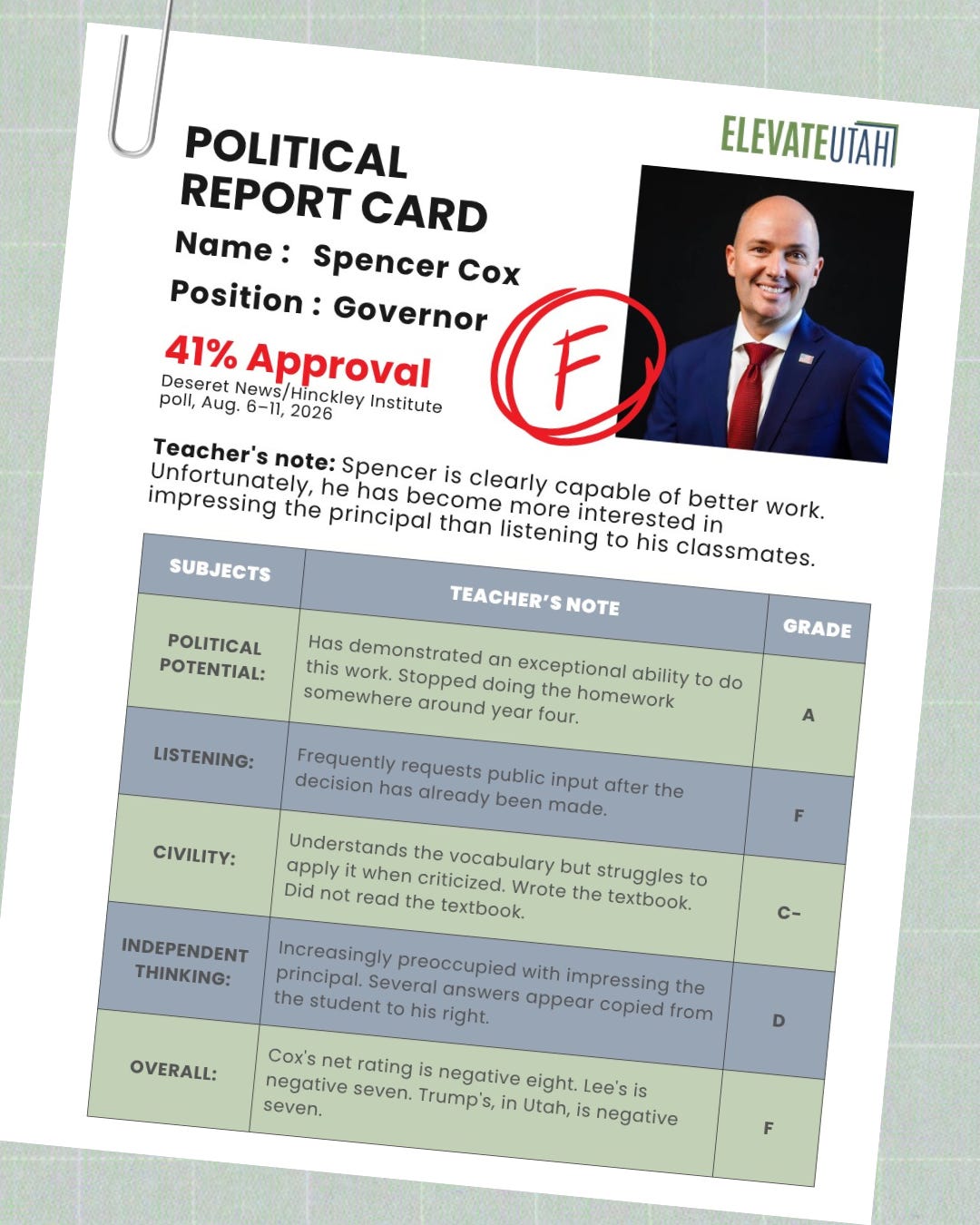
That’s pretty politically humiliating. One of America’s most popular governors four years ago is now polling numerically worse in Utah than Donald Trump AND Mike Lee. For the guy that spent years trying to prove he belonged in their group project. Congratulations. His approval rating finally does.
Mike Lee: F
Conduct: Needs improvement. (Hopefully dispelled soon.)
Teacher’s note: Mike participates frequently, although rarely on the assigned subject. Does not accept feedback without accusing the grader of socialism.
Lee is at 39% approval and 46% disapproval. He has been underwater before, so this is familiar weather for him. What is unusual is that his approval among Republicans fell from 73% to 63%. His approval among Democrats fell from 23% to 10%, which is insane that he was at 23% to begin with, but that’s just us.
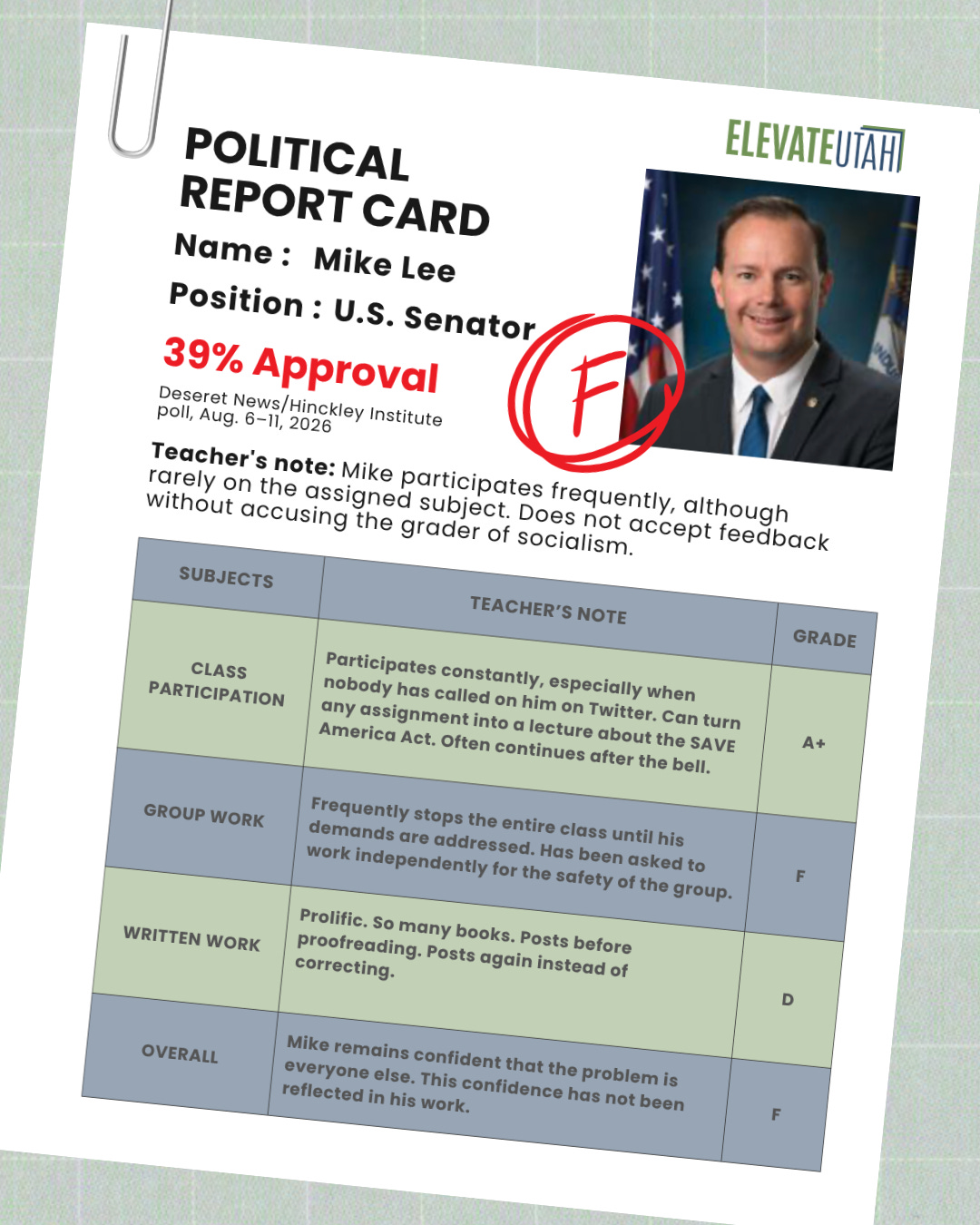
Mike remains confident the problem is everyone else. That confidence hasn’t shown up in his work, his crusade to sell off public lands, or his judgment the weekend a Minnesota lawmaker was shot dead in her home and he joked about it being what Marxists do.
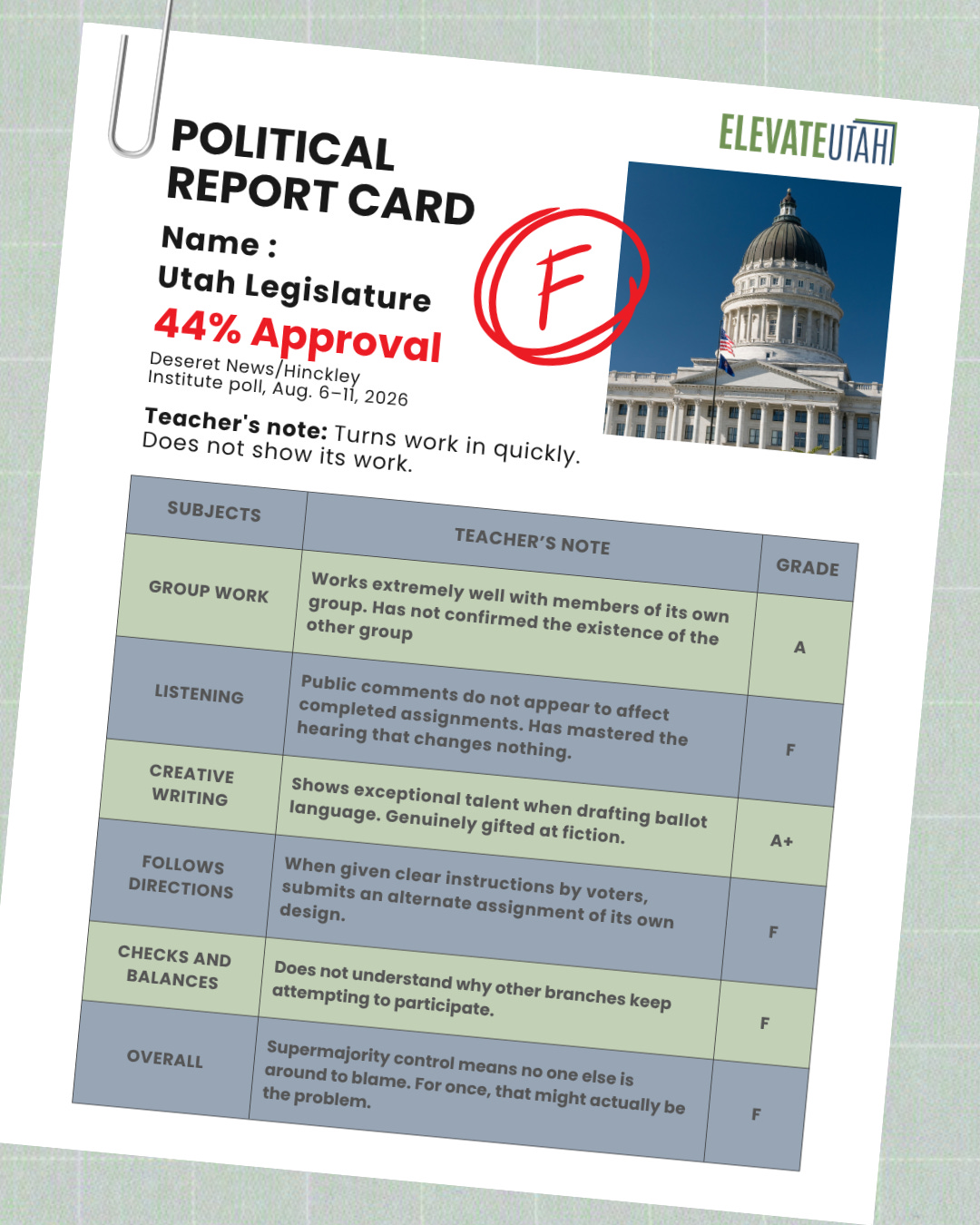
Utah Legislature: F
Gotta give it to them, the Legislature, with their supermajority control is certainly productive. Republican bills pass at around 70%. According to BYU political scientist Adam Brown, Democratic bills passed at just 26% in 2026, the worst rate in the 17 years he has tracked it.
Utah lawmakers are excellent at completing assignments they gave themselves.
And even by their own generous curve, the class average is slipping. The Legislature was pulling a 49% approval in early 2026. By August it had dropped to 44%, its first net-negative grade in years, right alongside the governor’s.
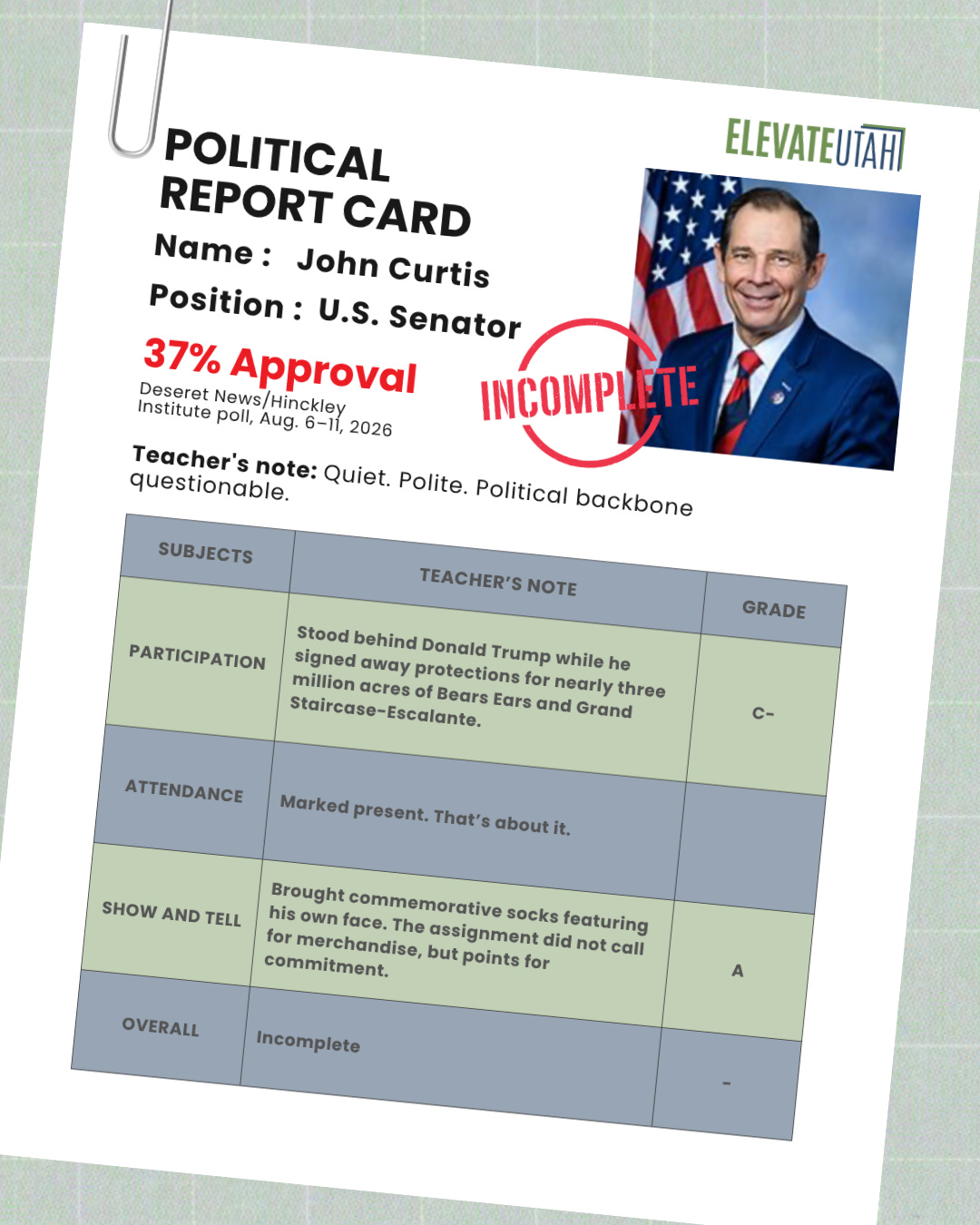
John Curtis: Incomplete
Curtis is at 37% approval and 38% disapproval, but more than a quarter of Utah voters say they do not know how they feel about him. That is roughly double the don’t-know rate for Cox or Lee.
This is interesting as a comparison to a test, because “I don’t know” technically doesn’t count against him. So Curtis is building a Senate career on the one test in America that does not penalize you for leaving it blank.
Curtis recently completed a 250-mile walk across Utah, from Dingle, Idaho to the Stadium of Fire in Provo, in honor of America’s 250th anniversary. He bought billboards and handed out commemorative socks with his own face stitched into them. Unfortunately, the route did not appear to pass through the political consciousness of one-quarter of his constituents. That is a remarkable comedown for someone who maintained a roughly 93% approval rating during his final years as Provo mayor. Curtis has already proven he can be extremely popular in one Utah city. The statewide expansion not going as well.
Eighteen months into his Senate term, Curtis is not failing. He has not been graded.
The lesson Utah’s leaders keep failing
So what is our final takeaway here? Cox, Lee and Curtis will not be on the ballot this November. But their classmates will.
Cox sells civility. Lee sells combat. Curtis sells a quieter, more pragmatic conservatism. The Legislature sells efficiency. All have very different personalities. Different brands. Yet, nearly identical report cards.
The common failure is not ideology. It is the growing belief that Utah’s leaders make decisions first, ask questions later, and treat public input like an annoying requirement instead of the assignment.
When one party is the only student enrolled in the course, it remains at the top of the class no matter what score it receives. Nobody ever has to send that report card home. But this week, Utah voters just told every incumbent in the state that they noticed. The only question left is whether anyone shows up to hold them accountable. And when those voters go looking for something different, who will be standing there?
That is your assignment. It is due in November. Class dismissed. Pencils down.
Great work! Wonderful start to the semester. A+
Pretty much covered everything. Good job.