

Last week, disagreement came in nearly every available format: hardcover, federal letter, court filing, and campaign promise.
Governor Spencer Cox sat down with Jon Stewart to promote his new book, Off Ramp, which he finished after Charlie Kirk’s death. Meanwhile, Lieutenant Governor Deidre Henderson learned that she was under federal investigation amid a dispute over the Justice Department’s demand for Utah’s unredacted voter records. The Supreme Court continued considering whether new mail-ballot restrictions could take effect before November. The New York Times published a story about Mormon women, redistricting and Utah’s courts. Donald Trump proposed giving American adults $5,000 if Republicans retain control of Congress. And Thursday marked one year since Kirk was killed at Utah Valley University. Friday marked twenty-five years since September 11.
And that is before we get to all the deeply unsettling AI news, which we are placing gently outside the scope of this Substack because a person can only process so many threats to civilization before breakfast.
Taken separately, each story is its own whole mess. Taken together, they raised a harder question about disagreement: not only what causes it or how politely we conduct it, but what systems exist to resolve it and what happens when those systems become part of the fight.
Notes from Professional Disagreers
Admittedly, we work in politics. We disagree with Republicans regularly. You may have noticed. We disagree with Democrats regularly. This may surprise some of you. We disagree with each other, too.
But disagreement is not an unfortunate side effect of democracy. It’s kinda the point. It is built into the premise.
People have different values, interests, and ideas about what government should do. Politics is the process we use to make collective decisions without waiting for universal enlightenment or merging the entire electorate into one deeply unsettling AI-generated perfect constituent.
Disagreement can expose differences, clarify choices and sometimes produce compromise. But it cannot do everything. It cannot determine whether an agency has legal authority, whether a law violates a constitution or which rules govern an election.
For those questions, we built institutions. The Constitution divides federal authority among separate branches so that no single person gets to decide every dispute.
Among those institutions: courts.
The constitutional system was never designed around the hope that everyone would eventually talk themselves into agreement. Article III gives the federal judiciary authority to resolve specified “Cases” and “Controversies” because some disagreements require a decision with legal force, not one more panel discussion.
Here in Utah, we also have a curiously religious word for the destructive version of disagreement: contention.
We sometimes use contention as though it means any conversation more uncomfortable than being asked to say the opening prayer. But there is a difference. Third Nephi condemns stirring people to contend with anger. It does not say that every difference of opinion can, or should, disappear.Doctrine and Covenants 121 warns against “unrighteous dominion” and says influence should be maintained through persuasion, patience, gentleness and love.
Disagreement describes a difference of position. Contention is a destructive way of conducting it. Dominion is what happens when power is used to compel the outcome.
A civility framework can address how people conduct disagreement. It cannot, by itself, determine who possesses legal authority, what limits apply to that authority or what happens when nobody changes their mind.
Everyone supports principled disagreement until the principle disagrees with them.
So let us return to last week, when disagreement left the book tour and entered the docket.
Disagree Better, Then What?
Before we go any further, we have a confession to make to you all: we ordered Cox’s book.
With our own hard-earned money.
We are going to read it so you do not have to. Look for our review sometime between now and whenever we finish it. It is election season. We are promising literacy, not speed.
So before we get too pedantic about civility frameworks, we should make it clear we have not read the book yet. This is not a review of Off Ramp. Maybe the full argument will answer questions the television interview could not. That is one reason we are reading it.
For now, we can only respond to the case Cox made on The Daily Show: that political opponents should remain in conversation rather than treating one another as irredeemable. In a setting we are still adjusting to seeing him in, Cox told Stewart that engaging with someone does not require abandoning your principles.

Stewart kept returning to the harder question: What happens when the people being asked to compromise do not have equal power?
That tension became clearest when Cox cited Utah’s 2015 compromise, which paired certain LGBTQ nondiscrimination protections with exemptions for religious institutions. Cox presented the legislation as evidence that people with different beliefs can remain engaged and produce a result. Stewart focused on the imbalance between the parties: one group was seeking legal protection from discrimination while the other was negotiating the circumstances under which that protection would not apply.
The legislation did result from negotiation. The people negotiating did not enter the room with identical stakes. That is where “Disagree Better” becomes more complicated than a reminder to lower our voices.
We have written before about the difference between a politician’s public persona and the way that politician uses power. Tone and substance both matter, but they are not interchangeable. A politician can communicate calmly while exercising significant authority. Politicians can claim to be moderate on the campaign trail and vote differently. Evaluating leadership requires looking beyond the manner of the conversation to what the conversation produces.
Cox and Stewart eventually found one clear point of agreement. When Stewart raised Mike Lee’s response to the political killings in Minnesota, Cox condemned the post and distinguished criticizing particular conduct from dismissing an entire group of people.
They did not have to resolve every disagreement in American politics to decide that one post crossed a line. For a moment, at least, the disagreement narrowed. Because we can all agree that Mike Lee sucks.
But the timing gave the conversation more weight. Cox has said that Kirk’s killing pushed him to complete Off Ramp. Last Thursday marked one year since Kirk was killed at Utah Valley University.
Political violence is not merely disagreement conducted badly. It is the abandonment of disagreement altogether.
Democratic politics depends on the premise that a person can lose an argument, an election or a court case and remain present for the next one. Violence removes that possibility. It replaces persuasion, law and public judgment with force.
That makes Cox’s concern understandable. The harder question is whether preventing political violence requires only changing how individual citizens speak to one another, or whether it also requires examining how leaders and institutions respond when anger, blame and power enter the conversation.
September 11 presented almost the reverse problem. The country broadly agreed about the horror of the attack and the heroism of the people who responded. Agreement about the event did not settle what the government owed those responders years later.
Stewart raised Lee’s 2019 opposition to permanently funding the September 11 Victim Compensation Fund. Lee was one of two senators to vote against the legislation.
That was not a disagreement over whether first responders deserved respect. It was a disagreement over whether that shared principle required a particular long-term commitment from the federal government and taxpayers.
This is where political agreement often becomes least comfortable. Nearly everyone can endorse the value. The dispute begins when that value acquires a price tag, a deadline or an obligation.
And while Cox was discussing all of this under studio lights, his lieutenant governor was discovering what unresolved disagreement looks like when the federal government sends it by demand letter.
The DOJ Detour
Cox was not the only Utah official with a reading assignment last week.
Lieutenant Governor Deidre Henderson said she was at book club when she learned that she was under investigation by the Justice Department. That month’s selection was Theo of Golden. Because this is a Substack and not a literary thesis, we will resist the urge to turn that piece of information into a metaphor.
The circumstances are strange enough on their own. The Justice Department has been seeking Utah’s complete voter-registration file. Henderson’s office provided the publicly available version but declined to provide the protected fields. The unredacted records sought by DOJ include voters’ full names, residential addresses, dates of birth, driver’s license numbers and partial Social Security numbers.
DOJ argues that federal voting and civil-rights laws entitle it to the records. Henderson’s office argues that neither federal nor state law authorizes the department to collect the protected information.
This feels like a different kind of disagreement from the one Cox and Stewart were having. Cox and Stewart could debate civility, remain unconvinced by each other and shake hands and leave the studio. Henderson still had to determine what the law required, what information she was responsible for protecting and how to answer a demand backed by federal authority.
The dispute cannot be resolved by the parties simply understanding one another better. Either DOJ has the legal authority to compel the records or it does not. Unless one side changes its position, a court will decide.
That does not make conversation irrelevant. It means conversation cannot substitute for law.
The Disagreement Is in the Mail
The voter-record fight was not the only federal disagreement landing on Henderson’s desk.
Henderson joined Republican election officials from several states in asking the Supreme Court to block new Postal Service rules affecting mail ballots. The proposed requirements include new barcodes and a process for comparing mailed ballots against voter lists supplied to USPS, with delivery potentially refused when the requirements are not met.
On September 10, a federal appeals court kept the restrictions blocked while the Supreme Court considered the administration’s request.
Henderson and other election officials argued that implementing major new requirements shortly before the November election could disrupt voting. Their concern was not only whether the rules were lawful, but whether election offices simply had enough time to redesign procedures, update systems, coordinate with USPS and tell voters what had changed.
A court can still be considering a legal question when a county clerk needs to order envelopes to make the election happen on time. That is the less cinematic side of democracy. Somewhere beneath the president, the Supreme Court and the national argument about elections, someone has to determine which barcode belongs where and whether a ballot placed in the mail will arrive.
Legal disputes and election administration operate on very different clocks. Courts deliberate. Elections have pretty firm deadlines.
Cox publicly defended Henderson, saying disagreements between Utah and the federal government should be resolved in court and that she should not be threatened for carrying out what she understands to be her responsibilities under Utah law.
Another reason we have courts: converting unresolved disagreements about legal authority into decisions the government can act on. The current state of disagreement didn’t break the system. They are one of the systems we created because disagreement is inevitable.
Which brings us to another group of Utah women who have spent several years testing what happens after a court makes that decision.
As Sisters In Zion (and the NYT)
On Sunday, The New York Times published a story about Mormon Women for Ethical Government, the faith-based organization that joined the League of Women Voters of Utah in challenging the Legislature’s changes to Proposition 4.
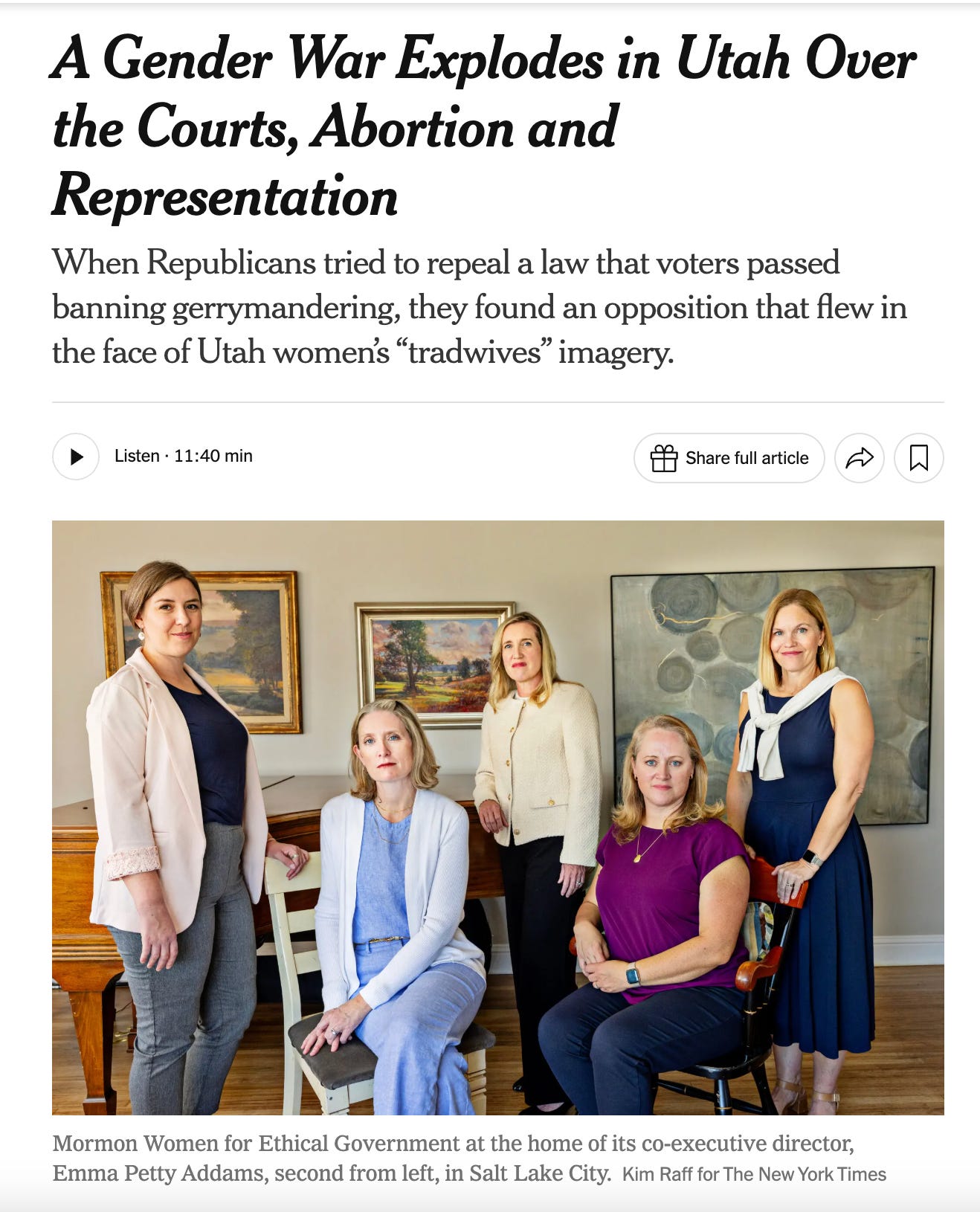
MWEG formed after Trump’s first inauguration with a mission centered on peacemaking and ethical civic engagement. Many of its members identified as Republicans and viewed the organization’s work as an extension of their religious commitments.
After the Legislature replaced Proposition 4’s voter-approved redistricting rules, MWEG and the League sued. In 2024, the Utah Supreme Court ruled unanimously that the Utah Constitution protects the people’s right to alter or reform their government through citizen initiatives. A district court later selected a congressional map submitted by the plaintiffs.
But the disagreement continued. Since those rulings, state leaders have expanded the Utah Supreme Court from five seats to seven, changed the judicial nominating process, and created a three-judge constitutional panel to hear certain cases challenging state laws. Republican Party officials also urged voters to reject Justices Diana Hagen and Jill Pohlman in their retention elections. Hagen later resigned; Pohlman is still on the November ballot.
Supporters described the changes as legitimate exercises of legislative authority and defended the qualifications of the judicial nominees. Critics described them as an attempt to reshape the judiciary after several rulings went against the Legislature. State Senator Todd Weiler, who helped lead the court changes, acknowledged to The Times that the legislation was partly politically motivated.
By then, the dispute was no longer just about lines on a map. It was about whether voters can use ballot initiatives to reform their government, how far lawmakers may go in changing those reforms, and what happens when one branch changes the courts reviewing its actions.
So this is disagreement at the structural level. The question is no longer simply whether the parties respect one another, speak kindly or remain in dialogue. It is who interprets the Utah Constitution, which court has jurisdiction and whether the rules for resolving the dispute remain stable while the dispute is underway.
This is also where the Mormon distinction between disagreement, contention and dominion becomes useful again.
MWEG describes its involvement in the lawsuit not as a rejection of peacemaking, but as an extension of its institutional principles. Its members pursued civic engagement, public persuasion and dialogue. When those methods did not resolve the legal dispute, they turned to the institution designed to decide it.
Under that view, peacemaking does not require pretending there is no conflict. Gentleness does not require surrendering a legal claim. And opposing contention does not mean that the person with less power must accept whatever the person with more power decides.
Sometimes principled disagreement looks like continuing the conversation. Sometimes it means asking a judge to decide.
That Certainly Is One Way to Resolve It
But this week, Trump offered another way around disagreement. “If the Republicans win, you win with us and you get $5,000,” Trump told the Republican midterm convention.
He called it a “Trump Dividend” for American adults if Republicans retain the House and Senate in November. The payment would not depend on how any individual voted, but Trump explicitly tied it to the partisan outcome he wanted.
Some might call that a bribe. Legal experts told PolitiFact that it might not meet the legal definition of bribery because no individual would have to vote Republican to receive the money.
So: perhaps not technically a bribe. Always a comforting category for a presidential proposal.
But. To be fair, candidates have always made material promises. They ask for votes by promising lower taxes, better jobs, larger benefits or cheaper health care. Democracy is not conducted in a monastery. Voters are allowed to consider what government might possibly do for them.
Trump did not invent that transaction. He made it unusually literal.
But winning an election is not the same as receiving unlimited authority. Congress would still have to approve the payments, and sending $5,000 to roughly 240 million adults would cost approximately $1.2 trillion.
That is where the proposal rejoins the rest of this story. The question is not merely whether the offer qualifies as persuasion, inducement or something more troubling. The question is whether winning gives the winner the power to deliver it.
It does not. Not by itself. Technically. But even a promise printed on a novelty-sized check eventually runs headfirst into Congress.
Agree to Disagree?
“Disagree Better” asks how we remain in conversation with people whose values and conclusions differ from our own. But last week kept raising a harder question: What happens next?
Eventually, someone has to decide. A court rules. An election ends. A law passes or fails. Someone gets the answer they wanted, and someone else is told no.
The constitutional bargain is not that every decision will feel fair, wise or satisfying. It is that no person or institution can turn temporary power into unlimited authority. We agree to live under rules that continue applying even when the outcome goes against us.
That is the difference between disagreement, contention and dominion. Disagreement says, “We see this differently.” Contention says, “You are the problem.” Dominion says, “I have the power, so your answer no longer matters.”
Democratic institutions do not make disagreement disappear. They give it somewhere to go. They divide authority, place limits on power and provide ways to challenge a decision without abandoning the system altogether.
There is no “off ramp” from that obligation. No special exit for losing, no exemption for winning and no exception for people powerful enough to go looking for one.
Utah ballots go out October 13. We all get a say. None of us gets the only say.
Once again, an intelligent, well thought out look at complex subjects. Tying them together cohesively was the icing on the cake. Thank you so much for your hours of hard work and deep thoughts on our behalf.
This was wonderfully written. I really appreciate the work you guys do to put this substack together