

If the first week told us how the Legislature wanted to be seen, the second week showed us how it actually intends to govern: quickly, confidently, and with very little concern for backlash (or public input).
The story of this week is not because of one shocking bill, but because of how many big, structural changes started moving at once, how casually they were treated, and how fast leadership pushed them forward. Business as usual.
By the end of week two, we already have bills signed by the Governor. Major structural changes with long-term consequences. They moved with almost no time for – or interest in – meaningful public input, sustained scrutiny, or course correction once concerns were raised.
At this point in previous legislative sessions, we typically see the introduction of 477 bills on average. This year: 750. Last year at this time: 597.
That speed is the story.
As a reminder:
See our full session guide resource before doing anything
Bookmark elevateutah.news for bill explainers, trackers, and action alerts
Follow us on YouTube, Instagram, TikTok, Facebook, Threads, for daily legislative breakdowns
Subscribe here for weekly recaps (paid subscribers get a gold star)
Check the bill tracker for what we support, oppose, and are deeply concerned about
Come to Our Weekly Hill Talk with Better Utah and Better Boundaries. Wednesdays at Church & State (6–7:30 PM) for live breakdowns and more partner organizations each week
Email us at hillyeah@elevateutah.news when something looks… suspicious
Power Is the Priority
The clearest throughline of week two is this: anything that limits the Legislature’s power is now the largest problem in the state.
Not federal enforcement agents killing people in Minnesota and kidnapping people at home in Utah, and the nationwide outcry that followed. Not Utahns struggling with housing and grocery bills or mental health systems at the breaking point. Not workers leaving jobs, caregivers burned out, or families priced out of healthcare.
That showed up most clearly, and most aggressively, in the judiciary. Of course.
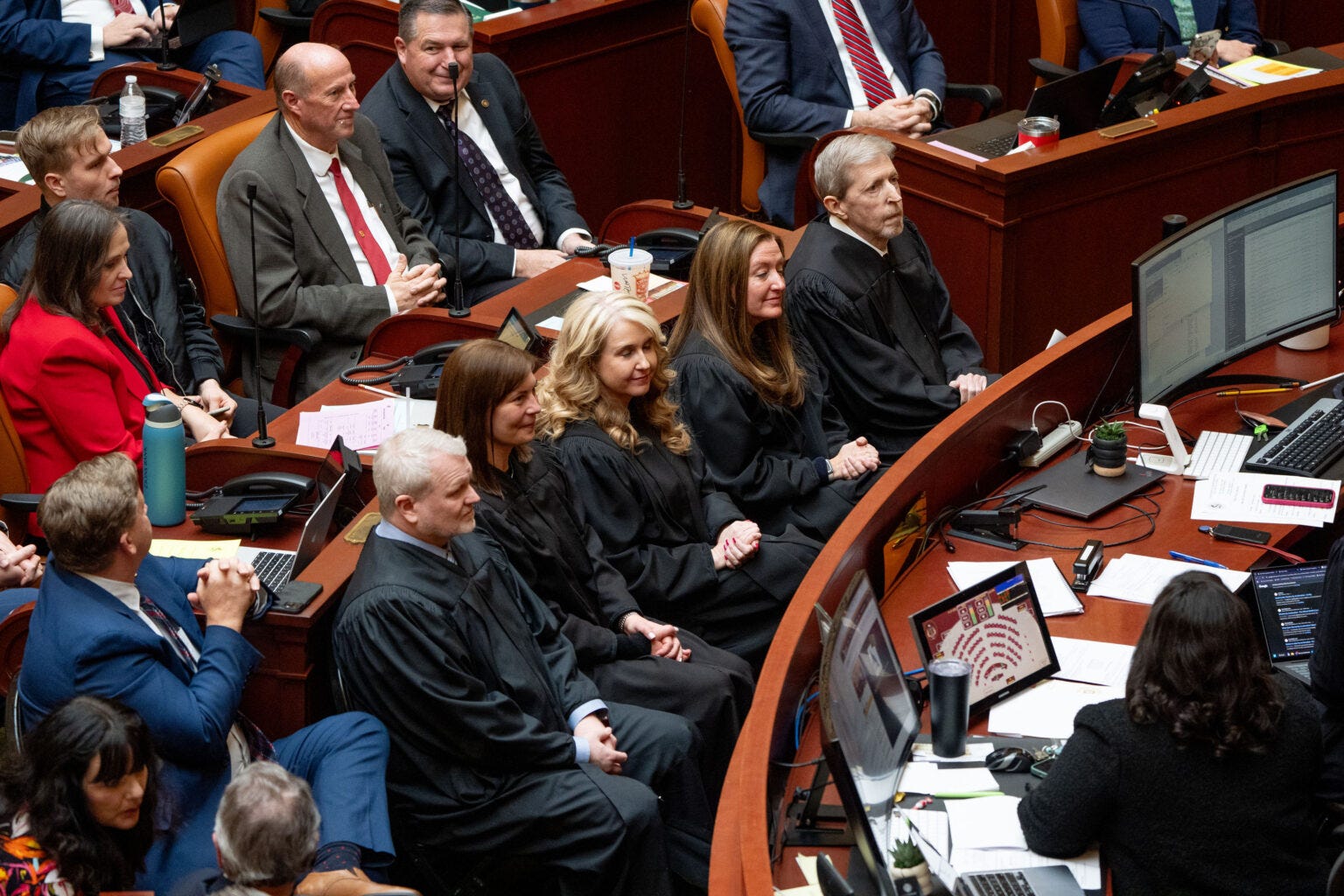
SB134, the court packing bill, didn’t just advance; it ripped through the process. Legislators were whipped into line by leadership. It passed the Senate and was immediately pushed to the House, where it was pulled from Rules and sent to the Business and Labor Committee, a choice that made a ton of sense for a bill reshaping the judiciary.
When they couldn’t get it onto that committee’s agenda within 24 hours, they moved it again. This time to the House Law Enforcement Committee.
As it turns out, there is a committee designed to handle structural changes to the courts. It’s called the Judiciary Committee. For reasons we don’t know, SB134 never went there. What we do know is that they were looking for any committee that would meet leadership’s accelerated timeline.
When asked why the bill was bouncing between unrelated committees, Rep. Wilcox explained it as “workload balancing.” There was no engagement with the substance of the criticism, no response to concerns raised by judges and legal experts, and no explanation for why a judiciary bill needed to avoid the judiciary process altogether. Just arguing with members of the public and making jokes about how much they hate lawyers.
Then came the final signal of just how preordained this all was.
Less than ONE DAY after final passage, the Governor has already signed SB134 into law. Because it passed with 2/3rds of the Legislature, it will go into effect immediately. That means the Governor can begin appointing judges to the Supreme Court on Monday.
And that long-awaited appeal to the Supreme Court that the Legislature has been sitting on since losing the Prop 4 decision? Our guess is that it might have a different path now.
At every step, the message was the same: the outcome mattered more than the route. The supermajority was prepared to ignore public testimony, professional warnings, and internal concern from the courts themselves to get this done and, most importantly, to do it fast.
Because it was inconvenient for them not to.
Utah’s trial courts are the ones under the most strain, and everyone in the system agrees on that. SB134 does address multiple funding requests that the judiciary has requested for the lower courts. However, if this bill were truly about efficiency, the expansion would have stopped there. It didn’t. The Supreme Court expansion stayed in, even after amendments made clear lawmakers knew that was the controversial part.
And unfortunately, SB134 wasn’t the only massive judicial bill on the move.
Out of nowhere, lawmakers advanced a second, even more extraordinary power grab: the creation of a brand-new “constitutional court.” This new court would siphon off constitutional challenges seeking injunctions away from Utah’s existing judiciary and into a structure with judges selected through a process far more vulnerable to political influence.
That means when the Legislature passes a law that is likely unconstitutional, the case wouldn’t necessarily go before the courts that have historically checked that power. It could be rerouted and heard by judges chosen under an expedited, executive-controlled process.
This is unprecedented. No other state has created a separate court like this under an appointment system. Two states (North Carolina and Tennessee) that hear constitutional questions, but in those states, the judges are elected and directly accountable to voters, not appointed by the Governor and confirmed by the same Legislature whose laws they are being asked to review.
And because we couldn’t help ourselves, we looked at what this kind of constitutional court system actually looks like in practice. That comparison makes the intent of this bill much harder to ignore.
Countries where one party or leader controls constitutional court appointments without supermajority requirements or meaningful opposition input include Putin’s Russia, Orbán’s Hungary, Erdoğan’s Turkey, Chávez’s Venezuela, Bukele’s El Salvador, and…. Hitler’s Germany. In each case, scholars point to judicial capture as the decisive moment in democratic backsliding — the point where power grabs disguised as “legal” and constitutional checks effectively disappear.
“When we look at cases of autocratization across the globe, the capture of constitutional courts is often the decisive moment in the slide towards authoritarian rule.”
By contrast, democratic systems that take constitutional review seriously — like Germany today — require two-thirds supermajorities across multiple legislative bodies precisely because history showed what happens when one party controls constitutional interpretation.
Utah lawmakers are citing democratic examples while building the opposite of their protections.
We’ll be doing a much longer piece on the broader attacks on the judiciary later. But for now, it’s worth saying plainly: this comparison alone should alarm anyone paying attention.
This bill was introduced publicly on Tuesday and rushed through committee on Wednesday, in the very same hearing as the court-packing bill. A giant structural change that did not stop. Did not pass go. Did not have time for anyone to review, let alone read or understand the implications, before accelerating through the process.
When courts don’t rule the way lawmakers want, the solution isn’t to write better laws. It’s to change the system that reviews them. The Legislature lost some big cases. Instead of adjusting policy, they’re adjusting the referee.
That’s not subtle. And by week two, we think they already given up trying to be.
Control, Everywhere All at Once
Week two made clear that this session isn’t just about one kind of control. It’s about stacking systems, building overlapping layers of authority that all move power in the same direction.
Voting bills are just one example. Large omnibus election measures kept advancing, bundling together expanded audits, tighter verification rules, new documentation requirements, and more aggressive voter roll maintenance. None of this is framed as suppression. Lawmakers use safer language: “confidence,” “integrity,” “election administration.”
But the effect is predictable because we’ve seen it before. Each new requirement adds friction. Each audit creates new discretion. Each “cleanup” measure increases the likelihood that eligible voters — especially naturalized citizens, older voters, students, and people who move frequently — get flagged, delayed, or quietly removed.
These systems don’t need to be openly punitive to be effective. They work by exhausting people. By shifting the burden of proof onto voters. By creating just enough uncertainty that some people decide it’s not worth the trouble.
That same logic showed up in sentencing policy.
A bill being run by the Speaker of the House moved to restructure the sentencing commission — the body that sets the guidelines judges rely on when determining criminal penalties. The bill removes all defense attorneys from the commission and replaces them with additional law enforcement members, while being marketed as a “victims’ rights” measure.
But the details tell the real story. The bill adds no new victims’ advocates. It simply concentrates decision-making power even further toward enforcement and prosecution, eliminating the perspectives most directly responsible for safeguarding due process and proportionality.
Defense attorneys were already in the minority. This bill eliminates counterweights entirely.
Again, the pattern matters.
This isn’t about public safety in any meaningful sense. It’s about who gets to define safety, who gets to shape outcomes, and whose voices are treated as obstacles rather than safeguards.
Control, stacked on control, until resistance becomes procedural noise.
Another Session, Same Targets
If week one showed that attacks on trans people would be part of this session, week two showed how completely normalized those attacks have become.
This is now the fifth legislative session in a row where trans Utahns have been targeted with sweeping, restrictive legislation. Five years of bills framed as “protections,” “clarifications,” or “common sense limits.” Five years of testimony from parents, doctors, educators, and trans people themselves explaining, in increasingly exhausted terms, what these laws actually do.
And somehow, each year, lawmakers find new ground to cover. New angles. New mechanisms. More intrusive ways to legislate bodies, families, and daily life.
Multiple bills targeting gender-affirming care, public insurance coverage, housing access, language, and basic participation in life have been introduced, and some moved through committees in rapid succession. The testimony was devastating. The stories were personal. The consequences were clear.
And yet, it was all treated as a procedural inconvenience.
No grappling with the fact that these policies compound harm year after year. No acknowledgment that this volume of legislation, aimed at the same small population, might itself be a problem.
Just: next bill.
There was one exception, though. From House Minority Whip Jen Dailey-Provost, whose statement during the committee meeting had many of us in tears:
“I know that speaking in opposition to this bill is a futile exercise because I can do a vote count. And so I just wanted to take this opportunity to thank everybody here for testifying. For testifying about the things that they care deeply about. I’m distressed that, as long as I’ve been in the legislature – I’m in my eighth session – there seems to be this dogged desire to continue to marginalize one of our most marginalized at-risk populations.
To our transgender community: I stand with you. I always will. And I love you, and I thank you for being here. And I’m really sorry that we have to constantly drag you up here to bear your souls and tell your stories and ask for compassion when I know you’re not going to get it.
I am emotionally exhausted by these bills and by this targeting, and I really wish that we could do better as a legislature and not pass legislation like this. For those reasons and many more, I’ll be voting no.”
When discrimination becomes routine committee work, lawmakers don’t need to escalate the rhetoric to escalate the harm. The cruelty is in the repetition. In the accumulation. In the message that no amount of testimony will ever be enough to slow the process down.
Show Me the Money
Something that rarely gets discussed in depth during legislative sessions is the budget — even though it may be the most consequential thing lawmakers do. Every morning in the early weeks of the session, legislators meet at 8:00 AM in appropriations committee hearings. These meetings shape what survives, what gets cut, and what is quietly scaled back long before the full budget is passed on the final night of session. By the time that last vote happens, most of the real decisions have already been made.
Nowhere is that more true than in the Social Services Appropriations Committee, where funding decisions determine whether people receive care, housing, healthcare, disability services, and basic support — or not.
For hours, state agencies, providers, and advocates lay out the reality of what Utah actually needs. Disability services stretched beyond capacity. Waiting lists are thousands and 20 years long. Medicaid is under constant pressure. Home- and community-based services keep people out of institutions. Behavioral health and crisis response teams are filling gaps that never seem to shrink. Juvenile justice, homelessness services, vaccinations and epidemiology, aging and adult care, Meals on Wheels.
It’s a reminder that when government works, it’s largely invisible, until it’s at risk.
What makes these hearings especially difficult to watch is not just the content, but the imbalance. Over two weeks, we’ve watched countless people stand before a committee and share painful, deeply personal moments of their lives. Parents explaining how transportation is the only thing standing between their autistic child and no services at all. Providers defending travel stipends because without them, they cannot hire or retain staff. Medical examiners explaining why being on scene matters. Family physicians pointing out, again, that basic, preventive care keeps people out of emergency rooms and saves the system money.
It starts to feel less like a modern budgeting process and more like a feudal petition system: people pleading for relief, forced to justify their suffering in public, while those with power decide, often abstractly, who is worthy of care and who is not.
Again and again, agencies are not asked how to improve outcomes, but to defend the very existence of the work they do.
These hearings are happening under the shadow of an already-issued directive. Each appropriations committee has been instructed to cut five percent from its budget, across the board. All of this is a consequence of the Big Beautiful Bill. Federal funding is cut, matches are lessened, and our state departments are left to clean up the mess. Just: find the savings.
At the same time, legislators are proposing yet another income tax cut — for the fifth year in a row. And that bill is moving quickly.
You cannot tell agencies they are barely holding together essential services while also insisting that cutting revenue won’t affect outcomes. Those two stories do not coexist.
What makes this even harder is that nearly everything on the chopping block is cheaper than the alternative.
Preventive primary care costs less than ER visits and hospitalizations.
Mental health support costs less than crisis response and jail beds.
Vaccinations and disease outbreak tracking cost less than a pandemic.
Home-based services cost less than institutional care.
Stable housing costs less than emergency shelters and policing.
These aren’t abstract tradeoffs. They’re well-documented, well-understood, and repeated year after year. And yet, the same agencies come back every session, forced to justify why prevention is still cheaper than punishment, to beg the lords and ladies for mercy and support.
A number of organizations are coordinating attendance at social services appropriations meetings because presence matters in these rooms. Here is a Google Form where you can sign up to attend, show support, and make it harder for these stories to be ignored.
And Then, International Politics, Because Clearly They’re Well-Qualified
As if to underline just how untethered the GOP’s priorities have become, Karianne Lisonbee introduced a bill mandating that Utah government materials adopt right-wing Israeli political language and banning the term “West Bank” outright.
The language the bill enforces is explicitly associated with factions in Israeli politics that reject a two-state solution and assert exclusive territorial claims. The term “West Bank,” by contrast, is internationally recognized, used in treaties, diplomacy, and decades of U.S. foreign policy. Utah would be directing its agencies to ignore that consensus – and Palestinian occupation – and substitute an ideological framing instead.
The bill solves no Utah problem. It addresses no constituent need. It improves no service, lowers no costs, and protects no one living here. It does not help families afford housing, fix air quality, expand healthcare access, or stabilize public schools. It has no bearing on state governance whatsoever.
What it does do is send a message. It signals alignment. It signals grievance politics. And it signals that Utah’s Legislature feels perfectly comfortable using state law to wade into one of the most volatile international conflicts in the world — not to promote peace or humanitarian concern or an end to the genocide, but to pick a side rhetorically.
This is what governing without accountability looks like. Time and attention are spent not on the hardest problems facing Utahns, but on ideological theater that carries no local cost for the people voting on it.
Other Updates
SB65 passed Senate committee. This bill redirects property tax revenue earmarked for public schools into the general fund. Amendment A all over again.
SB97 passed Senate committee. This bill caps how much municipalities can raise property taxes year over year.
SB116 passed Senate committee. This bill would automate future income tax cuts when revenue exceeds projections.
SB194 passed Senate committee. This is the large election omnibus expanding audits and voter roll maintenance requirements.
HB209 passed the House floor and heads to the Senate. This bill creates a bifurcated voting system that limits voters without documentary proof of citizenship to federal-only ballots while expanding election officials’ authority to investigate and remove voters from the rolls.
HB16 passed committee. This bill adds new barriers to utility-scale solar development on certain land.
HB141 passed committee. This bill creates a new tax on international money transfers, disproportionately impacting immigrant families.
HB179 passed committee, one of many raw milk bills, amid notable stakeholder disagreement around food and agriculture policy.
HB222 passed committee. This bill grants broad immunity to fossil fuel companies and major polluters from certain civil lawsuits.
One piece of good news: HB152 failed in committee on a tie vote, stopping it from advancing — for now. This is Trevor Lee’s bill that would have removed the requirements for parents to watch an informational module before exempting their children from vaccine requirements.
The Week Two Takeaway
Each of us had a moment this week (probably more than one, if we’re being honest) where we still had hope. Sitting in a committee room, listening to testimony, watching votes line up, thinking for just a second that the motion to table might pass. That someone would break ranks. That reason would cut through the pressure. That leadership wouldn’t get exactly what it wanted.
And that feeling is brutal. Because it almost never comes true.
But we’re not going to lose that hope. We can’t. If we do, what is any of this for? Why show up? Why testify? Why organize? Why keep watching at all?
But holding onto hope doesn’t mean pretending the other side is confused or that what they’re doing is accidental. The GOP supermajority knows exactly how this building works. They know who needs to be whipped into line. They know which committees to route bills through. They know that if a bill passes with less than two-thirds, it can be challenged by referendum. They know that if one or two members cave publicly, others might follow.
That’s why the pressure is relentless. That’s why the speed matters. That’s why leadership closes ranks so hard and so early.
But as you all know, we believe strongly that hope is not naïveté. It’s a strategy.
And the reason they work so hard to crush it is because they know it still matters.
We’ll keep showing up. We’ll keep watching. We’ll keep naming what’s happening, even when it’s exhausting, even when it hurts to admit how close some of these moments felt, even when it is personal and devastating.
Because let’s all try to still remember that the outcome isn’t inevitable. At least it doesn’t have to be. And they wouldn’t be working this hard if it were.
WHERES THE PEOPLES REPRESENTATION?
Is there anything we can do about the new “constitutional courts”?