

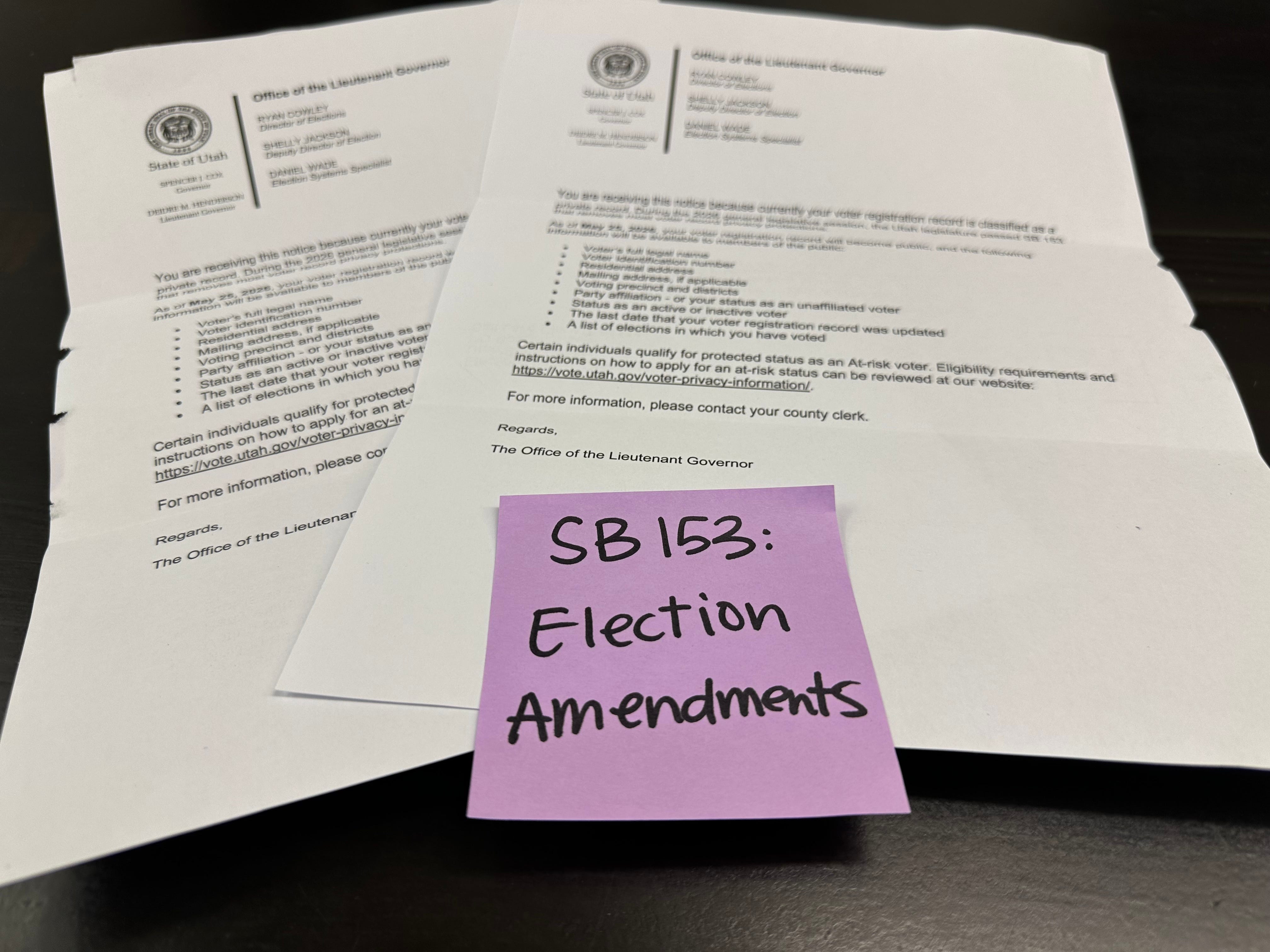
A few weeks ago, 300,000 people received a letter from the Lt. Governor’s office telling them that their voter registration information — which they had specifically chosen to keep private — would soon be publicly available to anyone willing to pay a fee. Scary! What makes it worse is that the bill behind it was run by Sen. John Johnson and Rep. Trevor Lee, two legislators with a well-documented history of trying to turn voter data into a commodity.
We want to explain exactly what SB153 does. But we also want to give you some context that comes specifically from our experience running campaigns in this state. Because in some ways, this law is genuinely concerning, and in other ways, it brings Utah back in line with how every other state in America already works and how Utah used to work, too.
First: What Even Is a Voter File, and Why Does It Matter?
Every state maintains a voter registration list — a database of everyone who is registered to vote. Depending on the state, that list contains some combination of your name, address, party affiliation, age range, and vote history, meaning which elections you participated in, but never who you voted for. This is called the voter file. It is the foundational tool of political campaigning everywhere in America, and it has been for decades.
Who can access it, and under what conditions, varies by state. After SB153, Utah joined more than 30 states that allow voter files to be purchased by anyone with a political interest. Another 19 states limit access to specific groups like campaigns, parties, nonprofits, and journalists. Zero states lock it away entirely. The voter file is how candidates find out who their voters are. It’s how parties identify their own members. It’s how campaigns figure out who to talk to, who to turn out, and who they actually represent. It is not a secret list. It is the basic infrastructure of participatory democracy.
What the voter file typically contains is closer to what used to be in the phone book: your name, your address, your party affiliation, and a record of whether you voted in recent elections. That’s it. The goal is to help candidates reach voters. Not to expose you, not to surveil you — to let the people running for office in your community know that you exist.
Utah was a dramatic outlier in this landscape.
What the Bill Actually Does
SB153 rolls back voter registration privacy protections that have been in place since 2018. Starting May 25, your full legal name, voter ID number, home and mailing address, voting precinct and districts, party affiliation, voter status, and a history of which elections you’ve voted in will be available to anyone who pays a fee to access the state voter list.
A few things that are important to say upfront. Your Social Security number, driver’s license number, and full date of birth remain private for everyone, under both state and federal law. It also does not include who you voted for in any given election.
There is no public lookup tool where anyone could type in your name and pull up your address. It’s not a list posted on a website somewhere. There is no searchable database. What exists is a bulk voter file that can be purchased from the Lt. Governor’s office for $1,050, only for specific political purposes, by campaigns, parties, and political organizations. Nobody is walking up to a government counter and asking for your address specifically.
The law also clarifies that voter lists can only be purchased for those specific political purposes. It is a class A misdemeanor to knowingly disclose information obtained from the voter list on the internet. The doxxing concern we’ve heard a lot about is real and valid, but the law does have guardrails.
To keep your record protected under the new law, you have to qualify as an “at-risk voter.” That category covers victims or threatened victims of domestic or intimate partner violence (with or without court orders or police reports), law enforcement officers, military members, public figures, and people protected by a court order. It also applies to anyone who lives with someone in any of these categories. The deadline to apply is May 6. Forms are at vote.utah.gov/voter-privacy-information.
Here’s the part that got buried in early coverage: the 300,000 letters were just the first wave, sent to voters in “withheld” status. Another million voters will lose their “private” status. All told, this law affects 1.3 million of Utah’s roughly 1.8 million active registered voters. That is most of the state.
How We Got Here: A Brief History of Utah Being the Only State Like This
Before 2018, Utah voter registration information was public, like it is in most states. Then the Legislature passed two laws — SB74 and HB218 — that created a new opt-in privacy system.
The implementation created a mess that nobody fully intended. Utah ended up with two distinct privacy categories that worked very differently from each other, and most people had no idea which one they were in or what the difference actually meant.
“Private” voters still had their information shared with political parties, candidates, and their contractors — it just wasn’t available to the general public. “Withheld” was the genuinely locked category, where records could not be released under any circumstances. So if you were a domestic violence survivor who needed real protection, “withheld” was the status that was actually private. “Private” was more of a medium setting: your information was still going to campaigns and parties.
The problem is that both categories ballooned far beyond what anyone anticipated. The “private” category grew to around a million voters, many of whom appear to have ended up there without actively choosing it. This is something we know from working in Utah politics: the way voter registrations were processed, including through the DMV, pushed a significant number of people into private status by default rather than by deliberate decision. The private record opt-in is just a big check box at the bottom of the voter registration form, so a lot of folks just… checked it. Many voters were classified as private without any reason listed for the classification.
The result: since 2018, Utah has been the only state in the country allowing voters to withhold their information without a reason. Utah’s deputy director of elections has said the change will make election administration “cleaner and simpler” following multiple confusing changes to privacy status over the past decade. The system was genuinely broken in ways that had downstream consequences for everyone.
Since 2018, the Legislature has debated whether those laws went too far and created unintended consequences. What they never did was find a careful, targeted fix — something that cleaned up the accidental-default problem while keeping strong protections for people with genuine safety needs. Instead, they handed the bill to two of their least careful members and got SB153.
About John Johnson and Trevor Lee
These are two of the most reliably problematic actors in the Utah Legislature, and that track record matters for understanding how this bill got written.
Trevor Lee, in particular, has spent multiple sessions trying to push voter data into territory that would make SB153 look modest. Earlier this very session, he had a voter registration cleanup bill that he amended on the floor into a voter data-selling scheme. The Senate killed it immediately.
Johnson’s stated rationale is that SB153 brings Utah in line with federal law. Utah’s previous system had created real legal exposure. Phil Lyman sued the state in 2025, arguing that the “withheld” status violated the National Voter Registration Act, which requires voter records to be open to public inspection. That lawsuit was ultimately dismissed because the judge ruled Lyman wasn’t directly harmed as a candidate, but the underlying legal tension was real, and it was part of why the Legislature acted.
What the law does poorly is the at-risk exemption. The protection may be too narrow and too bureaucratically burdensome. The threshold should be lower, and the process should be easier. That is a legitimate and important criticism of this specific bill.
The Implications for Democracy
We have spent years working to elect Democrats in Utah — one of the most under-resourced political environments in the country and there have been very real consequences to the 2018 laws.
Running competitive campaigns requires knowing who you’re talking to. When a Democratic candidate is trying to reach low-turnout Democrats in their district to encourage them to vote, those voters need to exist in the data. They might go to them with a different message than a voter they are trying to persuade. When a campaign is going door to door, the doors need addresses behind them. When a volunteer is phone banking, they need a list of actual voters in the district.
But here’s what we have watched happen in Utah because of a voter file where over half the state was effectively invisible to campaigns: Democratic candidates in competitive districts couldn’t find their own voters. Campaigns couldn’t identify who to persuade, who to turn out, or who needed to hear from them. Those voters didn’t get mailers, didn’t get door knocks, and didn’t hear from the candidate at all — which made them less likely to participate, which made already-difficult races harder to win.
It’s also harder to register new voters because we don’t know if private voters are unregistered or registered.
In a well-funded race, campaigns can partially work around a broken voter file by purchasing enhanced data from commercial brokers — third-party companies that compile voter information from dozens of other sources and sell it back for a premium. Which means campaigns with large budgets could reconstruct some of what was missing. Underfunded Democratic campaigns in competitive districts, which describes most of our work, could not. The voter file gap didn’t hurt everyone equally. It hurt the campaigns that could least afford it the most.
All of this is not to say that you should be happy that your data will soon be more accessible, but it may help to explain the motivations behind the legislature taking up this issue during a competitive election year.
What You Should Do Right Now
If you were in “private” or “withheld” status and have genuine safety concerns about your information being accessible, the deadline to apply for at-risk status is May 6. Here is exactly who qualifies:
Victims, or likely victims, of domestic violence or dating violence
Law enforcement officers
Individuals protected by a protective or protection order
Members of the armed forces
Public figures
Anyone who resides with a person in any of the above categories
Forms are at your county clerk’s office and at vote.utah.gov/voter-privacy-information.
And if you want this law to change, you know what to do. Contact your state legislators — and while you’re at it, make sure Sen. John Johnson and Rep. Trevor Lee hear from you too. They sponsored this bill. They should know how you feel about it.
This helps so much to get a clear explanation of what is going on. Thank you!
Thank you!! This is the explaining I was looking for! Couldn't find it anywhere else!